
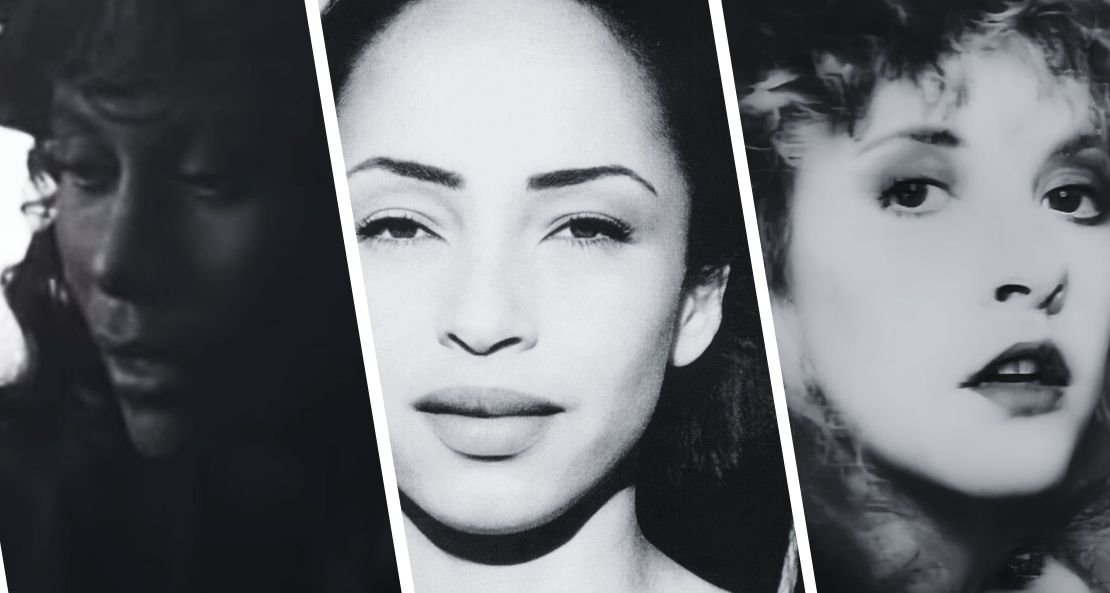
Nobody called these voices small at the time. The word “underrated” came later, once the industry realised it didn’t know where to shelve them.
Radio wanted formats. Critics wanted archetypes. What it got instead were singers who slipped between genres so easily that nobody quite knew how to talk about them without flattening what made them interesting.
Search for “underrated 80s female singers” and you’ll find the same names repeating, Sade, Stevie Nicks, Pat Benatar, Björk, but the real story isn’t why they were overlooked. It’s why the industry kept misunderstanding them.
Take Sade. When Your Love Is King arrived in early 1984, it didn’t behave like a pop single at all. The saxophone doesn’t dominate the mix; it slips in like it’s arriving late to the room.
The rhythm barely leans forward. And the vocal refuses urgency. UK radio didn’t quite know what to do with something that slow, and it still climbed to No. 6 on the UK Singles Chart anyway.
Your Love Is King feels less like a breakout hit than a blueprint for everything she would become.
Pat Benatar had the opposite problem. Nobody struggled to label her voice; they struggled to hear beyond the label.
By the time Shadows of the Night landed in 1982, she’d already proven she could carry rock radio without sanding down her edge, earning a Grammy for Best Female Rock Vocal Performance.
What people call power in Benatar’s voice is actually restraint. She pulls back from notes other singers would oversell, a detail her rock-chick framing tends to bury.
Stevie Nicks never moved in straight lines either. Rooms on Fire arrived at the tail end of the decade sounding less like a single built for radio and more like a half-remembered conversation.
Rupert Hine’s production wraps her voice in shimmer rather than structure, and Nicks doesn’t belt; she circles the melody like she’s trying not to disturb it, a performance built on atmosphere rather than precision.
The single reached No. 16 in both the UK and US charts, proof that audiences were listening even when critics weren’t sure what to call it.
Brenda Russell’s Piano in the Dark feels unusually direct for a late-80s ballad. The track climbed steadily to No. 6 on the Billboard Hot 100 and earned two Grammy nominations without ever sounding like it was chasing a trend.
Russell sings as if she’s discovering the melody while delivering it, leaving tiny gaps between phrases that make the performance feel unfinished in the best possible way.
Then there’s Björk’s early work with the Sugarcubes. When Birthday surfaced in 1987, British press didn’t quite know whether to call it indie, pop or something stranger.
Melody Maker naming it single of the week helped push the band into international conversation, but it was the vocal that lingered: sudden leaps in pitch, whispers that turn into laughter, melodies that refuse symmetry.
It didn’t sound polished; it sounded alive.
These voices weren’t “ahead of their time”; they were too alive for an industry obsessed with neat categories.
Nothing about how they sounded felt futuristic when they arrived; they sounded inconvenient. Pop slowed down around Sade without ever fully catching her stillness.
Rock bent toward Benatar’s control without knowing where to place it. With Nicks, melody drifted into atmosphere, while Russell made intimacy feel louder than drama.
And then Björk arrived, not breaking pop rules so much as ignoring the idea that they existed at all.
Some were too quiet. Some too forceful. Some too strange. The industry called that inconsistency. History just calls it listening differently.
Maybe they weren’t ahead of their time at all. Maybe the industry was simply slow at catching up.
Subscribe to NeonMusic.co.uk for more writing that treats music as something alive rather than archived.
You might also like:
- 15 Classic Songs TikTok Resurrected in 2025
- Rema’s Baby (Is it a Crime)?—The Sade-Sampling Afrobeats Hit
- Fleetwood Mac Songs: A Journey Through Their Greatest Hits
- How TikTok Viral Songs Dominated Charts in 2025
- Exploring the Soulful Melodies: The Unique Charm of Indie Folk Music
- Don’t Dream It’s Over: The Hopeful Anthem TikTok Keeps Misreading