
There is a moment, deep into Gorillaz’s extraordinary new short film, where Noodle silently mouths “I love you” to 2D and Russel before all three of them step off a boat and sink beneath dark water.
Murdoc watches from the bank, terrified, unable to follow. It’s the kind of image that rewrites itself each time you watch it: a farewell, a surrender, a choice.
Everything about The Mountain, The Moon Cave & The Sad God works this way, accumulating meaning on return rather than declaring itself upfront. That ambiguity isn’t a weakness. It’s where the film lives.
Released on 27 February 2026 to mark the arrival of The Mountain (with the deluxe edition landing alongside it), the eight-minute animated short, directed by Jamie Hewlett alongside Max Taylor and Tim McCourt of BAFTA-nominated studio THE LINE, is the most emotionally loaded piece of visual work Gorillaz have produced since the Plastic Beach era. Possibly ever.
It took 18 months to make. Every frame captures it.
The Mountain, The Moon Cave & The Sad God is an eight-minute animated short film released on 27th February 2026 alongside the deluxe edition of Gorillaz’s ninth studio album, The Mountain. Directed by Jamie Hewlett, the film fuses three tracks into a single narrative exploring grief, reincarnation and artistic rebirth, made in the wake of the deaths of both Damon Albarn and Jamie Hewlett’s fathers.
The Grief That Built a Mountain
Before you can truly understand what this Gorillaz short film is doing, you need to know what inspired it.
Both Damon Albarn and Jamie Hewlett lost their fathers during the period that produced The Mountain.
The album wasn’t conceived as a grief record; it began as a journey to India in search of new musical textures and spiritual grounding, but death has a way of rewriting your intentions. What started as wanderlust became a reckoning.
This is the fact that most reviews are skating over, and it’s the one that changes everything.
When 2D sings in The Moon Cave:
“To the Moon Cave / Where I bought my tears / Lit the lantern / On my childhood fears”this isn’t abstract poetry.
It’s Damon Albarn processing the specific, bodily weight of losing a parent: the way grief makes you a child again, the way it forces you back into rooms you thought you’d left.
The Moon Cave isn’t a mystical place. It’s the interior space you enter when someone who knew you before you became yourself is suddenly gone.
The short film, then, is a public ritual of mourning dressed in animation. It’s a different kind of vulnerability from earlier Gorillaz tracks that explored deception and fractured identity.
Three Songs, One Journey: What Is This Thing, Exactly?
The film fuses three tracks from The Mountain into a continuous narrative. Understanding each song’s character is essential to reading what the visuals are doing.
The Mountain
The Mountain plays like pure devotional music: an Indian classical-influenced drone piece with chanted refrains cycling through “serenity,” “darkness,” and “all good souls come to rest.”
It functions as an invocation rather than a pop song, a stage-setting mantra that pulls you into a sacred headspace before more conventional structures take hold.
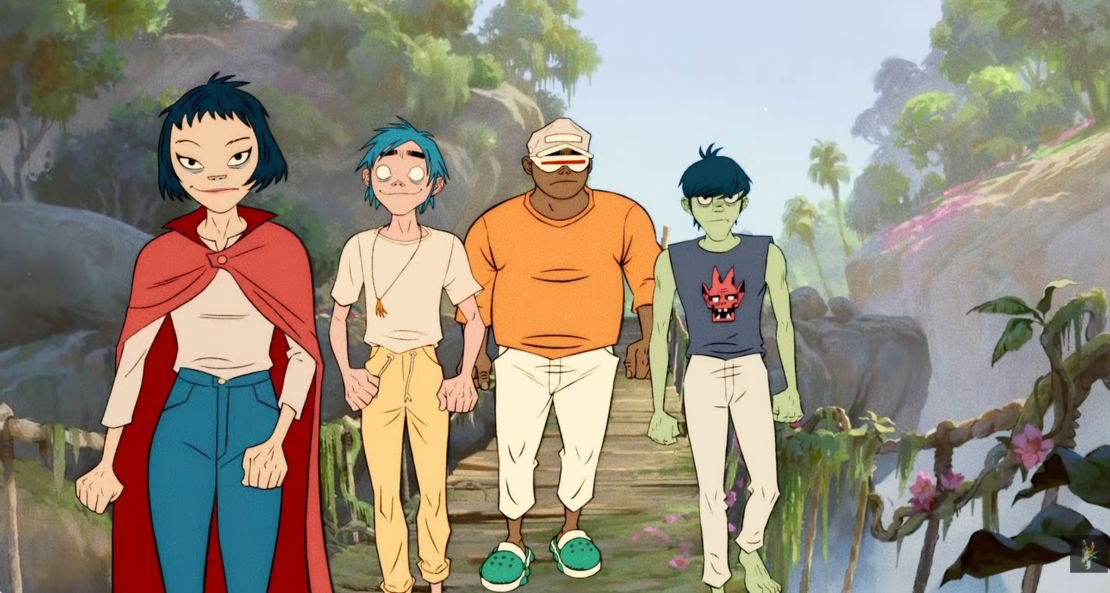
The opening, with Murdoc, 2D, Noodle and Russel walking through lush jungle towards a mountain vista, is scored by this track.
The deliberate callback to Disney’s The Jungle Book isn’t accidental. That film is about identity and crossing thresholds.
Noodle appearing first as her young Demon Days-era self before transforming into her present form signals exactly what kind of journey this is.
The Moon Cave
The Moon Cave is where the album’s genre collision becomes most audacious. 2D carries the opening over trip-hop atmospherics laced with indie-rock tension, his falsetto cracked at the edges in a way that sounds genuinely raw rather than performed.
Interlaced throughout is a sample of Asha Puthli’s spectral voice alongside a posthumous contribution from Bobby Womack:
“Maybe I should just wait, just a little bit / Forgetting bothers me.”
Womack died in 2014. In context, that line is devastating.
Then Black Thought arrives and shifts the entire structure:
“Is it hip hop? Is it Gothic? / Can it fit into the corner pocket? / Where the masjid, where the church is?”
His verse moves through philosophy, religion and technical precision without ever losing emotional weight. The late Trugoy the Dove echoes him into an outro that feels like a voice crossing over. Because it is.
The Sad God
The Sad God is the film’s emotional terminus. Sparse, aching, built on sitar courtesy of Anoushka Shankar and a restrained French horn, it presents Albarn as a god who gave humanity everything:
“I gave you atoms, you built a bomb / Now there is nothing and I have gone.”
He isn’t wrathful. He isn’t punishing. He’s exhausted.
When Kara Jackson adds her voice, “La-la-la, I gave you blue skies / La-la-la, I gave you my life” the song becomes a lament that feels both cosmic and painfully human.
The Posthumous Collaboration: Gorillaz and the Art of Bringing Back the Dead
The 2026 Gorillaz deluxe edition features guest voices from artists who are no longer alive: Bobby Womack, Trugoy the Dove, Tony Allen, Mark E. Smith, Proof and Dennis Hopper. The short film incorporates three of those posthumous contributors directly.
An album grappling with death literally uses the voices of the departed. The medium enacts the message.
When Bobby Womack’s voice surfaces in The Moon Cave, warm and slightly unmoored, the effect isn’t nostalgic.
It’s eerie in the quietest way: a man once alive, threaded through a song about transformation and loss.
Gorillaz have always played with the boundaries between real and fictional, living and dead; their entire concept rests on animated characters performing human music, a virtual band model that reshaped pop culture in the early 2000s.
Hand-Painted and Proud: The Anti-AI Statement Nobody Is Naming
Released in early 2026, when AI-generated animation has become cheap and increasingly indistinguishable from human craft, Gorillaz spent 18 months making this film with hand-painted backgrounds and physical materials.
Hewlett told Rolling Stone he wouldn’t use AI personally, while stopping short of a blanket rejection: “AI, if you’re using it in the art world, is a tool. Just like when Photoshop arrived on the scene. It’s what do you do with it really that matters.”
The film answers that question without needing to say so. Every background (the dappled jungle light, the moonlit river, the cave’s bioluminescent gloom) is labour-intensive and irreproducible by prompt.
One r/gorillaz commenter put it plainly:
“In a time like this where quantity is valued more than quality and generative AI animations are growing, I just love to see human made art.”
The timing wasn’t accidental.
The Reincarnation Reading: Are They Dead, or Just Being Reborn?
The ending has divided fans.
The surface reading suggests death. But mythic imagery complicates that: child Noodle, dragons, animal silhouettes that don’t exist in the physical world. The film operates in symbolic logic.
The more compelling interpretation is voluntary reincarnation. Murdoc’s fear isn’t of dying, it’s of living again. Noodle’s “I love you” reads as peace, not despair.
Behind it all sits the idea of moksha: liberation from the cycle of rebirth. Whether the band reaches it is another question entirely.
What This Does to Your Ears: The Sound in Full
For those listening to the three tracks as one unified movement, the journey is deliberate.
The Mountain opens in drone and mantra.
The Moon Cave fractures structure and expectation.
The Sad God strips everything back to breath and lament.
The production team, Gorillaz, James Ford, Samuel Egglenton and Remi Kabaka Jr. leave space in the mix. Space becomes meaning.
Where This Sits
Gorillaz have been making short films and music videos for over two decades. Across recent album cycles, their visuals have oscillated between political urgency and introspection.
Across Gorillaz’s ninth studio album cycle, few visuals have carried this much emotional weight. Plastic Beach came closest. The Rhinestone Eyes storyboard. The Stylo chase. The fractured world of On Melancholy Hill.
What makes The Mountain, The Moon Cave & The Sad God different isn’t scale. It’s alignment. The music and the imagery are processing the same grief at the same depth.
Plastic Beach wore its ambition loudly. This Gorillaz short film is patient, devotional, genuinely seeking something rather than performing the search.
It rewards the second watch. And the third.
Gorillaz have always been most interesting when they resist the pull of mainstream pop. Here, they step entirely outside it.
Watch it twice. The second time, you’ll notice what Murdoc is holding.
The Mountain (Deluxe) by Gorillaz is out now via Kong Records. The short film is available on YouTube.