
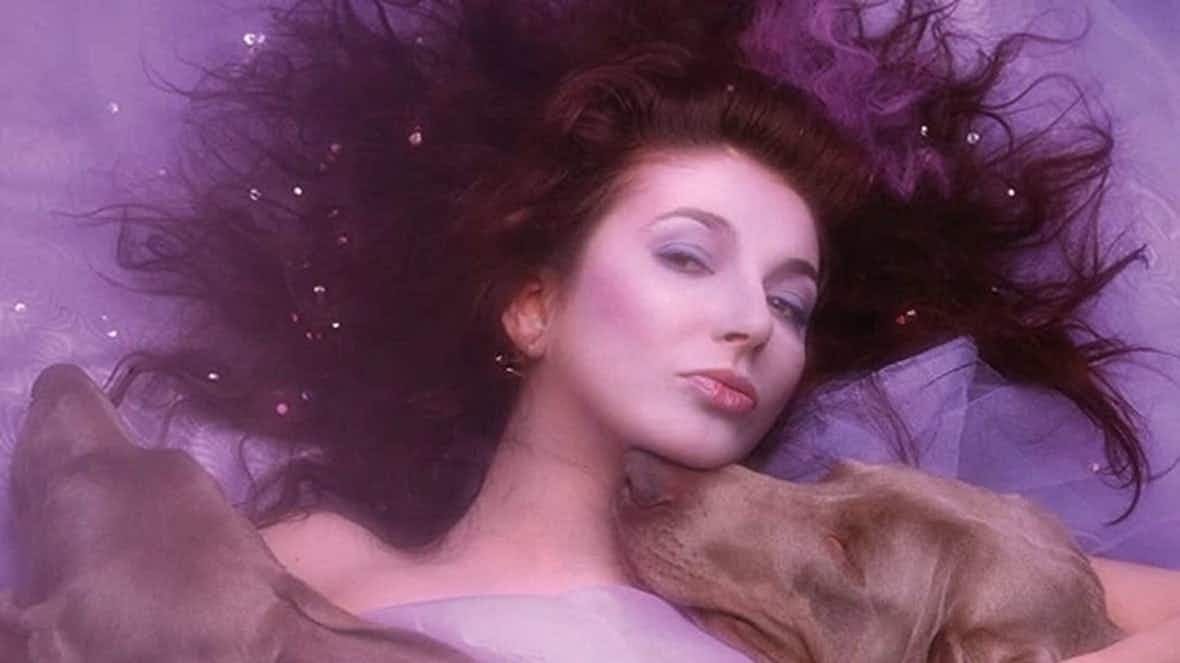
The meaning of “Running Up That Hill” by Kate Bush is about two lovers wishing they could swap places to understand each other’s emotional experience. Bush originally titled the song “A Deal With God,” imagining a supernatural exchange that could resolve the misunderstandings inside a relationship.
Running Up That Hill is about a man and a woman so consumed by love that the feeling itself becomes the problem. The intensity breeds insecurity, the insecurity breeds miscommunication, and the miscommunication breeds damage neither person intended. Bush’s solution, proposed in the lyric, is a deal with God: let them swap places entirely, inhabit each other’s experience, and perhaps the damage stops.
She wrote it in 1985, titled it “A Deal With God,” built it around a Fairlight CMI riff, and watched her label force a name change before release. Thirty-seven years later it reached number one.
The central wish appears plainly in the chorus:
“If I only could, I’d make a deal with God / And I’d get him to swap our places.”
What the song is actually saying, though, is more specific and more bleak than most people assume.
What Did Kate Bush Say the Song Means?
Bush addressed the meaning in interviews from 1985 through to 1992, and her account of it stayed remarkably consistent.
In a 1985 interview with The New Music, she explained that the song was about a relationship where love itself gets in the way. The intensity of feeling creates insecurity, and that insecurity produces misunderstanding.
The imagined deal with God would allow the man and woman to swap places so they could experience what it is like to be the other person. Bush said that if this were possible, many of the problems inside a relationship might disappear.
In interviews at the time, Bush explained the idea in simple terms, describing the song as an attempt to imagine what it would feel like to inhabit another person’s emotional experience.
She described the idea simply:
“If we could swap places with each other, we’d understand what the other person was feeling.”
In a 1985 interview with The Times, she framed it differently. The more you know someone, she said, the more capacity there is to hurt them unintentionally, or to hold back out of fear when honesty would actually be understood. The imagined exchange is a way of closing that gap.
In a 1986 interview with Island-Ear, Bush described the song as being about the fundamental differences between men and women and the hope that temporarily removing those differences might remove the obstacles inside a relationship.
Bush was also clear that the song was not about wanting to swap places with God himself, a misunderstanding some early listeners had. She dismissed that interpretation directly in a 1985 interview with Guitares et Claviers.
Lyrics That Reveal the Song’s Conflict
The lyric itself makes the emotional problem clear through a few key lines:
“It doesn’t hurt me.”
“If I only could, I’d make a deal with God / And I’d get him to swap our places.”
“You don’t want to hurt me / But see how deep the bullet lies.”
These lines reveal the contradiction at the centre of the song. One person insists they are not hurt while simultaneously describing damage that the other person cannot fully see. The fantasy of swapping places becomes the only way to prove what the other person cannot currently understand.
What the Song Is Actually Arguing
Bush’s explanation of “Running Up That Hill” is consistent across interviews, but taking her words alone only gets you so far. The lyric is doing something her explanations slightly soften.
The deal with God is structurally impossible. Bush knows it is impossible. The song does not offer the exchange as something achievable. It offers it as the only thing that would work, and then withholds it.
The repeated structure of the chorus, “if I only could,” is conditional rather than declarative. The song does not describe two people swapping places. It describes two people who cannot.
That distinction shifts the song’s emotional register. Instead of romantic idealism, the tone moves closer to grief. The deal is refused before it is ever made. The hill keeps going.
There is also something revealing in the direction of the wish. Bush does not say she wants to understand her partner better. She says she wants him to understand her.
The opening line, “It doesn’t hurt me,” sounds like a defence precisely because the hurt already exists. The imagined exchange is not symmetrical empathy. It is a desire to be believed. It is the wish that someone who loves you might finally experience what you feel.
That emotional structure explains why the song has travelled across generations and audiences far removed from the heterosexual relationship Bush described in the 1980s. The specifics fall away. What remains is the universal experience of loving someone who still cannot quite see the world from where you stand.
Songs about emotional miscommunication often endure for the same reason. R.E.M.’s Losing My Religion explores a similar kind of private obsession and misunderstanding, as we examined in our breakdown of R.E.M.’s Losing My Religion meaning.
Why Is It Called “Running Up That Hill”? The Original Title Explained
The song’s original title was “A Deal With God.” Bush considered that title inseparable from the song’s meaning. God in the lyric is not primarily a religious reference but a structural one: the only force capable of making the exchange possible.
As Bush explained in interviews, asking God felt more powerful than making a deal with the devil because it represented a more audacious request.
EMI warned her that the word “God” might lead to the single being banned or restricted in countries including Italy, France, Australia, Ireland, Spain, and possibly the United States. Bush found the concern absurd, but she had spent several years making the album and could not risk the single being blocked internationally.
Reluctantly, she changed the title to “Running Up That Hill.”
The album track still carries the compromise in its official name:
Running Up That Hill (A Deal With God).
EMI’s A&R department had also wanted “Cloudbusting” as the lead single. Bush insisted on releasing “Running Up That Hill” first because it was the first song she wrote for the album and because she believed it captured the emotional centre of Hounds of Love.
How Was the Song Produced?
Bush wrote “Running Up That Hill” shortly after she and her family moved to the countryside. She later described the period as creatively freeing.
The track began with a drum machine pattern programmed by Del Palmer. Over that pattern Bush layered a Fairlight CMI synthesiser, whose distinctive opening riff became the structural core of the song.
The deep drone that runs beneath the arrangement anchors the track harmonically and emotionally. Bush explained this process in the Classic Albums documentary released in 1991.
At the end of the track a distorted vocal effect appears. Bush and her engineer achieved the sound using studio processing that she deliberately refused to explain in interviews, saying that revealing production techniques too quickly often encouraged imitation.
The Sound of the Song
The production of “Running Up That Hill” creates a deliberate tension with the lyric.
Del Palmer’s drum machine pattern is metronomic and slightly martial, more machine than human. It does not swing or breathe like live drumming. Placed against a lyric about emotional intimacy, that rigidity becomes meaningful.
The rhythm suggests two people moving beside each other without ever fully meeting.
The Fairlight CMI riff that opens the track has warmth but little softness. It carries yearning without resolution.
Bush’s vocal performance becomes the counterweight. Her phrasing on the chorus sounds exhausted rather than triumphant, reaching upward but never quite breaking through. The layered harmonies add emotional mass without offering certainty.
The song builds steadily across five minutes yet never truly resolves. It never reaches the top of the hill. The running simply continues.
This balance between emotional intensity and mechanical structure helps explain why the track works in so many different contexts, from Stranger Things to dance floors to alternative and metal covers.
The Music Video Explained
The official video was directed by David Garfath and choreographed by Diane Grey. Bush performs a contemporary dance routine with dancer Michael Hervieu, both dressed in grey Japanese hakamas.
The choreography includes a repeated bow-and-arrow gesture that also appears on the single’s cover artwork.
Intercut sequences show the pair moving through crowds of masked figures. By the end of the video they are separated and carried away down a long corridor by lines of anonymous people.
Bush later explained that the masked figures represent the emotional forces surrounding the two lovers, the invisible pressures that push them apart even as they try to move together.
Bush intended this dance film to be the definitive visual for the song. MTV declined to air it and instead broadcast a live performance recorded on the BBC programme Wogan, which Bush considered an inferior substitute.
How Did “Running Up That Hill” Chart?
When it was released in 1985, “Running Up That Hill” entered the UK Singles Chart at number 9 and eventually peaked at number 3. It became Bush’s most successful single of the decade.
In the United States the song reached the Top 30, notable at a time when Bush had a smaller profile in the American market.
In 2022 the song returned to global charts after being featured prominently in season four of Netflix’s Stranger Things. The renewed popularity pushed the song to number 1 in the UK, giving Bush her first chart-topping single since “Wuthering Heights” in 1978.
The 44-year gap between number-one singles set a new UK chart record.
The track also climbed charts around the world during the resurgence.
In 2012 Bush had previously recorded a remixed vocal version of the song for A Symphony of British Music, the compilation tied to the London 2012 Olympic closing ceremony.
Running Up That Hill and Stranger Things
Season four of Stranger Things used the song as a defining musical theme for the character Max Mayfield, played by Sadie Sink. It accompanies Max’s emotional storyline following the death of her brother Billy in the previous season.
One of the series’ most memorable sequences unfolds in episode four as the song plays while Max attempts to escape the supernatural threat pursuing her.
The scene introduced “Running Up That Hill” to millions of younger viewers who had not been born when the track was originally released, triggering a massive streaming resurgence.
Bush later issued a statement expressing delight that the song had found a new audience decades after its creation.
Notable Covers of “Running Up That Hill”
Several artists have recorded notable covers of the song. Placebo released a darker interpretation in 2003 that reached number 44 in the UK. Meg Myers later recorded a version that found strong support on American alternative radio.
Other artists who have covered the song include Within Temptation and Will Young.
Before its Stranger Things revival, the track had already appeared in television shows including The OC and the Black Mirror episode “San Junipero.”
What Running Up That Hill Ultimately Reveals
Kate Bush wrote “Running Up That Hill” in 1985 about a specific tension between two people in love.
The song grew larger than its original premise because the emotional situation it describes is almost universal. That tension between desire and misunderstanding appears across pop writing as well, including records like our review of Lana Del Rey’s Born to Die, which explores love as something both romantic and destructive.
Most people have imagined some version of the same impossible exchange. Not literally with God, and not with the precise terms Bush outlines, but with the same longing behind it.
The wish to be completely understood by the person who matters most.
It is a theme that appears repeatedly in great songwriting, from Bush’s work here to the quiet alienation explored in our analysis of Simon & Garfunkel’s The Sound of Silence.
Bush’s lyric takes that wish seriously while refusing to grant it. The hill remains in front of the singer. The running continues.
The title she wanted, “A Deal With God,” describes an act of faith.
The title she was allowed to keep describes effort.
The song lives in the space between the two.
You might also like:
- Kate Bush’s Wuthering Heights Lyrics Meaning: Why This Haunting Voice Still Echoes Today
- Kate Bush Army Dreamers Lyrics: A Mother’s Lament and Anti-War Ballad
- Behind the Melody: The Deep Dive into Kate Bush’s This Woman’s Work Lyrics and Its Cinematic Journey
- The Irresistible Melodies: Exploring the Greatest Tunes of the 1980s
- Arctic Monkeys’ “505” Lyrics Breakdown: What’s Really Behind The Haunting Anthem?
- Never Gonna Give You Up Lyrics: The Story Behind Rick Astley’s Iconic Hit