
Most people assume “Losing My Religion” is about faith. It isn’t. The title borrows from a Southern American idiom meaning to lose one’s composure, to be pushed past the point where social restraint holds.
Michael Stipe took the phrase and built a song about secret obsession and the mortification of going too far. The “Losing My Religion” meaning has nothing to do with God and everything to do with a crush that has gotten out of hand.
In simple terms, “Losing My Religion” means reaching the point where emotional restraint collapses, usually under the pressure of obsession or unreturned feeling.
Released on February 19, 1991, as the lead single from Out of Time, the track was written by all four members of R.E.M. (Stipe, Peter Buck, Mike Mills and Bill Berry) and produced by the band alongside Scott Litt.
It peaked at number four on the Billboard Hot 100, topped both the Mainstream Rock and Modern Rock charts, and won two Grammy Awards in 1992, including Best Pop Performance by a Duo or Group with Vocal.
The song’s success dragged R.E.M. from college radio favourites into the mainstream at a scale the band had never experienced.
Warner Bros. initially resisted releasing it as the lead single; it has no conventional chorus and sits in a minor key throughout. The band pushed back. Mills later reflected that without it, Out of Time would have sold a fraction of what it did.
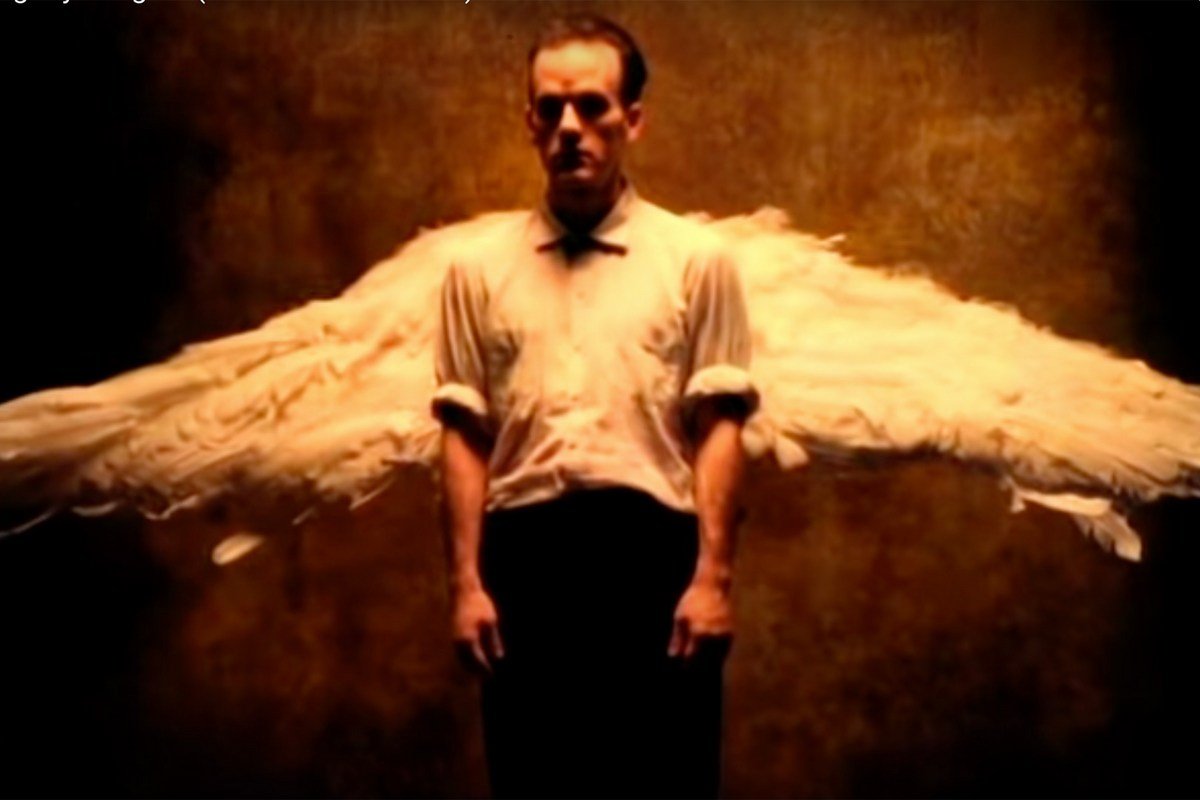
The accompanying music video, directed by Tarsus Johnson and inspired by Gabriel García Márquez, ran on constant MTV rotation and became inseparable from the song’s identity. Stipe, who had previously refused to lip sync on camera, appears throughout it looking hollowed out.
The angels, the spilt milk, the androgynous figures all fed the misreading that the song was a comment on religion, which only widened its reach.
The song’s signature mandolin riff came out of an accident. Buck had just bought the instrument and was recording himself learning to play it at home, tape running while he watched TV.
He listened back the next day and found, buried in the practice runs, a few seconds of something usable. That became the riff. The song was tracked at Bearsville Studios in Woodstock, New York, and Stipe completed his vocals in a single pass.
Stipe described his intention plainly: “I wanted to write a classic obsession song, so I did.” Elsewhere he laid it out: the crush where you think someone understands how you feel but can’t be sure, the hints dropped into every conversation, the moment you realise you’ve gone too far. That is the whole architecture of the lyric.
The song opens on a sigh, the interjection oh, before the narrator tries to argue himself out of his fixation: life is bigger / it’s bigger than you / and you are not me. That second phrase is an attempt at self-correction.
You have taken over my internal world, and I am trying to remember I exist separately from you. The effort fails almost immediately.
“The lengths that I will go to / the distance in your eyes” — these two lines sit in sequence without a verb connecting them. The first describes effort expended; the second describes what that effort meets. No return. The narrator lurches into the pre-chorus: oh no, I’ve said too much / I set it up. He has engineered his own humiliation by constructing a situation in which any slip would expose him.
The song’s structure reinforces the psychological loop rather than breaking it. Oh no, I’ve said too much appears six times across the full track.
The variation (I haven’t said enough) arrives twice, each time positioned as the direct reversal of the thought before it. The narrator is not developing; he is oscillating. Nothing in the arrangement shifts to suggest release.
The mandolin circles at the same tempo from the first bar to the last, and Stipe’s vocal never lifts into a conventional hook. It stays low, close, the words coming out flat and unguarded, which makes the lyric feel overheard rather than performed.
What Stipe originally wrote as that’s me in the kitchen became that’s me in the spotlight, replacing a private image of hiding with a public one of exposure. The embarrassment is the same. The visibility is not.
The bridge (consider this, the hint of the century / consider this, the slip / that brought me to my knees, failed) is the closest the lyric gets to saying outright what happened.
The word failed sits at the end of a line by itself, cut off. Whatever the narrator said or did, it did not work.
The fantasies he had been sustaining break apart, not through direct rejection but through the gap between what he imagined and what actually exists.
The song ends on that was just a dream / try, cry, why try. The dream was the false reading: the laughter he heard, the singing, the sign he thought he saw. Admitting it changes nothing. The word dream repeats three more times in the final seconds, each shorter than the last. It doesn’t stick. It runs out.
You might also like:
- How Creep Became Radiohead’s Unwelcome Masterpiece: Lyrics & Legacy Explained
- Unveiling the Hidden Meanings: A Deep Dive into Leonard Cohen’s Hallelujah
- George Michael’s Iconic Ballad: Careless Whisper
- The Hollies – The Air That I Breathe Lyrics Meaning: A Love Song That Asked for Nothing Else
- In the Air Tonight: The Song That Defined an Era and Still Feels Fresh