
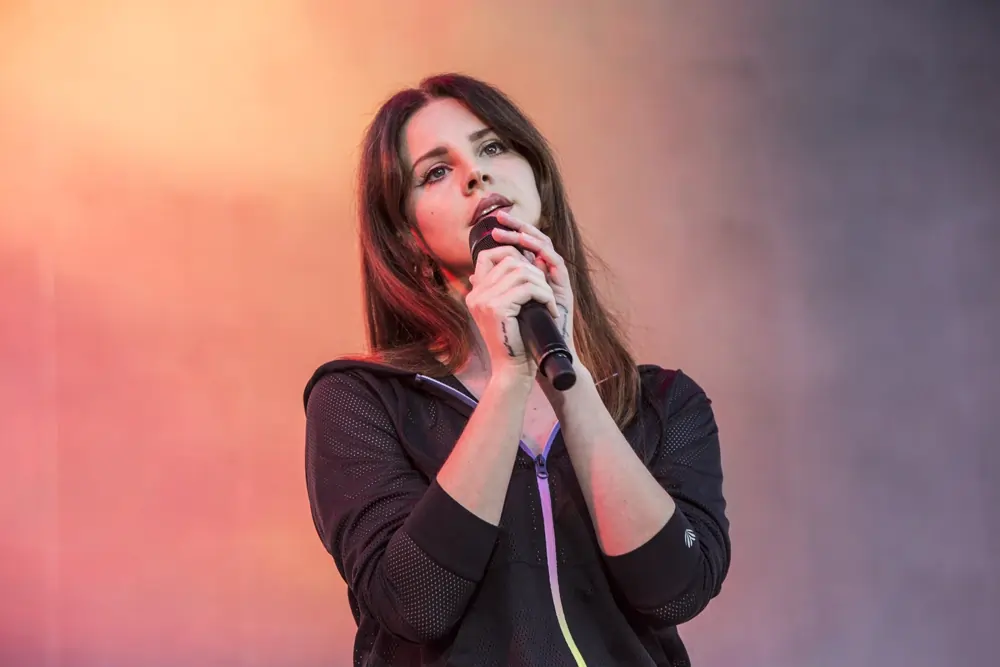
“Get Free” is about choosing your own life instead of one built around other people’s needs, whether that’s a controlling relationship, a toxic creative environment, or the kind of psychological hold that looks like love until you examine it. It is the closing track on Lust for Life (2017) and the album’s real destination: not a farewell but a declaration made after a long, difficult journey to get there.
What does “Get Free” by Lana Del Rey mean?
“Get Free” is about recognising you have a choice and choosing to leave, even when staying feels easier. It traces the moment someone stops confusing attachment with freedom and decides to live on their own terms.
The threshold
The opening lines establish what kind of song this is before anything else can. “Finally, I’m crossing the threshold / From the ordinary world / To the reveal of my heart.” That word “finally” carries years of delay in it. What follows is called a “modern manifesto,” which matters: a manifesto is not a reflection on a feeling. It is a public commitment made in the present tense.
The song was originally recorded under the title “Malibu” and was far more revealing about Lana’s life before she pulled back, stripped it down, and rebuilt it into what appears on the record.
The key word in that opening is not “threshold.” It is “finally.” It implies delay, repetition, failed attempts. You don’t say “finally” unless you have tried to leave before and didn’t. The crossing isn’t sudden. It is overdue.
Anyone who has spent time with Lana’s catalogue knows “Ride,” the 2012 short film track where restlessness is identity and belonging nowhere passes as freedom. “Get Free” answers it directly. She accepts the chaos in “Ride” and stays inside it. Here she decides to leave. That shift is the architecture of the whole song.
The names behind the manifesto
The pre-chorus appears twice in the song and both times runs underneath interjections, “shut up, shut up” cutting through the lines about birds of paradise and colours that lure you in. That voice is not directed outward. It is internal resistance, the part of the narrator that still argues against leaving.
The manifesto is being made over the top of it, not in its absence.
In the first pre-chorus the interjections interrupt the commitment itself, the act of naming Amy and Whitney and what they represent. In the second they cut through the process of disillusionment, the moment of recognising what the colours and the trance actually were.
The resistance does not disappear as the song progresses. It shifts target.
The dedication names who the manifesto is for. “I’m doing it for all of us who never got the chance…” The lyric sheet leaves the names blank, but in a 2018 World Cafe interview Lana confirmed she meant Amy Winehouse and Whitney Houston.
The “birds of paradise who never got to fly at night / ’Cause they were caught up in the dance” are artists whose potential was consumed by the people and systems surrounding them.
The war in the chorus
“Sometimes it feels like I’ve got a war in my mind / I wanna get off but I keep riding the ride.” The desire to change and the habit of remaining exist simultaneously, and neither cancels the other.
“War” is not metaphorical in a casual sense. It suggests two positions that cannot coexist: the part that wants out and the part that keeps choosing the familiar.
“I wanna get off but I keep riding the ride” is not contradiction, it is habit. The ride continues not because she enjoys it, but because she has learned how to stay on it.
Then: “I never really noticed that I had to decide / To play someone’s game or live my own life.” Not recognising a choice is not the same as not having one. The moment of noticing is the moment the dynamic loses its grip.
“And now I do” is four words, but it carries the weight of everything before it. Not a breakthrough, not a revelation. Just recognition. The kind that makes going back impossible.
The Crowley line
Verse two names the source of what has been holding her. “Gone is the burden of the Crowley way of being / That comes from energies combined.” The reference is to Aleister Crowley, the occultist whose central philosophy reduced to: do what thou wilt. Applied through a controlling or narcissistic personality, that becomes a justification for using everyone in reach as fuel. The “energies combined” is not romantic. It is extractive.
Lana’s self-assessment follows immediately. “My part was, I was not discerning.” Then: “And you, as we found out / Were not in your right mind.” Both parties get examined in the same breath. She was not paying attention. He was not well. Neither line softens the other.
Rainbows that disappear
The second pre-chorus strips the original pull down to its mechanism. “There’s no more chasing rainbows and hoping for an end to them / Their arches are illusions, solid at first glance.”
A rainbow looks complete from a distance. Up close, it disappears. That is the structure she is describing: something that only holds together as long as you don’t examine it too closely.
“The colours used to lure you in / And put you in a trance.” The “shut up, shut up” returns underneath, louder now because the illusions are being named rather than just felt. The sequence mirrors how those relationships actually work: compelling at distance, insubstantial on contact. You cannot argue with a trance. You can only come out of it.
Black and blue
The song ends on a colour shift. “Out of the black, into the blue” repeats over the closing bars until it becomes more instruction than lyric.
In the World Cafe interview Lana said the black was “negative thinking” and the blue was “a bit of a retreat into nature,” the ocean, then the sky. At a San Diego show in 2017 she described blue as her “own little talisman,” the closing word of the entire album chosen as an omen for where she was heading next.
The production earns that ending. “Get Free” moves in a major key where most of Lust for Life sits in shadow, and the reverb on Lana’s vocal opens up space around the words that the earlier tracks do not have.
Her voice at full reach on “into the blue” does not settle into anything fixed. The song does not close because the decision it describes is not a single moment. It is something you keep making.
It leaves you facing the direction it chose, with the understanding that staying there is up to you.
The Radiohead footnote
One external fact belongs in any account of the song’s life, even if it sits outside the meaning itself. In early 2018, Radiohead’s publisher raised a copyright claim over the chord progressions shared with “Creep.” Lana offered a partial publishing split; the dispute was eventually dropped. The writing credits on the song were not changed.
You might also like:
- What Born to Die Really Means: Lana Del Rey’s Album Explained 14 Years Later
- Lana Del Rey’s Cherry: A Love Song, a Breakdown, or Both?
- Lana Del Rey White Feather Hawk Tail Deer Hunter Review: The Strangest Love Song She’s Ever Made
- Best Lana Del Rey Songs: The Soundtrack of Summertime Sadness and Nostalgic Beauty