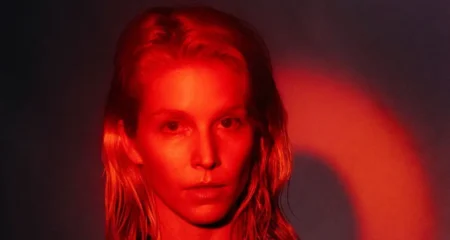


Artist: Mitski
Album: Nothing’s About to Happen to Me
Label: Dead Oceans
Release Date: February 27, 2026
Genre: Americana, Art-Pop, Indie Rock
Rating: 9/10
Eight albums in, Mitski has no obligation to surprise anyone. She still does. Nothing’s About to Happen to Me is her most abrasive record since Bury Me at Makeout Creek. “Where’s My Phone?” and “If I Leave” revive a guitar fuzz she largely abandoned over the past decade.
It is her funniest record since Be the Cowboy, with “That White Cat” and “Rules” carrying a dark comic energy that stops just short of absurdist. And it is her darkest full stop: “Dead Women” goes places lyrically that none of her previous records got near.
Nothing’s About to Happen to Me is Mitski’s eighth studio album and a loose concept record, following a reclusive woman’s psychological unraveling inside a decaying Victorian house, moving track by track from a quiet fear of being perceived, through the wreckage of a failing relationship, into fantasies of death and rebirth.
That fictional address is the Tansy House: a hoarder’s nest of generational mess, cats with odd-coloured eyes, stacks of letters never sent, and a wedding ring left on a shelf.
Mitski has described the protagonist as a woman who inherited a house she cannot quite manage. Outside it, she is a deviant. Inside, she is free. The album sounds as cluttered and inward-looking as that house.
Produced again by Patrick Hyland and recorded with the touring band from The Land Is Inhospitable and So Are We, the album sits sonically between those two pillars of her recent catalog.
The Americana instrumentation, pedal steel, banjo, double bass, comes back from The Land, but Nothing’s About to Happen to Me is messier, sharper, and more willing to be ugly.
Drew Erickson’s orchestral arrangements show up just often enough to make you aware of the scale underneath the small-town acoustics. Where The Land felt wide and open, this one is interior. Claustrophobic without apology.
The rock songs, “Where’s My Phone?”, “If I Leave”, “Lightning”, call back to Bury Me at Makeout Creek without trying to replicate it. The jazz-lounge detour of “I’ll Change for You” comes completely out of nowhere, but the bossa nova haze fits a drunk-at-a-bar lyric better than any rock arrangement would.
And the baroque-pop undertow that surfaces in “Dead Women” and “Charon’s Obol” signals something else: Mitski has been writing music and lyrics for a stage adaptation of The Queen’s Gambit, and the album’s baroque-pop undertow suggests the influence of her current theatrical work.
“In a Lake” opens with a waltz-like country figure that feels gentle before the lyrics land. It is a song about moving to a city not for ambition but for erasure. “Some days you just go the long way to stay off memory lane.”
More specifically, it is about the terror of having your story told by other people if you wait too long to tell it yourself. “For where you gotta write your book early, or it gets written up in your place.”
The soap metaphor, everyone smelling the same as your first time around, scripts on repeat, is the sharpest piece of writing on a very sharply written record. The ending, that wall of noise pollution, is both comfort and trap. She never gives you just one feeling.
“Where’s My Phone?” is funny. Not the polished, gig-ready kind of funny, the dark, self-aware kind, where you laugh because crying takes too much out of you.
The 90s grunge production is rawer than anything on her recent records. Lyrically, it captures the way a phone drains you even as you use it to numb yourself. The censored self-edit beep is the most genuinely comic moment Mitski has put on a record.
“Cats” is where the album cracks something open. “You say it’s so hard but it feels simple to me.” That line is not about cruelty.
It is about the moment you stop performing and decide to just exist as you are, with your cats, your small comforts, your stubborn self, and let people either accept it or go.
Mitski has spoken about drawing on cats as a symbol for the protagonist because cats are not disobedient; they simply operate outside the language of commands.
The closing image, hoping the cats are out following their hearts’ delight, is the narrator projecting onto them the freedom she has not yet given herself.
“If I Leave” has the most uncomfortable chord progression on the album, uneasy from the first note. It is about the guilt of wanting to leave someone who has been genuinely good to you. “If I leave, somebody else will love you, but nobody else could forgive me quite as often as you.”
The song understands something specific about how people with a history of chaos can experience peace as unsettling, how a nervous system calibrated to drama can read kindness as wrong.
The tunnel line, “I ride through a tunnel and it’s dark the whole way / I miss you”, is not about missing the person. It is about missing the person who knew your darkness and stayed.
“Dead Women” is the album’s most important song, and likely its most underexamined. It starts almost playfully before Mitski asks: “Would you have liked me better if I’d died?”
The song is a direct confrontation with true crime culture and the cultural habit of consuming dead women as content. “Rifle through it all, fill the blanks with what you need, profit off of it on your Netflix documentary.”
She is naming the whole machine: the way women’s lives get rewritten in death, the way grief becomes consumption, the way tragedy gets packaged and sold.
The line “She gave her life so we could f*ck her as we please” is one of the most vicious on any album in recent years. Mitski pictures herself as a ghost watching her friends heroically rewrite her story, getting it completely wrong, and the comedy is the horror.
“Instead of Here” follows directly, and the sequencing is deliberate. If “Dead Women” is about women being consumed after death, “Instead of Here” is about the impulse to disappear before that can happen. It is a dissociation song.
“Right as I dip a toe in the abyss, a knock on the door saying ‘Are you in there miss?’ I stay quiet as can be, I’m not here, I’m where nobody can reach.” And then: “I wish I’d known that I’m still just a kid.” The recognition that awful things happened to a younger self who didn’t deserve them, and that the kid is still there, still carrying it.
“I’ll Change for You” arrives with bossa nova lounge production and drunk-dial energy. “How do I let our love die when you’re the only other keeper of my most precious memories?”
Breaking up with someone means losing not just them but the version of yourself that existed with them, the memories only they can confirm happened. Mitski has said she wanted to write a song about being pathetic. What she actually wrote is a song about the terror of erasure.
“Rules” is the counting song, the one that builds its own pattern and then falls apart inside it. “Please pretend that you don’t see how I’m no longer there behind my eyes.” If you have ever caught yourself performing normalcy in a relationship long after you had already emotionally left, this song is a mirror with a smile on it.
“That White Cat” takes the album’s most absurd premise and goes philosophically large with it. A cat has decided it owns the house. Underneath that: what does ownership actually mean?
The narrator goes to work to pay for a house that a cat has claimed, that wasps have colonised, that possums have occupied. Everything you think belongs to you is temporary. Every story you tell about your own life is just a version someone else can overwrite.
“Charon’s Obol” stakes its claim as the album’s strangest track. In Greek mythology, the obol was a coin placed in the mouth of the dead to pay Charon the ferryman to cross the River Styx.
Mitski uses it to sketch a narrator who watches the dead girls who once lived in the Tansy House, tends to the ground where they are buried, feeds their dogs, becomes herself a kind of tribute. She almost was one of those girls. She sees herself in them. The orchestration here is the richest on the album, and it sounds like a song that has been waiting to be written.
“Lightning” closes the record with that Makeout Creek guitar fuzz returning, and it is not a triumphant ending. “I can hear the song of my death / Singing for the lightning to come / Calling to the thunder: Marco, polo, I’m here / Strike me, strike me down / I’m ready to come back as the rain.”
The darkness is not something to overcome. It is something that makes the light mean something. “If I’m dark, all the better to reflect the moonlight.” The album ends without resolution because that is not the point. Mitski puts you through it and steps back.
The most honest criticism of this record is that several songs end a verse before they should. Mitski has a structural habit of capping tracks at around three minutes, and here, where the concept is doing real load-bearing work, that habit costs more than usual.
“Charon’s Obol” is the exception at four minutes, and it is also the song where the album’s themes feel most fully inhabited. The shorter tracks are not failures, but you can hear the ideas in “Instead of Here” and “Rules” pushing against their own edges.
When a record is built around a character whose psychology is supposed to spiral and deepen across eleven songs, abrupt endings interrupt that descent. The Tansy House concept is strong enough to have sustained a longer record.
The truncation is not ruinous, but it does mean the album’s most ambitious structural idea, the slow accumulation of a mind coming apart inside a single house, never quite reaches the weight it is clearly capable of.
What the album costs in running time it recovers in precision. This is the record where Mitski’s two most distinct creative instincts, the theatrical and the intimate, finally occupy the same space without one undermining the other.
The Americana arrangements from The Land and the sharp, nervous rock of her earlier work are not competing here. They are serving the same character, the same house, the same slow unraveling.
The result is an album that is greater than the sum of its songs because each song is doing structural work on a concept you only fully understand at the end.
This is not a record that asks to be liked. It asks to be sat with. In a catalog full of music about longing and loss, this is the one about what happens after you stop reaching: what you find in that stillness, what the silence reveals, what the house looks like once you stop trying to keep it.
The answer Mitski arrives at is not peace. It is clarity. A woman, a house, a cat that has taken over, and the long, uncomfortable process of accepting that everything you thought you owned was never really yours to begin with.
That is what the album is about, taken whole. And Mitski, characteristically, makes it sound like the most terrifying and honest thing in the world.
You might also like:
- Your Best American Girl Lyrics by Mitski: Meaning, Identity, and Why It Still Hurts
- Mitski My Love Mine All Mine Lyrics: A Deep Dive into the Song’s Meaning and Inspiration
- Mitski I Bet on Losing Dogs Lyrics: Unpacking the Intricate Layers
- Unveiling the Depths of First Love/Late Spring Lyrics: Mitski’s Poignant Exploration of Vulnerability
- An In-Depth Examination of Mitski’s Washing Machine Heart Lyrics