
“Waiting Room” is a song about knowing you should leave and choosing not to embarrass yourself by admitting it. Not dramatically, not with tears. Just the quiet indignity of checking your phone too many times and knowing something in you still wants to give it five more minutes.
Jenevieve has spent the CRYSALIS era proving she doesn’t need to raise her voice to make a point, and this track holds to that. The production, built by Tommy Parker and Elijah Gabor, opens with a midtempo groove that pulls straight from the late 80s soul playbook but sits firmly in the present.
The bass has real body to it. There’s warmth in the low end that gives the whole thing a physical presence before she’s even opened her mouth. And when she does, that silky delivery does exactly what it always does: turns control into its own kind of power. She’s not chasing the beat. She doesn’t need to.
The lyric “oh me, oh my, I try / just be on time, baby / why’d you make me wait?” tells you everything about where she is emotionally. No explosion, no ultimatum. Just a woman keeping score quietly, watching the room, waiting for someone who already went to voicemail. The chorus flips between self-assurance and quiet capitulation: “was I too good for you?” into “I’ll wait.” She knows the answer. She waits anyway. She isn’t waiting for him. She’s waiting to stop caring.
At the 1:54 mark the whole thing shifts. Jordan Ward arrives and the production drops back, stretches out, goes more atmospheric. His verse is looser, more introspective, matching his current solo work on BACKWARD, his critically received sophomore record released in January 2026.
He’s at the bar, alone, wondering if he did something wrong: “why I couldn’t get a courtesy call? / thinkin’ there’s gotta be somethin’ I did wrong.” Then comes “you’re making me feel insecure like Issa Rae”, specific, self-deprecating, and it lands.
Then the production kicks back in, finds the midtempo groove again, and Jenevieve retakes the room. The structural shift is deliberate and it works. You get two people orbiting the same frustration from opposite sides, never quite finding each other.
The only complaint is the outro. The repetition doesn’t move the song forward, it traps it there. She’s still waiting when it ends, and the track stays in place because she does.
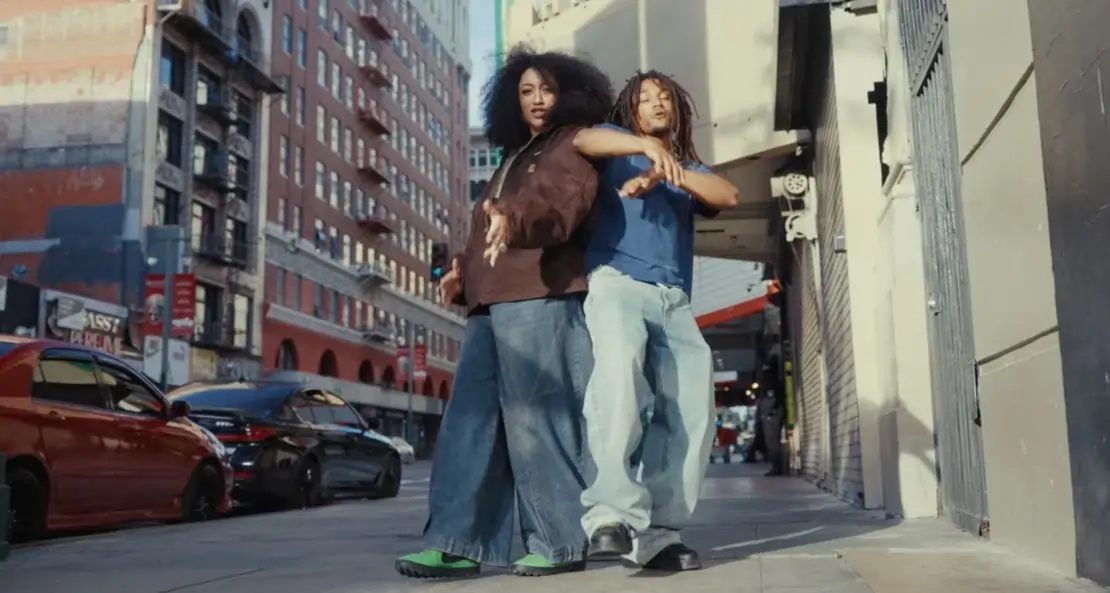
The visual, directed by Yanchi, is where the track gets a second layer. It borrows directly from the reverse-shot technique that Spike Jonze used for The Pharcyde’s 1995 single “Drop,” off their album Labcabincalifornia.
For that video, The Pharcyde performed their entire song phonetically backwards on the streets of downtown Los Angeles, with a USC linguist coaching them through the gibberish, so that when the footage was reversed, it played forward with perfect lip sync.
Yanchi picks that approach back up and plants it on real street locations, echoing both the Pharcyde reference and the themes running through Jordan Ward’s BACKWARD album.
The title isn’t incidental. Waiting, reversing, going back over things in your head: the visual language earns its reference rather than just nodding at it.
“Baby Powder” introduced an artist who understood that softness could be a weapon. “Head Over Heels” proved she could top a chart without hardening her sound.
“Waiting Room” is the next step in that logic: a track so composed it almost conceals how much it hurts. The CRYSALIS era has been making the case that Jenevieve works best in the space between confidence and doubt, and this sits right in the middle of that gap. Cool on the surface. Quietly falling apart underneath.
You might also like: