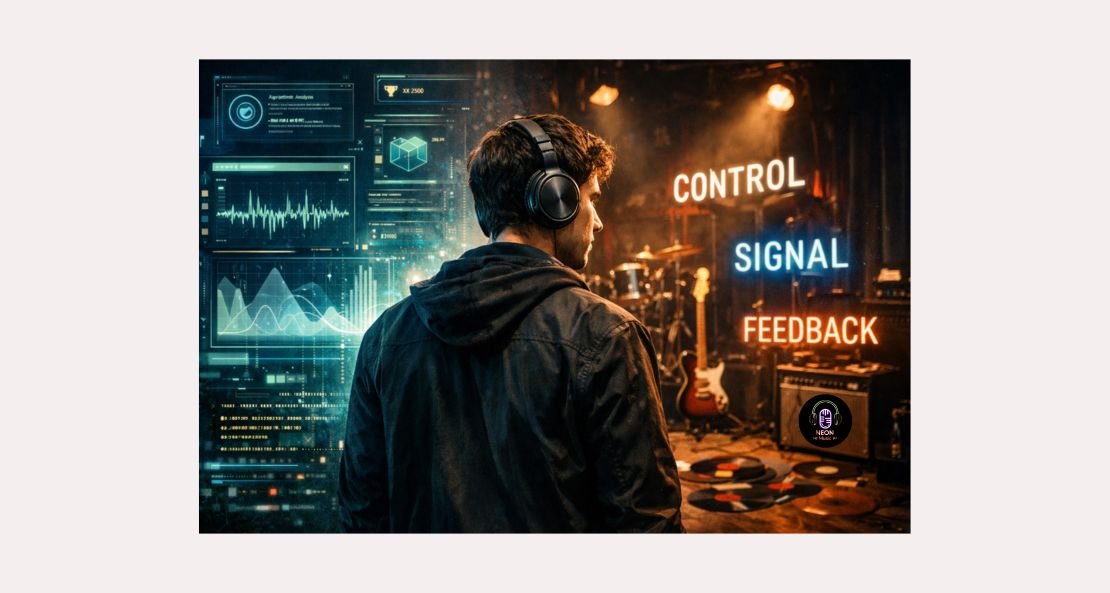
The real story is not that AI can generate songs. It is that the most powerful people in music now speak about music like a system to optimise, a gameplay loop to engineer, a market to expand rather than a craft to protect.
What feels different is the shift in values. The conversation has moved away from expression and toward engagement.
Neon Music sees this less as a technology debate and more as a power struggle over who defines what music is for.
Streaming platforms are already living this shift. Deezer reports roughly 18% of daily uploads are now AI-generated, even though those tracks represent a fraction of actual listening. Quantity is rising faster than cultural impact.
The friction that once defined music-making is being reframed as a flaw. And once impatience becomes a design principle, the meaning of artistry quietly changes.
When Creation Becomes Gameplay
Suno CEO Mikey Shulman describes a future where music behaves more like gaming: fans generate, remix, and interact rather than passively listen.
On the surface, it sounds collaborative. Underneath, the hierarchy shifts. The artist becomes a system designer. The listener becomes a player.
This is not neutral framing. It positions music as content to optimise for interaction, mirroring gaming’s logic of rewards and micro-transactions.
The promise is empowerment: Anyone can make music. Everyone has taste. Skill becomes optional.
But listen to the subtext. Platforms celebrate speed, iteration, and volume.
The most common user feedback isn’t about emotional breakthroughs. It’s about efficiency. Faster. Cheaper. Less friction. Not deeper. Faster.
Scroll TikTok long enough and you’ll see creators posting multiple AI tracks a day, each chasing a different micro-trend, each disappearing before the comments even settle.
When the barrier to making a song disappears, the cultural incentive shifts from crafting something to producing something. And the internet responds accordingly: endless output, endless scroll, endless noise.
The Illusion of Collaboration
One of the most seductive ideas in AI music is that the tool feels like a creative partner.
A co-writer. A collaborator. But collaboration without disagreement is something else entirely.
Human collaboration involves negotiation, resistance, and vulnerability. AI collaboration removes those tensions. You keep what you like, discard what you don’t. No ego. No compromise. No friction.
On paper, it sounds ideal. In practice, it risks flattening music into a mirror. AI encourages self-referential listening, where creators primarily consume their own generated tracks.
Instead of communities forming around shared influences, users orbit their own personalised outputs.
Music becomes less of a conversation and more of a feedback loop. Endless output creates endless solitude.
The Industry Didn’t Stop AI. It Joined It.
If this were only about technology, the story would end with ethics panels and lawsuits. Instead, the industry is restructuring itself around the tools it once resisted.
Major labels that sued AI companies are now striking licensing deals and building subscription-based systems for fan-driven creation.
Warner Music’s settlements and partnerships signal a shift from confrontation to integration.
That change reframes everything. AI is no longer just disruption. It is becoming infrastructure.
When labels move from legal opposition to revenue participation, resistance starts to look like nostalgia.
But monetisation is not the same as cultural alignment. The same deals that promise new income streams also tighten control, introducing “licensed ecosystems” and new limits on ownership.
Creation expands. Ownership contracts. The industry calls this progress. Nobody agrees on what’s actually improving.
The Taste Economy and the Disappearing Crowd
AI executives claim that in a world of infinite music, taste will matter more than skill. Discernment becomes the new craft.
The pitch sounds liberating. The outcome feels lonelier. It quietly rewrites the artist’s role. If skill becomes secondary, influence stops flowing through mastery and starts flowing through curation.
The hero is no longer the musician who pushes a genre forward. It’s the listener who chooses the right prompts.
AI companies frame this shift as creative democratisation. Anyone can make music. Anyone can experiment. That promise resonates because it challenges the idea that artistry belongs to an elite few.
There is genuine potential here. Therapy groups use generative songwriting to help patients express emotion. Educators use AI melodies to teach complex ideas through rhythm. Some creators discover confidence precisely because the barrier to entry disappears.
But participation without ownership is not freedom. Platforms decide how songs are distributed, monetised, and sometimes erased. The tools feel open. The structure remains closed.
This collapses the historical distance between artist and audience. The result is a paradox: more people make music than ever, yet fewer shared references emerge.
Without common influences, scenes fragment into hyper-personalised ecosystems. The crowd disappears.
Live Music as the Last Unfiltered Space
If recorded music becomes an infinite commodity, physical performance retains scarcity and unpredictability.
This idea already echoes in industry moves: Suno’s acquisition of concert discovery tools suggests that even AI platforms know where authenticity still lives.
The camera separated cinema from theatre. Generative AI may do the same for music, creating a sharp divide between recorded output and live experience.
If that happens, artists won’t disappear. They will relocate, from the algorithmic feed back to the room. Vinyl drops, artist-led communities, and live gigs already signal this shift—listeners searching for something undeniably real.
A Future Built on Refusal or Reinvention
The danger lies less in the tools themselves than in the ideology shaping them. When executives frame music primarily as engagement or gameplay, they reshape expectations long before audiences notice the change.
This moment is a negotiation, not a collapse. Artists are deciding whether to integrate AI, resist it, or carve out spaces where human imperfection becomes the selling point.
Because the real tension is not human versus machine. It’s craft losing ground to convenience.
And that choice decides whether AI becomes an instrument or just another way to skip the hard parts. This isn’t closure. It’s a fight for meaning.
For more Neon Opinions and cultural diagnostics, subscribe to neonmusic.co.uk and follow where music is actually moving, not just what’s trending.
You might also like:
- AI Songs Top Charts: Breaking Rust & the Rise of AI Slop
- Breaking Rust AI Exposed Country Music’s Algorithm
- Do You Own Suno AI Music? Terms of Service Explained
- Spotify Price Increase 2026: AI Music & Artist Survival Guide
- How Streaming & TikTok Shape 2025’s Biggest Hits
- Streaming Payouts 2025: Which Platform Pays Artists the Most?