

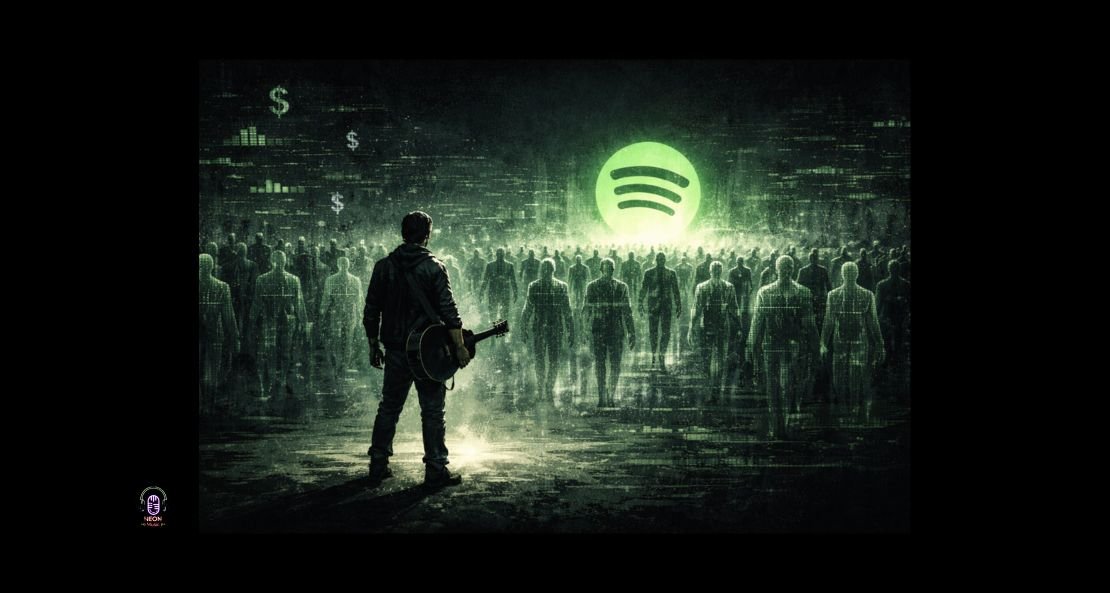
The price hike isn’t the problem. It never was.
When Spotify announced Premium would jump to $12.99 in February 2026, the headlines focused on subscribers paying an extra dollar monthly.
What they missed was the sleight of hand happening underneath: a Basic tier deliberately obscured through dark patterns, an AI content flood diluting royalty pools, and a leadership transition that positions the platform even deeper into synthetic audio territory.
The real story isn’t about what subscribers will pay. It’s about what artists won’t receive.
The Hidden Tier You’re Not Supposed to Find
Spotify still offers a Basic music-only subscription at $10.99 monthly. You won’t find it easily.
The company uses comparison prevention, obstruction, and sneaking to bury its existence so thoroughly that over 99% of subscribers never encounter it.
Try searching Spotify’s pricing page. Basic doesn’t appear. Check the app’s subscription options. Nothing.
The tier exists solely for “eligible” Premium subscribers at Spotify’s discretion, and only existing Premium members can downgrade. New subscribers? Locked out entirely.
Digital Music News identified the dark patterns at work:
Comparison prevention combines features and prices in deliberately complex arrangements, making side-by-side evaluation nearly impossible.
Obstruction places barriers between users and their goals, requiring multiple steps where one should suffice.
Sneaking hides options that might cost the company revenue whilst prominently displaying more expensive alternatives.
This matters beyond consumer rights. The Basic tier serves a legal function. When Spotify bundled audiobooks into Premium subscriptions in late 2023, it reclassified those tiers under Phonorecords IV agreements, slashing mechanical royalties to publishers and songwriters.
Standalone music subscriptions like Basic pay the full 15.35% rate. Bundled plans? About 24.5% of total content cost.
Keeping Basic technically available lets Spotify claim a non-bundled option exists whilst ensuring almost nobody actually uses it.
The Mechanical Licensing Collective sued over this bundling strategy. The case continues.
Meanwhile, subscribers who do find Basic and subsequently cancel can never resubscribe. That’s the language typically reserved for grandfathered plans being phased out.
The Leadership Change Nobody’s Discussing Properly
Daniel Ek stepped down as CEO on 1 January 2026, transitioning to Executive Chairman. Co-presidents Gustav Söderström and Alex Norström now handle day-to-day operations. The press release framed it as strategic evolution. The timing tells a different story.
Ek’s departure caps months of artist boycotts over his investment in Helsing, a German defence technology company developing AI-powered military drones.
Through his investment company Prima Materia, Ek poured nearly $700 million into Helsing in 2025 alone, serving as the company’s chairman.
Artists including Hotline TNT, Deerhoof, and Xiu Xiu removed their catalogues from Spotify in protest.
The movement never reached Taylor Swift proportions, but it exposed something more concerning: most boycotting artists remain signed to labels controlling their masters, meaning their back catalogues stayed on Spotify regardless. They could only withhold future releases.
King Gizzard & the Lizard Wizard left Spotify in July 2025. Within months, AI-generated clones appeared under names like “King Lizard Wizard”, actively promoted by Spotify’s own recommendation algorithm. The theoretical became terrifyingly real.
Ek’s “stepping aside” removes the lightning rod whilst changing nothing about Spotify’s fundamental trajectory. He retains input and oversight.
The new co-CEOs have spent their entire careers at Spotify, steeped in its culture and priorities. If you expected a philosophical shift, the appointment of internal successors should recalibrate those expectations.
The AI Flood Nobody Can Accurately Count
Deezer’s research scientist estimated one-third of the 100,000 tracks uploaded daily are AI-generated.
That’s 33,000 synthetic songs entering streaming platforms every single day. Spotify hasn’t disputed these figures publicly.
Suno generates approximately 7 million AI tracks daily. Deezer reports 50,000 new AI tracks hitting its platform.
Given Spotify’s market dominance, conservative estimates suggest 100,000 AI-generated tracks land on Spotify daily.
They all draw from the same royalty pool as human creators.
Spotify’s head of artist and industry partnerships Bryan Johnson claims “infinitely small consumption of fully AI-generated tracks” means “no dilution of the royalty pool.”
The maths doesn’t support that assertion when you’re adding millions of AI tracks monthly to a streamshare model where every play shifts the percentage distribution.
Here’s how streamshare works: your royalties depend on your percentage of total platform streams in a given period.
If 100,000 AI tracks each generate 50 streams monthly (a low estimate), that’s 5 million streams redirected away from human artists. Every month. Compounding.
The first AI-powered artist to chart on Billboard arrived in November 2025. Xania Monet’s track topped the R&B Digital Song Sales chart, amassing 44.4 million streams and generating over $52,000.
In September, Monet secured a $3 million recording contract after what Billboard described as a “bidding war”. Most AI artists don’t disclose their synthetic nature in platform descriptions.
AI-generated artist Blow Records earned an estimated £123,176 from 2025 releases alone, despite only launching in June.
Their track “Predador de Perereca” went viral on TikTok with 1.6 million video uses. They’ve accumulated over 45 million streams and 2.8 million average monthly listeners.
For context, that’s more monthly listeners than established acts like Rizzle Kicks. Understanding how to maximise your streaming revenue becomes even more critical when competing against this AI flood.
The Data Breach Spotify Can’t Undo
In December 2025, Anna’s Archive scraped metadata for 256 million audio tracks and 86 million music files from Spotify. They bragged about it publicly, distributing 300 terabytes via bulk torrents.
Spotify partnered with major labels to sue Anna’s Archive in the United States District Court for the Southern District of New York.
The complaint alleges Anna’s Archive circumvented Spotify’s technological measures using thousands of accounts to download files they had no legal right to access.
This matters for two reasons beyond the immediate copyright violation:
First, that scraped data becomes training material for generative AI models. The lawsuit alleges specific DMCA violations around breaking technological barriers, but the toothpaste is out of the tube.
Those 86 million audio files are now floating in the digital ether, available to anyone running AI training pipelines.
Second, it exposes how vulnerable streaming platforms remain to systematic data extraction.
If Anna’s Archive could scrape a quarter-billion track metadata records, what stops commercial AI companies with significantly more resources? The answer appears to be: not much.
Spotify announced it removed over 75 million “spammy tracks” in the past year. That’s encouraging until you realize they’re playing whack-a-mole against opponents who can generate content faster than any human moderation team can review it.
What Spotify’s AI Partnerships Actually Mean
In October 2025, Spotify announced collaborations with Sony Music Group, Universal Music Group, Warner Music Group, Merlin, and Believe to develop “artist-first AI music products”. The press release emphasized four principles:
- Partnerships with rightsholders
- Choice in participation
- Fair compensation and new revenue
- Artist-fan connection
Read past the corporate language and the picture clarifies. Spotify is licensing catalogues from major labels to train AI models that will generate new revenue streams.
Artists and rightsholders can choose whether to participate. Those who opt in receive compensation through “upfront agreements” rather than “asking for forgiveness later”.
Goldman Sachs estimated superfan monetization could generate $4.3 billion in annual revenue by 2026.
Spotify’s AI tools appear designed to unlock that revenue by creating interactive features appealing to listeners willing to pay premium prices for enhanced engagement.
The “prompted playlist” feature rolled out January 2026 exemplifies this direction.
Premium subscribers in the US and Canada can now generate playlists from text prompts reflecting “vibes, feelings or memories”.
The AI creates custom mixes that can refresh daily or weekly, with descriptions explaining each song recommendation.
It uses generative AI trained on… well, Spotify hasn’t disclosed the training data specifics, but given their partnerships with major labels and the timing of these announcements, educated guesses become straightforward.
Here’s the uncomfortable question: if Spotify can generate playlists that feel personally curated, how long before it can generate the actual songs filling those playlists?
The technology already exists. The licensing frameworks are being negotiated. The revenue incentive is enormous.
Spotify pays royalties on human-created music. It wouldn’t pay royalties on platform-generated content.
The Revenue Reality Independent Artists Face
The price increase generates an estimated $978 million in additional annual revenue.
None of that flows directly to artists. It goes to Spotify, which then distributes royalties via streamshare calculations after taking its cut. Spotify’s path to profitability relies on these incremental price increases whilst controlling costs.
Using Spotify’s own 2024 data, an artist receiving one in every 1,000,000 streams generated approximately $10,000.
That’s an average outcome under streamshare, not a fixed per-stream rate. The April 2024 eligibility rule requires tracks to hit 1,000 streams in the previous 12 months to earn recorded-royalty payouts.
If you’re an independent artist competing against AI-generated content that costs nothing to produce and can be uploaded in unlimited quantities, the maths becomes grim quickly.
Premium subscribers generate 3-4 times more revenue per stream than free tier listeners.
The price hike might actually benefit artists if it doesn’t trigger subscriber churn. But that assumes the additional revenue gets distributed via streamshare to human creators rather than absorbed by platform costs or redirected to AI-generated content that Spotify potentially owns.
The bundling issue compounds this. With 99% of US subscriptions now bundled, most artists receive significantly reduced mechanical royalties compared to standalone music subscriptions. The Basic tier theoretically addresses this, but Spotify’s dark patterns ensure almost nobody can access it.
Understanding which songs actually generate billions of streams reveals the scale required to make streaming work as primary income.
What Artists Can Actually Do
Treat streaming platforms as advertising, not income. This isn’t defeatism; it’s strategic clarity. Spotify offers distribution and discovery.
It does not offer sustainable artist revenue at any meaningful scale unless you’re pulling millions of streams monthly.
Build direct relationships with listeners through email lists, Patreon, Bandcamp, or owned platforms.
Every subscriber who pays you $5 monthly directly generates more revenue than thousands of Spotify streams whilst removing platform intermediaries.
Collect every royalty stream you’re owed. Most independent artists claim only master recording royalties through distributors.
Performance royalties flow through PROs (PRS for Music in the UK, ASCAP or BMI in the US).
Mechanical royalties require separate collection through publishers or admin services like Songtrust. YouTube generates direct licensing royalties many artists never claim.
Understand the 1,000-stream threshold. Tracks generating fewer than 1,000 streams over 12 months don’t qualify for recorded-royalty payouts under Spotify’s current model.
That means your first priority is hitting that minimum threshold consistently rather than chasing viral moments.
Release strategically rather than frequently for frequency’s sake. Spotify’s algorithm rewards consistent engagement, but throwing tracks into the void hoping one sticks wastes resources.
Focus on quality releases every 6-8 weeks with proper pre-release pitching to playlist editors through Spotify for Artists at least 7 days before launch.
Diversify revenue streams aggressively. Live performance, merchandise, sync licensing, teaching, session work, production for other artists. Multiple income sources create stability that streaming alone cannot provide.
Document everything. Track which releases perform best, analyze listener demographics, monitor where engagement happens, and study the patterns. Understanding chart movements reveals what works for your specific situation better than generic advice.
The Uncomfortable Truth About Sustainability
Ireland’s three-year pilot programme paying 2,000 musicians a basic wage produced remarkable results.
Artists quit part-time jobs, mental health improved, creative output increased, and cultural contributions became measurable. The programme became permanent in 2026 based on those outcomes.
The Living Wage for Musicians Act remains in legislative pipelines. If passed, it could create new royalty structures requiring platforms like Spotify to pay minimum rates regardless of streamshare mathematics.
These solutions acknowledge what the music industry keeps trying to avoid: streaming royalties alone cannot sustain the vast majority of working musicians.
The maths doesn’t work. It never did. Adding AI-generated content to the royalty pool equation makes sustainability even less achievable.
The choice facing artists isn’t whether to use Spotify. It’s whether to mistake Spotify for a career rather than recognizing it as one tool among many. The platform serves discovery and accessibility.
It cannot serve as your primary revenue source unless you’ve already achieved scale that makes you less vulnerable to these systemic issues.
Spotify’s price increase, leadership transition, and AI partnerships reveal a company optimizing for profitability and shareholder value.
That’s not a moral failing; it’s what publicly traded companies do. But artists need to understand the game being played rather than expecting platforms to prioritize creative sustainability over financial returns.
The 1,000-stream threshold exists because Spotify determined that processing micro-payments for tracks generating minimal streams cost more than those streams generated in revenue.
The bundling strategy exists because it improves Spotify’s negotiating position with rights holders whilst reducing mechanical royalty obligations.
The dark patterns hiding Basic tier exist because driving subscribers toward higher-priced options increases revenue.
None of this serves artists. It serves Spotify.
Recognition of that reality should inform every strategic decision you make about where to invest time, energy, and resources in building a music career that actually sustains you.
Key Takeaways for Artists
Price Increase Details:
- Spotify Premium rises to $12.99/month (US) from February 2026
- Previously $11.99/month (increased from $10.99 in June 2025)
- Estimated to generate $978 million additional annual revenue
- No direct benefit to artists; revenue distributed via existing streamshare model
Basic Tier Access:
- Music-only subscription at $10.99/month technically still exists
- Deliberately hidden through dark pattern design
- Only “eligible” existing Premium subscribers can downgrade
- New subscribers cannot access Basic tier at all
- Once cancelled, cannot be resubscribed
- Exists primarily to counter bundling lawsuit claims
AI Music Scale:
- Approximately 100,000 AI-generated tracks uploaded to Spotify daily
- One-third of all daily uploads are AI-generated (Deezer research)
- All AI tracks draw from same royalty pool as human creators
- First AI artist (Xania Monet) charted on Billboard in November 2025
- AI artist Blow Records earned estimated £123,176 from 2025 releases alone
Royalty Collection Checklist:
- Master recording royalties (via distributor like DistroKid, CD Baby, or TuneCore)
- Performance royalties (PRS for Music UK / ASCAP or BMI US)
- Mechanical royalties (requires publisher or admin service like Songtrust)
- Direct licensing royalties (YouTube, sync, etc.)
- Neighbouring rights (session musicians, featured artists)
- Full revenue collection guide
Streaming Threshold Requirements:
- Minimum 1,000 streams per track in 12 months to qualify for payouts
- 30 seconds of playback counts as one stream
- Premium subscribers generate 3-4x more revenue per stream than free users
- Streamshare model means your percentage of total platform streams determines payout
Revenue Reality:
- One in every 1,000,000 streams generated approximately $10,000 in 2024 (Spotify data)
- Independent artists typically receive $3-5 per 1,000 streams to master rightsholder
- After distributor fees and splits, actual artist payment varies significantly
- Bundled subscriptions pay reduced mechanical royalties (52% revenue base vs. full rate)
Want to survive the streaming economy? Subscribe to Neon Music for analysis that cuts through industry spin and gives you actionable intelligence.
You might also like:
- How Much Do Artists Make on Spotify in 2025?
- Maximise Revenue: Collect Every Penny from Spotify, Apple & Tidal
- Spotify’s Bold Profit Move: How Price Hikes Drive Profitability
- How Streaming & TikTok Shape 2025’s Biggest Hits
- How TikTok Viral Songs Dominated Charts in 2025
- Spotify Streaming Chart Watch: December 2025 Rankings