
For the first time in country music history, a voice that doesn’t exist topped the charts. “Walk My Walk” by Breaking Rust spent its second week at No.
1 on Billboard’s Country Digital Song Sales chart in November 2025, sending shockwaves through Nashville’s songwriter community and raising serious questions about what happens when synthetic artists compete with human ones.
The song, generated entirely through artificial intelligence, exposed how vulnerable chart systems have become to AI-generated content flooding streaming platforms.
The implications stretch far beyond a single chart position. This moment represents a turning point for an industry built on authenticity, personal storytelling, and the connection between artist and fan. And it’s happening faster than anyone anticipated.
The AI Invasion: How Synthetic Music Hijacked a Genre Built on Authenticity
Breaking Rust exists only as code. There’s no late-night honky-tonk performances, no years of honing craft in dive bars, no lived experiences to draw from.
The artist has virtually no footprint beyond Instagram, Spotify, and YouTube pages that offer no indication of AI involvement.
Yet “Walk My Walk” sold enough copies to dominate a chart that has historically belonged to human songwriters pouring their real lives into three-minute stories.
Breaking Rust isn’t alone. Cain Walker, another suspected AI artist, claimed the No. 3 spot with “Don’t Tread on Me” and debuted at No. 9 with “Ain’t My Problem” on the same chart.
Together, these synthetic acts occupied one-third of the country digital sales top 10.
According to Billboard, at least one AI artist has appeared on its charts for six consecutive weeks, and the publication acknowledges that figure could be higher since identifying AI-generated content has become increasingly difficult.
The flood of AI music isn’t limited to country. R&B artist Xania Monet became the first known AI act to earn radio airplay charting when she debuted at No. 30 on the Adult R&B Airplay chart after her deal with Hallwood Media reportedly attracted $3 million in bidding offers.
Christian, rock, and emerging artist charts have all seen AI or AI-assisted acts appear in recent weeks, suggesting this phenomenon spans genres and shows no signs of slowing.
The Machinery Behind the Music: How ‘AI Slop’ Floods the System
The numbers tell a staggering story. Deezer, the French streaming platform that deployed the music industry’s first AI detection tool, now receives 50,000 fully AI-generated tracks every single day.
That’s 34% of all daily uploads to the platform, up from just 10,000 daily submissions in January 2025.
Even more alarming: Deezer found that up to 70% of streams on AI-generated tracks are fraudulent, driven by bot networks designed to game royalty payments.
Michael Lewan, head of the Music Fights Fraud Alliance, warns that artificial streaming poses a bigger threat to music’s integrity than AI itself.
“A system that is not protecting organic engagement and authentic listenership will be more prone to attacks by people making a quick buck off of the royalty pool,” he told NBC News.
The mechanics are disturbingly simple. Generative AI tools like Suno and Udio allow anyone to create hundreds of royalty-eligible tracks in minutes at virtually no cost.
Upload them through distributors like DistroKid, run them through bot-driven streaming farms, and you’ve created an automated system for extracting micro-payments.
The goal isn’t creating a hit but generating hundreds of thousands of plays that each pay a fraction of a cent.
A recent Ipsos survey commissioned by Deezer revealed that 97% of listeners couldn’t distinguish between human-made and fully AI-generated songs in blind listening tests.
If fans can’t tell the difference, how can they make informed choices about supporting real artists?
Nashville Fights Back: ‘Art Should Be Human’
For Nashville songwriter, producer, and artist Tommy Iceland, Breaking Rust’s chart success felt like a tipping point.
“Art in all forms should be made by humans,” Iceland said. “I want to hear real personal stories. I want it to come from a real place.”
Iceland, who moved to Nashville from Sweden and has written for other artists while building his own career, can detect what he calls a “distinctive, artificial sound” in AI-generated mixes.
His concern extends beyond artistic integrity to career viability. “It’s easier for a label to sign an AI artist that never argues with them,” he explained. “They can shape this AI artist into whatever they want, so it’s definitely going to be harder for younger artists to get that attention and stand out.”
Lee Thomas Miller, board president of the Nashville Songwriters Association International (NSAI), called the Breaking Rust chart performance “fishy” and questioned whether fans even realise the song wasn’t created by a person.
“I find it hard to believe that thousands of people actually went out and purchased this,” Miller said, pointing out that the country digital sales chart reflects paid downloads rather than streams or radio airplay.
Miller raised copyright concerns that strike at the heart of the AI music debate. “If a computer program can make you sound exactly like Taylor Swift, what do we know? We know it’s been listening to Taylor Swift,” he noted.
“If you’re using copyrighted material to train your model, the output is going to be some degree of something that should have been protected in the first place.”
Singer-songwriter Mark Taylor, speaking just before heading onstage in Baltimore, put it more bluntly: “There’s something to be said for artists and writers bringing emotion into a room. AI doesn’t know what it’s like to experience heartbreak or have a beer on a Friday night.”
Taylor worries about the disconnect between synthetic hits and the live music experience that sustains careers. “Are people going to go buy tickets to see a robot?” he asked.
“It’s extremely discouraging for somebody that tries to go write songs to make people feel something every day to have a computer make something up and have a number one out of it.”
The Stakes: What Human Artists Stand to Lose
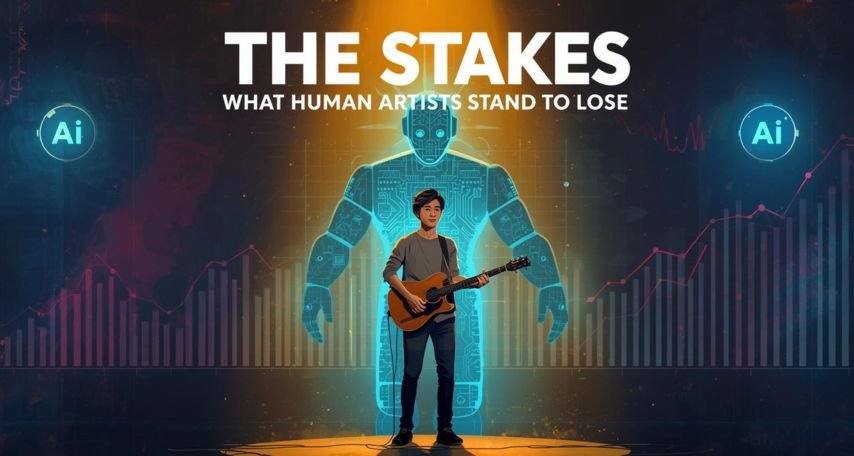
The consequences extend beyond hurt feelings. Fletcher Foster, president and CEO of F2 Entertainment Group who manages country artists, warns that AI-generated songs occupying chart positions create real economic harm.
“It’s incredibly detrimental to have AI-generated songs taking up precious spots on the chart because not only do they clog up the chart, but they take positions away from a well-rounded artist that can have a career generating revenue and publishing, touring, brand partnerships,” Foster said.
Country radio consultant Joel Raab points to research showing listeners react negatively to AI voices on their stations.
Radio stations depend on touring advertising and artist-driven revenue, making the embrace of synthetic artists economically shortsighted.
“Leaning on that type of programming consistently seems very shortsighted considering radio makes money off of touring advertising and other artist-driven revenue,” Foster added.
The artist development process has become nearly impossible even before AI entered the equation.
COVID-19’s disruption and the massive shift to digital streaming platforms already made breaking new artists more challenging than ever.
Now, human artists must compete against an unlimited supply of synthetic content that can be produced instantly at essentially zero cost.
The Bigger Picture: AI’s Growing Footprint in Music
The indie band The Velvet Sundown suddenly drew hundreds of thousands of Spotify listeners in July 2025 amid speculation that the band was an AI creation.
The pattern repeats across platforms and genres: mysterious artists appear from nowhere, rack up streams, and leave fans and industry insiders questioning what’s real.
Some major labels are making peace with AI. Universal Music Group announced a deal with Udio in October 2025 that settled UMG’s involvement in a lawsuit against the AI startup.
The agreement paved the way for a version of Udio that would create commercial streaming experiences while paying participating UMG artists for their contributions to training the AI model.
State and federal lawmakers are racing to catch up. Country star Martina McBride testified in support of the NO FAKES Act, bipartisan federal legislation that would give individuals the right to protect their voices and likenesses from AI replication without consent.
“Ultimately, Washington, D.C. is going to have to come in and say, ‘This is what we’re going to allow, and this is what we’re not,'” Miller said. “The Copyright Office will have to decide what is payable, what is a royalty, and what is just made-up computer code.”
At minimum, songwriters and industry advocates want clear labelling requirements so consumers know when a track isn’t performed by a human.
“I think the consumer deserves to know what’s going on,” Miller said. “If it’s not even a real person, there should be some sort of warning.”
What Comes Next: Can Human Music Survive the Algorithm?
Despite the concerns, some industry voices believe human connection will prevail. Leslie Fram, founder of FEMco, a Nashville creative consulting group, argues that “casual streamers might shrug and say ‘If it sounds good, who cares?’ but dedicated fans, especially in genres like country, crave the human ‘mistakes’ that add soul.
Fans will stream AI songs short-term, but loyalty? That’s earned through real stories, not algorithms.”
Country radio consultant Joel Raab agrees: “Looking ahead, the realness of human music with heart and human soul will win every time.”
The question remains whether that optimism holds up against the economic realities. A CISAC report estimated that AI could cannibalise up to 24% of music creators’ revenues by 2028.
With 50,000 AI tracks flooding streaming platforms every day and 70% of AI streams driven by fraud, the system appears designed to favour synthetic content over human artistry.
Breaking Rust’s songs are already spreading beyond music. Cain Walker’s website sells “Don’t Tread On Me” merchandise.
The commercialisation of synthetic artists proceeds even as basic questions about authorship, copyright, and fair compensation remain unresolved.
For now, Broadway’s honky-tonks remain packed with live bands and human voices.
But every day that passes without regulatory action, clear labelling requirements, or platform accountability brings the industry closer to a tipping point where the artificial drowns out the authentic.
When the next No. 1 is created in code, who’s the author? More importantly, when fans stream a song generated by an algorithm trained on copyrighted works without permission, who should get paid? These aren’t hypothetical questions anymore.
Breaking Rust already proved that AI can reach the top of the charts. What happens next depends on whether the industry acts fast enough to protect the human artists who built country music on real stories, real heartbreak, and real connection.
Join the conversation: what’s your take on a top-charting song with no human behind the voice?
You might also like:
- AI and the Creation of Electronic Music
- The Influence of AI on Music Production
- Can’t Stop the Twang: Top Country Songs Ruling the Charts in 2024 (So Far)
- The 30 Most Controversial Country Songs That Changed the Genre
- Morgan Wallen Joins Spotify’s Billions Club: First Country Artist
- Decoding Last Night: An In-depth Analysis of Morgan Wallen’s Lyrics