
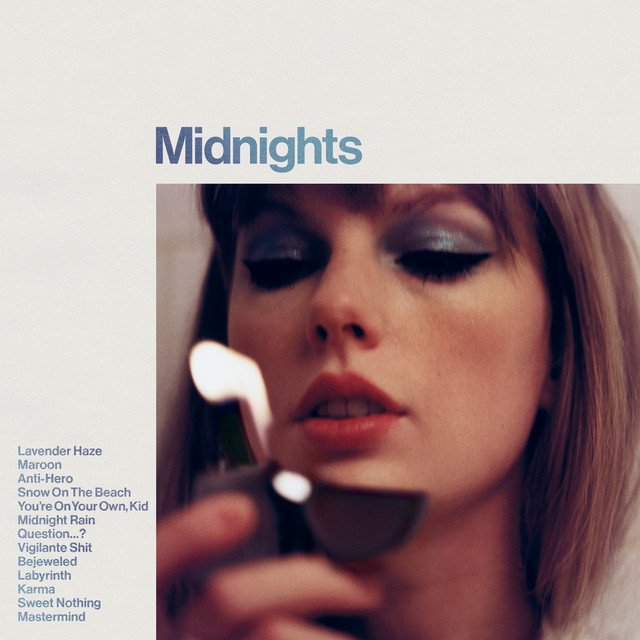
Midnights is Taylor Swift’s most refined album and her least willing to take the kind of risk that made her previous two worth remembering.
Released October 21, 2022, on Republic Records, it is her tenth studio album, the first written entirely with producer Jack Antonoff, and the clearest statement she has made about the relationship between artistic control and commercial re-entry.
So what does Midnights actually mean? Swift described it as “a collection of music written in the middle of the night, a journey through terrors and sweet dreams.”
The album delivers that atmosphere with precision. What it does not deliver is disruption.
Artist: Taylor Swift | Released: October 21, 2022 | Label: Republic Records Producers: Taylor Swift, Jack Antonoff (11 of 13 tracks), Sounwave, Jahaan Sweet, Keanu Beats Writers: Taylor Swift, Jack Antonoff, Joe Alwyn (as William Bowery), Zoë Kravitz, Lana Del Rey, Sam Dew Genre: Synth-pop, electropop, bedroom pop, dream pop
The album debuted at number one on the Billboard 200 with 1.578 million units in its first week, the largest single-week US sales figure for any album since Adele’s 25 in 2015.
In the UK it opened at number one with 204,000 units, the fastest-selling album of 2022. It holds 7x Platinum certification in the US and 3x Platinum in the UK.
“Anti-Hero” reached number one on the Hot 100; “Lavender Haze” and “Karma” peaked at number two. At the 66th Grammy Awards in 2024, Midnights won Album of the Year, Swift’s fourth such win and a record in that category.
The production draws on vintage analog hardware throughout: Yamaha DX7, Oberheim OB-8, Moog synthesizers, Juno 6, Mellotron. Drum programming is sparse.
The genre sits at the intersection of synth-pop, bedroom pop, and electropop, with occasional R&B phrasing that surfaces without fully committing.
The 3am Edition, dropped as a surprise in the early hours of release day, adds seven bonus tracks including three co-written and produced by Aaron Dessner, Swift’s collaborator on Folklore and Evermore.
Folklore and Evermore were critically acclaimed, pandemic-era albums that required something from casual listeners: patience, a tolerance for folk-adjacent quietness, a willingness to follow Swift somewhere unfamiliar.
They worked. They also moved her away from the pop centre of gravity she had occupied since 1989.
Midnights is the re-entry. It is not a retreat from the ambition of those albums so much as a decision to bring that ambition back inside the commercial frame, to keep the lights low even when the songs are asking for daylight.
The album runs thirteen tracks at an almost uniform mid-tempo. There is no dramatic gear change. No moment where the pressure built across the running order finally releases.
Antonoff’s synth palette is consistent to a fault, intimate and precise and, by the back half of the record, somewhat predictable. A listener arriving cold at track eight would find it difficult to locate precisely where in the sequence they had landed.
“Lavender Haze” opens with a stuttering beat and a vocal Swift delivers in a lower, flatter register than her earlier pop work. She sings about ignoring the noise of public expectation, about refusing the “1950s shit” demanded of a woman in a visible relationship. The melody is modest. What carries it is the harmonising on the pre-chorus, stacked vocals that add warmth the verses withhold.
“Anti-Hero” is the structural exception. It has genuine movement: the pre-chorus builds into a chorus with actual lift, and Swift performs it without the close, flat delivery she employs elsewhere. “It’s me, hi / I’m the problem, it’s me” arrives at the bridge as self-critique delivered with the cadence of a sketch, personal enough to feel clinical but constructed for mass identification. She likens herself to a performatively selfless politician and to Godzilla trampling a city of sexy babies. The images are specific and deliberately absurd. Admitting to being the problem is not the same as changing. The song does not pretend it is.
“Snow on the Beach” features Lana Del Rey, though Del Rey takes no dedicated verse. The internet mocked this. When you understand it, the choice reads differently. Del Rey’s voice sits distributed across the hook, blended into Swift’s rather than placed against it.
The production is twinkling synth and a thread of violin, and the effect is genuinely collaborative in the way the credit implies: two voices occupying the same melodic space without competing.
What the arrangement gives up in spectacle it gains in atmosphere. It is one of two tracks on the standard edition that operates in a genuinely different register, and notably one of two that does not attempt a radio-ready chorus.
“Maroon” is the other. The production sits low in the mix throughout, ambient rumble and drums that arrive late and fade early. Swift sings in a flat, contained middle register for most of it. By the final chorus, the vocal is heavily processed and stacked, which creates an odd gap between the intimacy of the lyric and the distance the arrangement constructs around it.
The couplet “You were sunshine / I was midnight rain” compresses the album’s central split, comfort versus disruption, settlement versus the pull away from it, into six words. It is the most interesting melodic idea on the standard edition.
“Midnight Rain” handles the same binary with greater explicitness. The pitched-down counterpart vocal, treated to a low near-masculine register, runs against Swift’s natural tone throughout the song, two timelines occupying the same track without meeting. “He wanted comfortable / I wanted that pain” is sung directly across this divide, clean against processed, bright against low.
“You’re on Your Own, Kid” contains the album’s most compressed biography: a teenage outsider writing songs in her bedroom, a famous adult returning to her hometown feeling like a prom queen who arrived in a blood-soaked gown. Swift nods quietly to her struggles with disordered eating (“I hosted parties and starved my body”), then pivots toward something like permission. The structure is conventional but the details are not.
The 3am Edition is where the album’s editorial logic becomes legible. Dessner’s production on “Would’ve, Could’ve, Should’ve” moves: charging percussion, a melodic arc, a sense that something specific and serious is at stake.
It operates with an urgency the main record withholds. On Folklore and Evermore, Dessner’s instincts ran against Antonoff’s often enough to create friction; here, with Antonoff working alone across the standard edition, no such pressure exists. The result is a particular kind of smoothness, difficult to object to track by track.
“Bejeweled” sits comfortably inside the 1989 template, a big melodic hook and bright synth tone built for playlist placement.
“Vigilante Shit” strips down to thin bass tones and a near-silent beat, which should read as menace but lands closer to studied restraint, a withholding that never commits to what it is withholding.
These are not failures of execution. They are choices. The most emotionally exposed writing on the record, including “Would’ve, Could’ve, Should’ve” with its precise account of a teenage girl’s relationship with a manipulative older man, did not make the standard edition. That is not incidental.
The album was curated for cohesion over volatility, and it shows exactly where that curation ran.
“Mastermind” closes the record with something close to self-awareness. Swift acknowledges the scheming and then discovers the object of it already saw through it. “I swear I’m only cryptic and Machiavellian ’cause I care” is a genuinely good line.
The song also offers the clearest structural departure of the closing run: the production opens up as it builds, the synth pulse widening slightly rather than holding its contained register, and Swift’s vocal sits higher in the mix than anywhere else on the record.
For three minutes the album stops calibrating. It is a better ending than the record surrounding it strictly earns, which is itself the kind of thing Mastermind seems to be arguing about.
The album is stronger in its individual moments than as a continuous listening experience. Antonoff’s production is controlled and warm, but rarely surprising, and the same synth textures that feel intimate at track one read as routine by track ten.
Vocal processing, pitch-shift, stacking, the occasional androgynous morph, provides variation, but the overall dynamic range stays narrow across the full runtime.
Midnights won Album of the Year at the Grammys and moved more units in a single week than almost any record of the preceding decade.
It is the sound of one of the most successful artists in pop history choosing exactly how much of herself to expose and executing that choice without a single visible mistake.
The craftsmanship is not in question. What the album confirms is Swift’s dominance. What it stops short of confirming is her daring.
You might also like:
- Everything You Need to Know About Taylor Swift’s Lavender Haze
- The Real Meaning Behind Taylor Swift’s Cardigan Lyrics
- The Meaning Behind Taylor Swift’s August and Its Yearly Comeback
- Taylor Swift’s Cruel Summer Explained
- Taylor Swift’s Opalite Meaning and Review
- Taylor Swift Albums: A Complete Discography