
“SAOKO” is Puerto Rican slang for outstanding rhythm, movement, and energy, a term rooted in African origins that passed through Latin Caribbean music before landing at the centre of ROSALÍA’s most abrasive single to date.
The word had already been immortalised by Wisin and Daddy Yankee in their 2004 reggaeton anthem “Saoco,” and ROSALÍA pulls it directly into her own track as both homage and statement of identity.
So what does “SAOKO” actually mean? As ROSALÍA frames it, the song is a catalogue of images for personal transformation, the idea that you are most yourself at the exact moment you are changing.
Released on 4 February 2022 via Columbia Records, “SAOKO” was the second single from Motomami, ROSALÍA’s third studio album, and the opening track on the record.
Written by ROSALÍA alongside Noah Goldstein, Sir Dylan, Michael Uzowuru, Justin Quiles, David Rodríguez, Wisin, DJ Urba, and Yomi Fresh, with production shared between ROSALÍA, Goldstein, Sir Dylan, and Uzowuru.
It runs for two minutes and seventeen seconds. Genre-wise, it sits at the harder end of alternative reggaeton, with experimental elements that push it well past the genre’s established edges.
Three years on, with LUX having arrived in November 2025 and taken ROSALÍA into full orchestral classicism, “SAOKO” reads clearly as the opening shot of a new phase: a signal that she was done with any expectation placed on her.
We covered LUX in full over at Neon Music – the two records make an interesting pair when you hear them back to back.
The song began life at Electric Lady Studios in New York, where ROSALÍA was working a session that lost its intended collaborator partway through.
She went to the upright piano in Studio B and started improvising. “It was at night,” she recalled to Apple Music’s Zane Lowe, “and making this beat seemed as fun as driving a Lambo.”
She distorted the piano, added reggaeton drums sourced from a production library sent to her by producer NaisGai, and built the track around an interpolation of the Wisin and Daddy Yankee classic.
It is not a direct lift: the “Saoco” hook is re-recorded and woven in from the opening seconds, running throughout the track. ROSALÍA described it as “the most direct homage I can make to classic reggaeton, a genre that I love.”
“SAOKO” was the last song completed for Motomami. By that point the album was already shaped. She knew exactly where the energy needed to go.
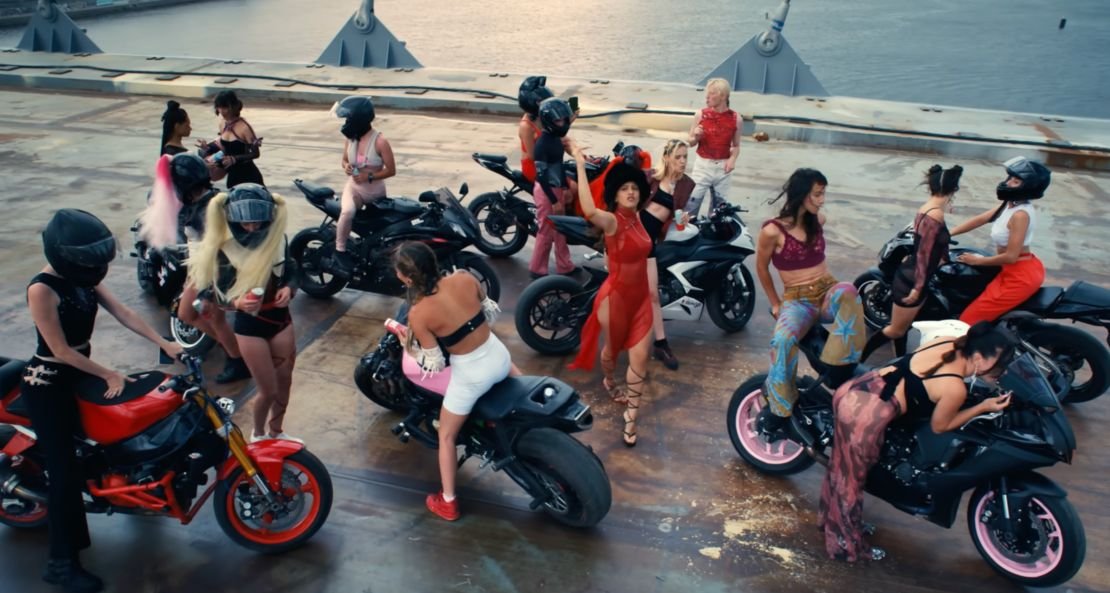
The accompanying music video, shot over three days in Kyiv at the Podilskyi Bridge with an all-female professional motorcycle crew, won an MTV Video Music Award for Best Editing.
The song peaked at number 5 in Spain and number 22 on the US Hot Latin Songs chart, reaching 2x Platinum certification in Spain, Platinum in Brazil, and Gold in Mexico.
The chorus is where the song makes its structural argument. Each line of yo me transformo stacks a different image: a butterfly, drag queen makeup, a sex siren, a meteor shower, a self-contradiction.
Yo soy muy mía, yo me transformo – I am very much my own, I transform. Each new entry adds pressure to the claim, and by the time the chorus ends the phrase has shifted from observation to something closer to doctrine.
ROSALÍA spoke to this directly in an interview with Clash: “each and every phrase is an image of transformation. Celebrating transformation, celebrating change. Celebrating that you are always yourself even though you are in constant transformation or even that you are you more than ever at the very moment you are changing.”
The second verse moves through quick flashes of cultural imagery at a different pace. Frank Ocean appears: Frank me dice que abra el mundo como una nue’, a line ROSALÍA has confirmed came from an actual session they shared, one Ocean never used himself.
Kim Kardashian’s blonde era. LEGO branding. And then yo manejo, Dios me guía, a phrase embroidered inside ROSALÍA’s Ford Raptor that she lifted verbatim into the lyric.
The verse drops these references and keeps moving without explaining the connections between them.
The arrangement is genuinely strange. Heavy synthesizers sit alongside a distorted upright piano, traditional reggaeton drums, and a ten-second avant-jazz talking interlude, an improvised exchange between ROSALÍA and her team recorded live at Electric Lady, that critics at the time compared to Eddie Palmieri’s The Sun of Latin Music (1974).
Elsewhere the sonic references point to Nine Inch Nails’ The Downward Spiral and Kanye West’s Yeezus, both of which ROSALÍA has cited as direct artistic influences.
The track runs at a consistent tempo throughout with no conventional breakdown. The bridge briefly strips things back: fuck el estilo / fuck el stylist / tela y tijera’, y ya, before the outro hammers cógela y córtala (take it and cut it) in repetition until the track ends. No conclusion. The phrase just stops.
Vocally, ROSALÍA moves between spoken and sung delivery without signalling the shift in advance, which keeps the verses from settling into any single register.
The chorus sits closer to recited than pushed. Nothing is forced. The voice holds the same controlled intensity throughout, even as the production underneath stays cracked and grinding.
In an interview with Clash, she described the song’s aim as giving listeners the feeling of being “the shit,” pure, unstoppable energy. The vocal delivery backs that up.
The lyrical friction the track sets up, between yo manejo and Dios me guía, between the rolling list of identities and the insistence that she remains entirely herself throughout, never gets addressed directly.
ROSALÍA names the contradiction and keeps moving. There is no scene where she sits with it.
The outro plays for longer than it probably needs to.
Released: 4 February 2022 | Label: Columbia Records | Producers: ROSALÍA, Noah Goldstein, Sir Dylan, Michael Uzowuru | Genre: Alternative reggaeton / experimental | Album: Motomami
You might also like:
- Rosalía’s ‘Sauvignon Blanc’ Video Explained: Devotion, Wealth and the Fire
- ROSALÍA La Perla Video: Armour as Aftermath
- ROSALÍA Dios Es Un Stalker Review: Tango Meets Divine Obsession on Lux
- ROSALÍA Mio Cristo Piange Diamanti Review: When Sacred Grief Turns to Sound
- ROSALÍA Turns Heartbreak Into Divine Opera on Berghain feat. Björk Yves Tumor
- Decoding Despacito: Unravelling the Meaning Behind the Captivating Lyrics