

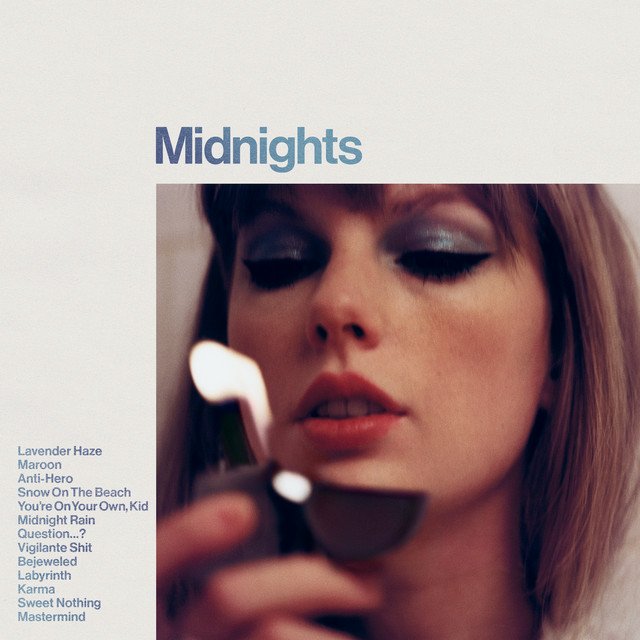
Taylor Swift’s “Anti-Hero” is a song about self-hatred dressed up as a pop confession. Released on 21st October 2022 as the lead single from her tenth studio album Midnights, alongside the music video which premiered on the same day, it positions Swift as the source of her own problems, not through any single incident, but as a condition of being herself.
So what does “Anti-Hero” actually mean? It means Swift has stopped deflecting. The song works through her worst qualities at a steady pace, without resolution, without relief.
Swift co-wrote and co-produced the track with Jack Antonoff. It is classified as synth-pop and pop rock, built on a LinnDrum loop treated with tremolo, Antonoff’s OB-8 synthesizer, and a tempo of 97 beats per minute in E major.
On Instagram, Swift said: “This song really is a real guided tour throughout all of the things I tend to hate about myself. I struggle a lot with the idea that my life has become unmanageably sized, and not to sound too dark, I struggle with the idea of not feeling like a person.”
That statement is the article of faith the entire track operates on.
Taylor Swift’s “Anti-Hero” Explained: Production, Structure, and What It’s Really Doing
To have Taylor Swift’s “Anti-Hero” fully explained, it helps to start with what the song refuses to do. The structure is methodical to the point of being stubborn.
There are two verses, each followed by a pre-chorus and chorus, then a bridge, then a repeated chorus breakdown that runs almost until the song runs out of time. There is no key change. No dramatic lift. The arrangement doesn’t escalate. It accumulates.
Antonoff built the production by applying a tremolo effect to a LinnDrum beat, which gives the rhythm a slightly wavering, seasick quality underneath what sounds like a straightforward pulse.
The result sits differently to a standard programmed drum loop. It has the mechanical regularity of drum machine production but something unsettled underneath it, like the pattern is confident while the ground it stands on is not. For the synths, he used an OB-8, which he described to Time as sounding like an old organ in a baseball stadium.
That comparison is worth sitting with. It implies scale without grandeur, a sound too large for any room but not quite impressive either. The synths in “Anti-Hero” do something similar. They fill the track without lifting it.
The production holds at roughly the same density from start to finish. The drum loop doesn’t drop out to create contrast; it just keeps moving. This is a song that refuses to announce its own importance through the usual sonic mechanisms. It stays level while Swift cycles through self-condemnation.
The chorus arrives and then returns and then returns again, each time with slightly less instrumental support around it, until the final repetitions are almost just Swift’s voice against the beat.
By the end, the hook has been delivered so many times it stops functioning as revelation and starts functioning as fact. That’s the structural argument the song is making: this isn’t a moment of self-awareness. It’s a permanent condition.
The New Yorker’s Lauren Michele Jackson observed that the verses are bisected in delivery, Swift singing one phrase aloft and the next near monotonic, as though she backs up each confessional line with its own rebuttal. That alternation keeps the verses from building toward anything. They move sideways, not forward.
“Anti-Hero” Lyrics Analysis: The First Verse, the Ghosts, and the Weight of Depression
The first verse moves through Swift’s depression with the casualness of someone reporting weather. The imagery in the “Anti-Hero” lyrics is precise rather than elaborate. “
Midnights become my afternoons / When my depression works the graveyard shift.” The timeline is inverted. Night becomes day. The shift never ends.
When she sings about the people she has ghosted standing in the room, the music video delivers this literally. Figures in bedsheets stand motionless in a kitchen at night, appearing during a meal, undemanding and entirely present. They are not accusatory. They are simply there. The visual choice matters because it resists dramatising the guilt. These ghosts do not threaten or confront. They accumulate, in the same way the song accumulates. Swift does not face them. The video does not require her to.
The pre-chorus shifts into a more confessional gear, and the vocal delivery tightens slightly. “I should not be left to my own devices / They come with prices and vices / I end up in crisis.”
Then the chorus opens and the tension releases into that blunt, almost cheerful admission. The shift in tone at the chorus is the track’s main dynamic trick.
It presents the most damning self-assessment in the brightest melodic moment. The hook does not sound defeated. It sounds, strangely, like relief.
“Anti-Hero” Video Symbolism: The Monster, the Doppelganger, and the Dinner Party
The second verse introduces the lyric that attracted the most interpretation: “Sometimes I feel like everybody is a sexy baby / And I’m a monster on the hill.”
Responses ranged from a reading of female infantilisation in the entertainment industry to a reference to the sitcom 30 Rock, where a similar phrase appears in a joke about how women are expected to present themselves.
Lindsay Zoladz of The New York Times argued the line demonstrated the fetishisation of female youth in the music industry specifically. Swift doesn’t clarify. The line sits between two more straightforward images and generates its own gravitational pull regardless of source.
The “Anti-Hero” video symbolism makes the metaphor physical here. A giant version of Swift attempts to participate in a dinner party, accidentally destroys the furniture, and is shot with an arrow by a panicking guest. She eats the food alone.
The sequence illustrates the specific discomfort of existing at a scale that disrupts ordinary social interaction, of being too present, too large, too much, regardless of intent. The arrow does not kill her. She takes it, registers surprise, and keeps sitting there.
The line “Pierced through the heart, but never killed” plays over exactly this moment. The video is not illustrating the lyric. It is testing it.
This second-verse giant is the third version of Swift in the video, distinct from both the primary Swift and the doppelganger introduced in the first chorus.
The doppelganger appears as Swift opens her front door and finds a version of herself in sparkly clothes with a relentless, performative energy. She smashes a guitar. She drinks shots while the primary Swift watches in something closer to exhaustion than horror. At one point the doppelganger writes on a blackboard: “everyone will betray you.” The primary Swift takes notes.
This duality is the video’s central device. The alternate Swift represents the version of herself that the public fixates on, the curated, performing, image-managed figure. The primary Swift observes her. Neither version controls the other. Neither version defeats the other. The doppelganger is not a villain in the video’s logic. She is simply louder, and harder to look away from.
The pre-chorus for verse two replaces personal anxiety with public-facing irony: “Did you hear my covert narcissism / Lightly disguised as altruism / Like some kind of congressman.” She is mocking her own charitable visibility before anyone else can.
What “Covert Narcissist” Actually Means in the “Anti-Hero” Lyrics
The covert narcissism lyric is one of the most searched lines in the song, and for good reason. It has attracted genuine debate about what Swift is actually admitting.
A covert narcissist, in psychological usage, is someone who harbours an inflated sense of self-importance but expresses it through self-effacement and victimhood rather than overt display. The defining feature is a lack of self-awareness about the pattern.
The counterargument worth noting is that someone who accurately identifies and names that pattern in themselves is demonstrating a level of self-awareness that disrupts the original diagnosis.
The line may be less a confession and more a description of the fear of being perceived that way, the anxiety of someone scrutinising their own good acts for hidden selfish motives, finding possible selfishness even in charitable behaviour, and then labelling it before anyone else can.
That is not what a covert narcissist does. It is what a highly self-conscious person does.
Whether that reading holds or not, the lyric lands differently when placed next to the image of a congressman, a figure whose public benevolence is almost universally understood to serve a private interest.
By invoking that comparison, Swift frames her own altruism as inherently suspect, not because it is, but because she cannot stop reading it that way. The anxiety in the line is not about who she is. It is about who she might be without knowing it.
“Anti-Hero” Meaning Unpacked: Fame, the Bridge, and the Fear of Legacy
Understanding the full “Anti-Hero” meaning requires sitting with its most extreme section. The track captures Swift’s ongoing struggle with the price of fame.
She previously discussed how the 2016 public feud with Kanye West and its resulting backlash left her feeling isolated and deeply affected her mental health, describing the period as a “mass public shaming” that made her question her identity and sense of self-worth.
“Anti-Hero” revisits those emotions with added years of perspective, blending that history with a touch of dark humour.
The dinner party scene in the video, where a giant Swift struggles to fit in and ends up eating the guests’ food alone while they recoil, extends the fame anxiety into physical space.
The scale of her presence makes normalcy impossible not out of arrogance but out of proportion. She does not want to disrupt the party. She cannot avoid it.
Lines in the pre-chorus about watching someone leave because they grew tired of the scheming reflect Swift’s insecurities about her personal relationships, the fear that her public persona and the history it carries might eventually exhaust the people closest to her.
This anxiety appears in earlier work too, in “Delicate” and “Call It What You Want,” where she questions whether someone could love her despite what she carries publicly.
The bridge follows that fear to its logical endpoint. It describes a nightmare in which Swift’s daughter-in-law murders her to access the inheritance. The delivery is unhurried.
The melody sits lower and more detached than the choruses, in a spoken-adjacent register that contrasts with the relative brightness of the hook. Swift reads the nightmare aloud like a grocery list.
The funeral scene the video builds around this bridge is the song’s most pointed satirical sequence. Her fictional children argue over what she left them. One arrives from Ibiza. Another records the service for his podcast.
A physical fight breaks out when a decorative cross is grabbed as an improvised weapon. The image is specific: an object of professed value used to injure someone over money. It is a critique of how quickly stated values give way when inheritance enters a room.
Her imagined children, obsessed with finding hidden messages even in her will, also poke fun at her fanbase’s constant quest for Easter eggs. The will’s postscript resolves it plainly: there is no secret encoded message.
The scene is at once a fear of exploitation and a joke about her own mythology, and the video plays both readings simultaneously without resolving the tension between them.
The bridge is the song’s only real structural break, the moment where the rhythm pauses and the lyrical perspective shifts from general self-inventory to a single imagined future scenario. It is the only place in the song where Swift speculates rather than reports.
The Scale Scene: Controversy, Body Image, and What Got Cut from the “Anti-Hero” Video
The music video faced backlash for a scene depicting Swift stepping on a scale that reads “fat,” while a second version of herself shakes her head in disapproval.
Critics labelled the scene fatphobic, arguing it reinforced the idea of being fat as inherently negative. The scene was subsequently edited out of the video on streaming platforms.
Swift has spoken publicly about her struggles with body image, including in her 2020 Netflix documentary Miss Americana, where she discussed dealing with an eating disorder.
Swift did not publicly explain the scale scene’s specific intent. What she said at the time was that the video depicted her “nightmare scenarios and intrusive thoughts.”
The most plausible reading of the scene is that it represents her internal experience around body image during a period of disordered eating, specifically how that language operated inside her own thinking, but that is inference rather than a stated intention.
Rolling Stone and several commentators argued that context was essential and that Swift should not have to sanitise her psychological history to make her art more palatable.
The point of the scene, they argued, was to illustrate how disordered the thinking was, not to endorse it.
Others questioned why she removed the scene at all, arguing it weakened the artistic statement she was making.
Rolling Stone‘s Tomás Mier wrote that Swift had been forced to minimise her disordered eating experience and concluded that the issue was not that Swift thought being fat was a bad thing, but that she had been made to believe it was.
The removal itself became a secondary controversy, with critics on both sides reading it as either a reasonable accommodation or a capitulation to pressure that undermined the song’s own argument about self-criticism.
Chart Performance, Awards, and Critical Reception
“Anti-Hero” debuted at number one on the Billboard Hot 100, spending eight weeks total at the top spot, Swift’s longest-running number-one to that point.
In the UK, it entered the Official Singles Chart at number one and held the position for six consecutive weeks. It reached number one in Australia, Ireland, Canada, New Zealand, and across multiple European markets.
The song accumulated over 17.4 million Spotify streams in its first 24 hours, a platform record at release. It was certified 4x Platinum in the UK and 8x Platinum in Australia, and logged 1.31 billion global subscription streams across 2023 according to IFPI data. It finished 2022 as the best-selling song of the year in the US, with 436,000 digital downloads sold.
Critics praised the track’s production and its lyricism. Pitchfork described the single as an amalgamation of Swift’s past albums, referencing the synth-pop of 1989, the image analysis of Reputation, and the dense writing of Folklore and Evermore.
Billboard ranked it the best song on Midnights, commending what it called its wondrously scathing self-examination and Antonoff’s production.
The Guardian‘s Alexis Petridis sensed an appealing confidence in Swift’s approach, that she no longer felt she had to compete on the same terms as her peers.
The Ringer‘s Rob Harvilla characterised the final choruses as flustered and stammering, which is accurate. By the end of the song, the delivery has lost whatever composure it started with.
At the 2023 MTV VMAs, the music video, written and directed by Swift, won six awards including Video of the Year, making Swift the first artist to win the category in consecutive years. The song received Grammy nominations for Record of the Year, Song of the Year, and Best Pop Solo Performance at the 66th Annual Grammy Awards.
Anti-Hero Lyrics
The full lyrics for “Anti-Hero” are available via licensed platforms including Genius and Spotify.
Final Observation
The chorus repeats five times across the track’s three minutes and twenty seconds. Each iteration is structurally identical. Swift does not vary the phrasing, does not embellish the delivery, does not build toward a final declaration that supersedes the earlier ones.
Most songs that use repetition as a device are building toward something: a key change, a final lift, a moment where the accumulated weight of the hook lands differently because of what preceded it. “Anti-Hero” does none of that. The fifth chorus sounds like the first.
You might also like:
- Charli XCX & Ariana Grande’s “Sympathy is a Knife” Remix: Fame’s Double-Edged Blade
- Lana Del Rey’s Chemtrails Over the Country Club: Lyrics, Meaning, and Analysis
- Phoebe Bridgers’ “Scott Street” Lyrics Meaning: A Journey Through Bittersweet Nostalgia and the Art of Feeling Lost
- A Deeper Dive into Zach Bryan’s Music: Stories That Shaped His 25 Best Tracks