
Updated March 25, 2026:
What “Chemtrails Over the Country Club” Is Actually About
“Chemtrails Over the Country Club” is a song about choosing comfort over clarity: the domestic fantasy of swimming pools, drag racing, and jewels worn just because, set against a sky full of things you’d rather not name. Lana Del Rey plays a woman who has made her peace with suburban life and means it, but the title image is always overhead. The chemtrails. A conspiracy theory made visible: the suggestion that something covert is being released into the air above the safest places.
The country club doesn’t protect you, neither does the picket fence. That’s the friction the song runs on.
In the simplest terms: “Chemtrails Over the Country Club” is about choosing a beautiful illusion even when you can see it isn’t real.
Background: White Hot Forever Becomes Something Quieter
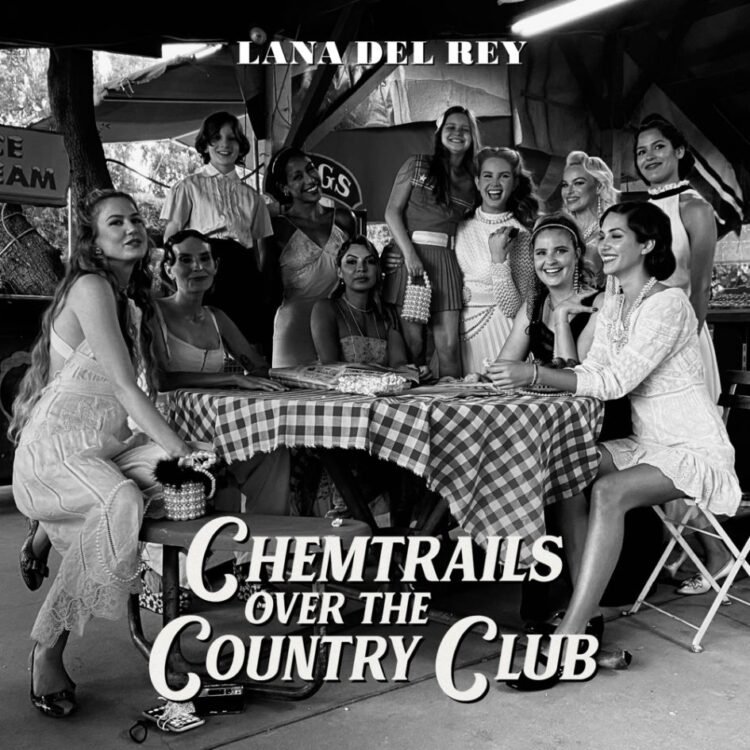
The song was released on 11 January 2021, the second single from Lana’s seventh studio album of the same name. It was written and produced with Jack Antonoff, who handled the arrangement in its entirety, playing 12-string acoustic guitar, bass, and drums himself; Bleachers bandmate Evan Smith added the only horn. The album itself was originally titled White Hot Forever, and had been planned for a September 2020 release before vinyl production delays caused by COVID pushed it to March 2021.
The delay mattered. By the time the song dropped, the world had been locked inside its own version of a country club bubble for the better part of a year. The timing sharpened everything.
Lana explained her choice of title track in a September 2020 interview with Interview magazine: the track mentions her “stunning girlfriends” and “beautiful siblings,” and captures “wanting so much to be normal and realising that when you have an overactive, eccentric mind, a record like Chemtrails is just what you’re going to get.” It’s a candid admission that the calm surfaces in the song are things she works toward, not things that come naturally.
The album, described as folk, country folk, and Americana, was shaped in part by sustained listening to Joni Mitchell and Joan Baez. Track 11 is a cover of Mitchell’s 1970 song “For Free.” The influence runs deeper than tribute. It’s in the restraint.
Antonoff described the process in an interview with The Tennessean: during the Norman Fucking Rockwell! sessions, he and Lana had written far more than one album’s worth of material. The quieter songs, the ones that didn’t fit the more grandiose NFR mode, became the bedrock of Chemtrails. The album wasn’t a departure so much as material that had been waiting for its own space.
Lyric Meaning: Breaking Down “Chemtrails Over the Country Club”
The Chorus
“I’m on the run with you, my sweet love / There’s nothing wrong contemplating God / Under the chemtrails over the country club”
The chorus sets the song’s central contradiction immediately. Running, but not from anything visible. Contemplating God, but in the most luxurious setting available. The line “there’s nothing wrong” is not reassurance. It’s what someone says when they’re convincing themselves. Lana’s delivery is calm enough to read as sincere, which makes it more unsettling.
The chemtrail conspiracy theory, which claims that contrails from aircraft are actually chemicals deliberately dispersed by governments, matters here not because Lana believes it, but because of what it represents: the threat you can see but can’t name, drifting over the prettiest address in town. It works because it does exactly what the song does: makes anxiety visible in a form you can dismiss.
Verse 1
“Take out your turquoise and all of your jewels / Go to the market, the kids’ swimming pools / Baby, what’s your sign? / My moon’s in Leo, my Cancer is sun”
The opening verse lists the accessories of a certain kind of life. Jewels worn casually. Trips to the Brentwood Market. Kids’ swimming pools. There’s a studied ordinariness to it, the way people who grew up craving normalcy describe it back to themselves.
The astrology lines require more attention than they usually get. She says “My moon’s in Leo, my Cancer is sun,” which is the opposite of how astrology is typically articulated. You would say “my sun is in Cancer, my moon is in Leo.” She inverts it, and the inversion isn’t accidental. In astrological terms, the sun sign represents the outer self, the identity you present to the world. The moon sign is the interior, the emotional core, the part that stays private. By putting her Cancer (associated with introspection, emotional depth, home) where the outward-facing sun sits, and her Leo (boldness, performance, radiance) in the hidden moon position, she’s describing someone whose inner life is louder than what they show, and whose public persona requires something the private self finds exhausting.
The later outro flips the phrasing again: “My Cancer is sun and my Leo is moon.” Both versions appear in the song. The point isn’t confusion. It’s that she can’t quite settle the order.
“I’m not unhinged or unhappy, I’m just wild”
This line is directed at critics, people who pathologise unconventional women. Drag racing isn’t a cry for help. Going to the market barefoot isn’t a breakdown. The defence shouldn’t need to be made, but she makes it anyway, which says something about the kind of scrutiny she’s been under since 2012.
Verse 2
“It’s beautiful how this deep normality settles down over me / I’m not bored or unhappy, I’m still so strange and wild”
This is where the song gets complicated. There’s genuine longing in “deep normality.” Not irony. She’s describing the feeling of ordinary life fitting like something she borrowed rather than something that belongs to her. The second assertion, “I’m still so strange and wild,” isn’t contradicting the first. Both things are true. She wants the picket fence and she cannot fully be contained by it.
The line “it’s beautiful how this deep normality settles down over me” is doing something precise: “settles down over” rather than “settles into.” Normality doesn’t become her. It descends on her. The preposition gives it away.
The Outro Chorus
“Washing my hair, doing the laundry / Late night TV, I want you on me”
These lines are easy to dismiss as domestic filler. They’re not. After several minutes of pools, jewels, and chemtrails overhead, Lana lands in the most ordinary possible place: hair washing, laundry, television. The erotic charge of “I want you on me” dropped into the middle of a chores list is deliberate. It’s the same move the whole song makes: something uncomfortable pushed into the most mundane available container. The uncanny doesn’t announce itself. It turns up between the laundry and the late-night TV.
“It’s never too late, baby, so don’t give up”
Repeated twice, this line carries a different weight depending on which reading of the song you hold. As straight comfort it’s warm and genuine. But the song has spent its entire runtime establishing that the speaker is someone who reassures herself out loud (“there’s nothing wrong”), so “it’s never too late” also reads as the kind of thing you say when you suspect it might be. The repetition doesn’t reinforce the reassurance. It exposes the work the reassurance is doing.
The Final Chorus Shift
“You’re in the wind, I’m in the water / Nobody’s son, nobody’s daughter / Watching the chemtrails over the country club”
“Nobody’s son, nobody’s daughter” is a declaration of non-belonging. Not orphan-tragic. Unowned. Outside the inheritance structure, outside the expectation. It’s also, in the context of the reading below, the one moment in the song where she identifies the condition required to see the system from outside it. She states it clearly. Then the chorus comes back in and she’s under the chemtrails again. The exit sign is visible. She doesn’t take it.
The imagery of wind and water, things that carry contamination, links back to the chemtrails. If the conspiracy theory were correct, you’d find the chemicals in both.
What “Chemtrails Over the Country Club” means, pulled to its core: comfort chosen over clarity, with full knowledge of the choice. Everything after that is detail.
The Music Video: Three Books at Once
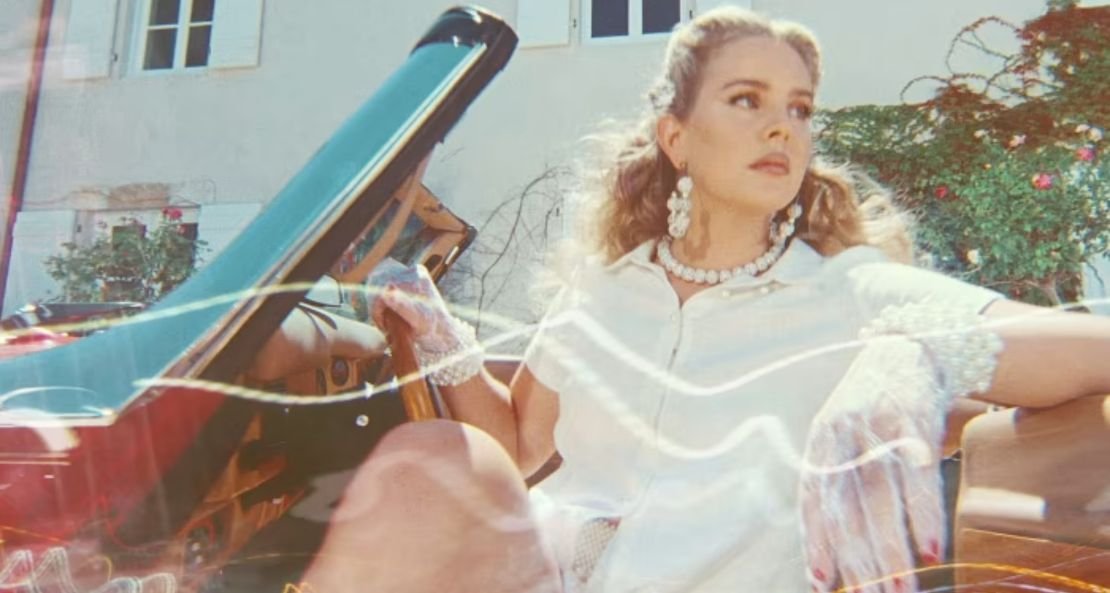
The lyrics do their work through implication. The music video does it through collision. Directed by Kyle Wrightman and Alex Lee (the duo BRTHR), it runs two visual registers in parallel before forcing them into each other. The first half is 1960s Americana: Lana in a diamanté mesh mask (the same one she wore to a COVID-era book signing, to public outcry) driving a replica 1930s Mercedes-Benz 500K convertible, meeting friends at the pool, wearing jewels in the sun.
The second half is something else entirely.
The video draws on three literary sources simultaneously, and understanding all three changes what the transformation sequence means.
Women Who Run With the Wolves (Clarissa Pinkola Estés, 1992) is the primary reference. Lana has spoken about the book’s influence publicly. Estés argues that women carry a “wild woman archetype,” a primal, instinctive nature that gets suppressed by domestication and social expectation. The werewolf transformation in the video is the re-emergence of exactly that. When Lana and her friends burn the car and run into the woods, they’re not becoming monsters. They’re becoming themselves. The domestic life, the car, the jewelry, the pool, was the costume. The wolves are what was underneath it the whole time.
The Great Gatsby runs through the visual language from the first frame. The red Mercedes recalls Gatsby’s car, the one Daisy uses to kill Myrtle. There’s a brief flash early in the video of Lana dead on the floor, blood at her head, never explained, never returned to: the same unsettling disposability as Myrtle, there and then gone. The high-society women shopping barefoot is the kind of class transgression Fitzgerald catalogued obsessively: the new rich performing the wrong version of wealth, wearing real jewels in the swimming pool, going to the grocery store like ordinary people do. Lana has a song called “Old Money.” She did the soundtrack for Baz Luhrmann’s Gatsby adaptation. The reference system here is deliberate and layered. The video is asking what Fitzgerald asked: what does it cost to maintain the performance, and who pays when it collapses?
The Wizard of Oz supplies the structural hinge, and it earns more unpacking than it usually gets. The tornado, triggered by Lana biting into a lemon, a small act of bitterness that unravels everything, doesn’t transport her to a fantasy world where she doesn’t belong. It drops her into the version of herself she already was. Her friends from the society sequences reappear in the forest, now as wolves: the same people, stripped of their country club context. Unlike Dorothy, Lana doesn’t spend the wild sequence trying to get home. She burns the car. She dances. She stays. When she does return, showering in her jewelry, getting into the white bed, the film refuses to confirm whether the forest sequence was real or dreamed. Oz resolved its ambiguity with a reassuring “it was all a dream.” This video leaves both possibilities open, which is the more honest ending. The implication is that the wildness and the domesticity are equally real, equally hers, running in parallel rather than one cancelling the other out.
The video has accumulated over 57 million views on YouTube as of March 2026.
What Antonoff Built
The production on “Chemtrails Over the Country Club” is worth reading as deliberately anti-spectacular. Antonoff stripped the arrangement to its minimum: piano, acoustic guitar, barely-there percussion. The drums don’t arrive fully until late, and when the song ends, they continue alone. A drums-only outro that connects directly to the closing of “The Greatest” from Norman Fucking Rockwell! That track signed off on the culture going to hell. This one echoes it: something winding down without resolution, the beat continuing after everything else has gone quiet.
The blankness of the arrangement sits in studied contrast to the imagery it’s describing. Pool parties and drag races and existential unease, delivered at the pace of someone half-asleep in the sun. That gap is where the tension lives.
The Critical Divide
The song received scores of 0 to 8 out of 10 from the same publication (The Singles Jukebox), which tells you most of what you need to know about where it sits critically.
The strongest objection is that the song is complacent. That pointing at the connection between wealth, white American suburbia, and quiet apocalypse, then settling back into the sun-lounger, is the problem rather than the analysis. One critic noted that the song’s “glamorous ennui” had been genuinely affecting in Lana’s earlier work because it maintained lyrical distance from what it was romanticising. Here, the distance is gone. She appears to mean it.
The strongest defence is that she does mean it, and that’s precisely the point. “Chemtrails Over the Country Club” isn’t critique issued from a safe distance.
It’s written from inside the bubble, by someone who finds the bubble genuinely appealing and has stopped pretending otherwise. That’s a more interesting and more honest position than ironic detachment, which is the mode her critics seem to want from her.
The “complacency” charge assumes the song is trying and failing to be a protest. It isn’t. What Del Rey is doing is closer to what the title does grammatically: the phrase doesn’t only mean “chemtrails that hover above the country club.” It can also be read as “I am so over the country club,” done with it, past it, watching from a remove. Both readings coexist in the same four words. A song that held one position cleanly wouldn’t need that ambiguity.
Rolling Stone’s framing of her as “pop’s premier Cassandra” captures this better than the complacency critique does. Cassandra doesn’t refuse to warn people because she’s comfortable. She warns them from inside Troy. The point is that she’s still there.
If You Push the Idea Further
The most revealing way to hear ‘Chemtrails Over the Country Club’ is to take the chorus completely literally. There’s nothing wrong. She means it. And that’s exactly the problem.
What Baudrillard called the simulacrum describes this precisely: the copy that has replaced the original so completely that the original no longer exists as a reference point.
The country club in this song is not a real place. It’s an image of an image. The American suburban dream that Lana is romanticising never existed as cleanly as she renders it: no era of white picket fences and kids’ swimming pools was ever as innocent as its own mythology claimed.
What she’s longing for is a simulation of a past, which means the longing itself is for something that was always already fake.
Now consider the chemtrails. The chemtrail conspiracy theory is itself a simulacrum of danger. It looks like a threat and carries all the emotional texture of one. But it’s a copy of danger rather than danger itself.
Actual environmental contamination, pesticides, industrial runoff, pharmaceutical waste in the water supply, is real, documented, and largely invisible in daily life. The chemtrails are the version of that threat that is visible, spectacular, and ultimately deniable. A fake threat standing in for real ones.
What Del Rey has built is a song where a simulated paradise is threatened by a simulated danger. The two are perfectly matched. She can only perceive the threat that operates at the same level of reality as her own existence. The actual dangers, the ones that don’t resolve into a clean overhead image, the ones that would require dismantling the country club to address, are precisely what the country club protects her from seeing.
This is why the song doesn’t feel like critique and doesn’t feel like celebration, but instead produces a feeling you can’t place until you realise you’ve been warned about nothing real while standing next to something that is. It’s a portrait of someone genuinely safe from the dangers she’s aware of, and genuinely unaware of the dangers she’s not. The tragedy isn’t hypocrisy. It’s structural.
Where It Sits in Her Discography
The song connects backward and forward. “The Greatest” from Norman Fucking Rockwell! signs off on culture going to hell while she pours another drink. “Chemtrails Over the Country Club” picks up two years later: culture has continued going to hell, she’s now at the pool, and there is nothing wrong contemplating God.
The “candle in the wind” motif, used twice across the album, borrows from Elton John’s memorial to Marilyn Monroe: a song about a woman destroyed by fame and public expectation. Lana rejects the comparison both times. She will not be defined by fragility or early tragedy, by the doomed glamour that consumed the women she’s been compared to since the start of her career. The country club existence, comfortable, watched-over, slightly ridiculous, is at least survivable.
“Chemtrails Over the Country Club” is not a song about being happy. It’s a song about choosing the life that doesn’t kill you. The exit sign is there. She goes back to the pool. There’s nothing wrong contemplating God.
For more on where this fits in her catalogue, read our analysis of Say Yes to Heaven and A&W. Both songs pull at the same thread: the gap between the life Lana performs and the one she actually wants.