
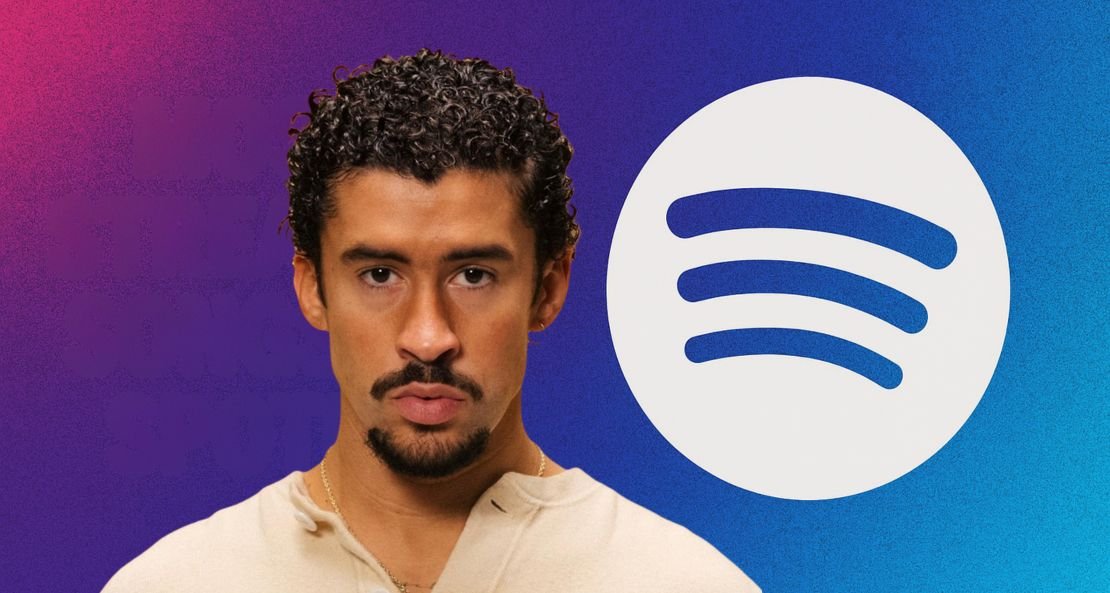
Bad Bunny just made history again, and most artists are looking at the wrong numbers.
Spotify’s annual ritual dropped this morning, and whilst everyone’s busy sharing their personalised slideshows on Instagram Stories, the real story sits in what these numbers reveal about how music actually works right now.
Bad Bunny claimed his fourth global crown with over 19.8 billion streams, which sounds massive until you realise what that actually represents: consistency over spectacle, catalogue depth over viral moments, and a fanbase that treats his discography like a library rather than a playlist.
Taylor Swift landed second globally but first in the US, which tells you more about streaming geography than it does about either artist’s reach.
The split matters because it exposes the fundamental difference between building a global brand and dominating a territory. Both strategies work. Neither is inherently better. But if you’re an artist trying to figure out where to focus your limited budget, this distinction could save you thousands in wasted ad spend.
Here’s what caught my attention: “Un Verano Sin Ti” from 2022 still sits at number 10 globally. That’s a three-year-old album outperforming almost everything released this year.
Most artists obsess over their first week numbers like they mean something. Bad Bunny’s catalogue momentum suggests they don’t.
The global songs chart crowned Lady Gaga and Bruno Mars’ “Die With a Smile” at number one, followed by Billie Eilish’s “BIRDS OF A FEATHER” and Rosé’s “APT.” with Bruno Mars again.
Alex Warren landed at number four with “Ordinary,” and if you don’t know who that is, that’s precisely the point. Independent artists can compete at this level now. The machinery still helps, but it’s no longer mandatory.
Kendrick Lamar’s “luther” featuring SZA topped the US songs chart whilst Morgan Wallen’s “I’m the Problem” took the album crown domestically.
The genre split between these charts is loud if you’re listening: hip-hop and pop dominate globally, country owns specific territories, and Latin music sits comfortably in both worlds.
You might also like:
- How Livestreaming Became Hip-Hop’s Secret Weapon in 2025
- What Streaming, TikTok and Playlists Tell Us About 2025’s Most-Streamed Songs
- Latin Music’s Streaming Boom And The Bad Bunny Debate: A New Era Of American Culture
- Spotify Chart Watch: December 2025 Movements
- Inside the Rise of Esports: From £1M CS2 Tournaments to Mainstream Media
- When AI Took the Top Spot: How Slop Songs Are Disrupting the Charts
Understanding where your sound fits determines whether you’re chasing the right audience or wasting time on the wrong continent.
The KPop Demon Hunters soundtrack at number two globally demonstrates something film and TV people have known for years but most musicians ignore: placements create catalogue assets that stream for years.
Billie Eilish’s “Hit Me Hard and Soft,” SZA’s “SOS Deluxe: Lana,” and Sabrina Carpenter’s “Short n’ Sweet” rounded out the global top five albums. What connects them isn’t genre. It’s cohesion. These aren’t collections of singles hoping one sticks. They’re bodies of work that reward start-to-finish listening.
Wrapped added features this year that actually matter to artists beyond the novelty. Listening Age compares users’ taste to their age group, which sounds trivial until you realise it’s demographic data you’d normally pay for.
Fan Leaderboard shows where your most obsessive listeners rank, giving you a clear target list for exclusive content or direct outreach. Clubs sorts listeners into six distinct types, which is basically free audience segmentation.
The Wrapped Party feature lets users host competitions comparing stats with friends. That’s your music becoming social currency without you lifting a finger.
Listening Archive shows users their most memorable streaming days. Top Albums gets more visibility this year, which benefits artists who still believe in album craft over singles spam.
Over 18,000 artists uploaded Wrapped Clips last year, reaching hundreds of millions of listeners. The deadline was 21st November, which means if you’re reading this now, you’ve already missed it.
Calendar it for next year because the conversion rate on superfans is absurd during this window. When someone discovers they’re in your top 1% of listeners, a 30-second thank-you video turns them into the kind of advocate who bullies their friends into streaming your music.
The clips had to be vertical, under 30 seconds, and couldn’t include music, explicit content, logos, text, or filters. Those restrictions aren’t arbitrary. They force authenticity, which is exactly what connects during Wrapped season when everyone’s drowning in data visualisations.
What makes Bad Bunny’s dominance interesting isn’t the number. It’s the strategy underneath. Two albums in the global top 10, three years apart, means he built something that compounds rather than peaks and crashes. Most artists treat releases like lottery tickets. Bad Bunny treats them like property investments.
The presence of Arijit Singh and Fuerza Regida in the global top 10 alongside Kendrick Lamar, Bruno Mars, and Ariana Grande should tell you something about where streaming is heading.
Language barriers collapsed years ago, but most Western artists still act like English is a prerequisite for success. It’s not. Quality translates. Authenticity travels. The algorithm doesn’t care what language you’re singing in if people keep pressing play.
Joe Rogan topped the podcast charts globally and domestically, which is about as surprising as water being wet. Rebecca Yarros’ “Fourth Wing” led audiobooks, a newly added category that signals Spotify’s ambitions beyond music.
For artists, that expansion means more competition for ear time. Your new single isn’t just fighting other new singles. It’s fighting true crime podcasts and fantasy novels.
Taylor Swift led the US with Drake, Morgan Wallen, Kendrick Lamar, and Bad Bunny following. Globally, The Weeknd and Billie Eilish ranked higher.
That geographical split isn’t trivia. It’s a roadmap. If your music skews country, focus domestic. If it’s pop or urban, think global distribution from day one. If it’s Latin, you’ve got the rare advantage of both.
Morgan Wallen dominated US charts whilst barely registering globally, which proves genre-specific regional appeal still works if you own it completely. There’s no shame in being massive in one territory. There’s quite a lot of money in it, actually. The mistake is trying to force global appeal when your sound naturally connects with a specific region.
Apple Music released Replay on Tuesday, beating Spotify to the punch. YouTube Music dropped its Recap last week.
The timing creates a concentrated window where music streaming dominates social media, which means artists who prepare content around multiple platforms multiply their visibility without multiplying their effort.
Film the same thank-you video three times with slightly different framing and you’ve covered all three platforms’ year-end features.
Last year, Spotify caught heat for replacing personal insights with AI features nobody asked for. This year, they acknowledged the mistakes and rebuilt accordingly.
That responsiveness matters because it demonstrates that platforms actually listen when enough people complain. Artists who provide clear feedback about what works and what doesn’t shape these features more than they realise.
There’s no single path to streaming success, which is both liberating and terrifying depending on your temperament.
Bad Bunny’s approach centres on cultural authenticity and album-focused releases that create lasting value. Taylor Swift combines consistent output with strategic re-releases that keep decades-old material relevant.
Billie Eilish builds through album craft and genuine fan connection rather than chasing playlist placements.
Alex Warren sitting in the global top five songs demonstrates that independent artists who connect emotionally can compete with major label infrastructure.
The streaming economy rewards resonance over resources, though pretending resources don’t help is naive.
The advantage independent artists have now is that you can test resonance before investing heavily in promotion. Release, watch the data, double down on what works.
Wrapped generates enormous organic social reach because users create content around their stats without prompting.
For artists, this social proof matters more than paid advertising. When thousands of fans share screenshots showing you as their top artist, it creates network effects that drive discovery better than any algorithm placement.
Users in an artist’s top 1% could access special video messages and sometimes purchase exclusive merchandise in previous years.
The superfan economy represents music’s future, where 100 people paying £100 generates more stable income than 10,000 people paying nothing. Developing direct relationships with your most engaged fans creates stability in an industry that otherwise feels chaotic.
Spotify recommends users update their app before Wrapped launches to avoid technical issues. Artists should treat their Spotify for Artists profiles with the same care, ensuring everything reflects current information, showcases recent releases prominently, and includes proper metadata.
It sounds basic because it is basic, but you’d be surprised how many artists ignore fundamentals whilst obsessing over growth hacks.
Wrapped counts streams from January through October, with the exact cutoff varying slightly each year. This 10-month window means November and December releases won’t impact current year results but position you for next year. Knowing this, you can time releases strategically rather than randomly hoping for the best.
Think about your 2026 Wrapped Clip now, not in November when the deadline approaches. What milestone will you celebrate? What story connects with fans emotionally rather than just listing accomplishments? Which song represents your year? These decisions separate memorable clips from forgettable ones.
Consider what encourages repeated listening throughout the year. Deep cuts that reward multiple plays perform better than obvious singles sometimes.
Lyrical complexity that reveals itself over time keeps people coming back. Production choices that hold up to scrutiny matter more in the streaming era than they did when people bought albums based on two singles and a magazine review.
Wrapped demonstrates how fundamentally music consumption has changed. The era of front-loaded first-week sales died. Sustained catalogue performance over months and years replaced it. Artists who understand this shift and build accordingly position themselves for careers rather than moments.
Platform transparency around listening data provides information that would have been inaccessible in previous decades.
Knowing exactly who listens, where they’re located, and how often they engage allows for strategic decisions that maximise limited resources. Previous generations worked blind. You don’t have that excuse.
Bad Bunny’s global dominance, Lady Gaga and Bruno Mars’ collaboration success, and Alex Warren’s independent breakthrough point towards different viable paths.
What matters is finding your lane, serving your audience better than anyone else could, and treating this as a marathon rather than a sprint. Wrapped provides a yearly checkpoint to measure progress, celebrate wins, and recalibrate strategy.
The numbers tell stories if you’re willing to listen. They reveal what connects across cultures, languages, and demographics. They show which strategies compound and which burn bright then fade.
They expose the difference between lucky virality and sustainable careers. Use them wisely, or keep wondering why nothing sticks.
🔍 NeonSignal: Streaming Success Reframed
Signal: Catalogue Consistency Beats First-Week Peaks
Status: Accelerating
Timeframe: Next 3–6 months
Why this matters:
Spotify Wrapped 2025 underscored that artists who sustain engagement throughout the year – not just at release – dominate listener attention and cultural relevance, signalling that long-term relationship building matters more than momentary hype.
What happens next:
Future release strategies will emphasise year-long engagement tactics – playlist placement, narrative storytelling, audience connection – rather than focusing solely on first-week metrics.