
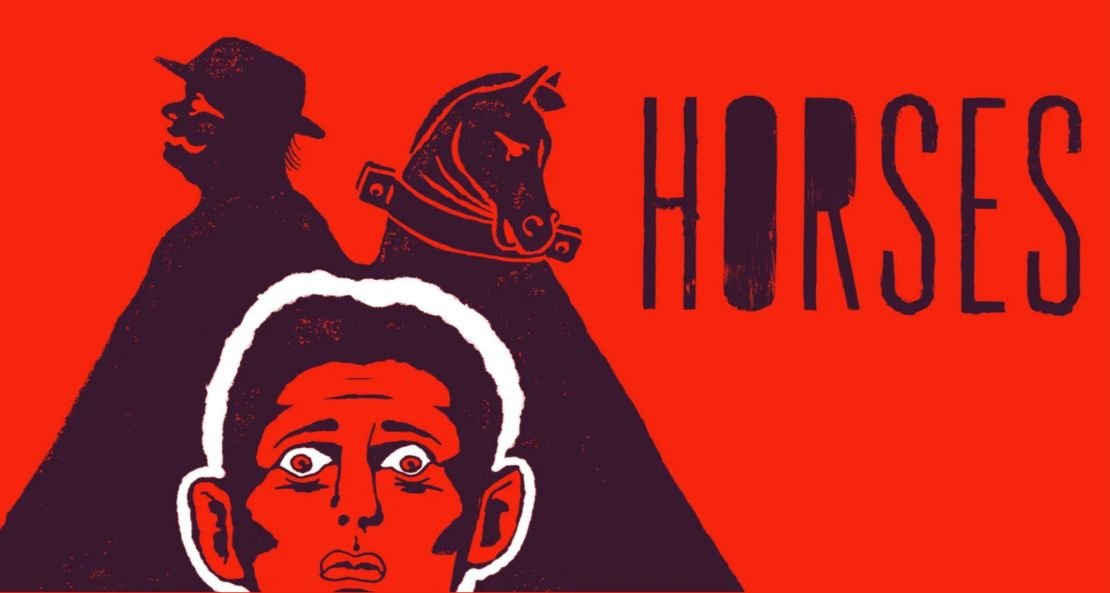
Picture a farm where the horses aren’t horses at all. They’re naked humans, masked and collared, treated as livestock. They pull ploughs on their shoulders, race for spectators, feed on hay and water.
You play a young man sent to work this farm for two weeks, gradually discovering that every task demands complicity in something grotesque. The game asks you to participate, to choose, to become part of the horror.
This is Horses, the debut game from Italian developer Santa Ragione and creator Andrea Lucco Borlera. It’s surreal, uncomfortable, and deliberately confronting. It’s also a game that [three of the world’s largest digital storefronts have refused to sell.
The question at the heart of this controversy cuts deeper than content policies or age ratings: who decides which art deserves to reach audiences, and on what grounds can they deny it?
A Vision Born from Discomfort
Borlera conceived *Horses* during his time as a film student at Roma Tre University. The project draws inspiration from surrealist filmmakers Luis Buñuel and Jan Švankmajer, alongside the provocative work of Yorgos Lanthimos.
Borlera has spoken about childhood memories of his grandfather’s farm, where horses and their handlers frightened him. That early discomfort became the seed for something darker.
The game blends live-action sequences with 3D animation, presented in stark black and white. Silent film-style title cards deliver dialogue. The aesthetic deliberately unsettles.
Players see close-ups of mouths enunciating monologues through vile grins, spliced with footage of vegetables being watered. The constant whirring of film grain taunts you throughout.
Over three hours, you complete tasks that grow increasingly disturbing. You feed the “horses.” You search for ones that have escaped. You witness interactions that illuminate a power structure built on exploitation and dehumanisation.
The game’s protagonist, Anselmo, befriends one of the enslaved humans and eventually participates in their liberation, but not before the narrative forces you to reckon with your own complicity.
Santa Ragione invested approximately $100,000 in development, half raised from friends. The studio hoped to recoup costs through sales on Steam, the platform that commands an overwhelming share of PC gaming distribution. That plan collapsed in June 2023.
The Ban That Kept on Banning
Steam rejected Horses just days before Santa Ragione planned to announce the game. The automated review stated: “Regardless of a developer’s intentions with their product, we will not distribute content that appears, in our judgment, to depict sexual conduct involving a minor.”
The message continued with a definitive closure: “This app has been banned and cannot be reused. Re-submissions of this app, even with modifications, will not be accepted.”
Santa Ragione maintains the accusation misrepresents the game. All characters are clearly older than 20. The developers suspect the ban originated from an incomplete scene in an early build, where a young girl rides on the shoulders of one of the “horses” during a farm visit.
The scene contained no nudity or sexual content, but the juxtaposition of child and masked, naked adult appears to have triggered the rejection.
Santa Ragione revised the scene months before release, replacing the child with an adult woman, but Steam refused to reconsider.
For two years, the studio requested clarification. Steam redirected them to general guidelines about “content that is patently offensive or intended to shock or disgust viewers.” No specific scenes were identified. No path to compliance was offered. The door remained shut.
Then came November 2024. GOG, the DRM-free storefront, announced it would distribute Horses. The game garnered positive preview coverage from outlets including The Guardian, Rock Paper Shotgun, and IGN. Anticipation built.
On December 1, 2024, one day before the scheduled launch, Epic Games Store informed Santa Ragione that it too was banning the game. Epic cited violations of policies on “inappropriate content” and “hateful or abusive content.”
The company claimed an International Age Rating Coalition questionnaire resulted in an Adults Only rating, despite Santa Ragione having already completed that questionnaire weeks earlier and received PEGI 18 and ESRB M ratings.
Epic offered no specifics about what needed changing. The studio filed an appeal. Twelve hours later, Epic rejected it without further explanation.
Hours later, Humble Store also removed Horses from sale, offering no explanation despite having previously assured Santa Ragione it would continue distribution after Epic’s ban. Three major platforms. Three rejections. One game, completed and ready to ship.
What the Platforms Say (and Don’t Say)
Epic Games communications director Jake Jones provided a statement to PC Gamer: “We set clear guidelines for the content that can be distributed on the Epic Games Store and found violations of those guidelines during our extensive review.”
The statement says everything and nothing. What violations? Which guidelines? Epic had already approved multiple builds of the game, including the final version 18 days before launch.
The company even filled out an age rating questionnaire on behalf of the developers, contradicting their earlier ratings, yet provided no explanation for why it conducted this secondary review or how it arrived at different conclusions.
Steam’s position remains similarly opaque. The platform distributes numerous explicit pornographic games, some acknowledging legal grey areas by stating “All characters depicted are over the age of 18” in their descriptions.
Yet Horses, which contains no pornography and censors all nudity through pixelation, receives a permanent ban with no avenue for appeal.
Santa Ragione points out that mature works with comparable or stronger themes routinely appear on Netflix and Amazon Prime Video. Controversial directors remain an accepted part of streaming catalogues.
Film operates under a different framework, one that treats provocative art as legitimate even when uncomfortable. Games, apparently, do not receive the same consideration.
The Financial Stranglehold
The bans don’t simply hurt Santa Ragione’s reputation. They threaten the studio’s survival. Without access to Steam, the studio couldn’t secure external publishers to fund completion of Horses.
No one in the industry considers an indie game viable if it can’t reach Steam’s massive user base. Santa Ragione resorted to private funding from friends, creating what the studio describes as “a completely unsustainable financial situation.”
The studio also encountered Steam’s opaque key distribution policies. Santa Ragione’s previous game, Saturnalia, was a timed exclusive on Epic Games Store because Epic partially funded development.
After the exclusivity period ended and the game launched on Steam, the studio requested keys to include Saturnalia in bundles. Steam refused, citing undisclosed sales thresholds. Without bundle opportunities, Santa Ragione couldn’t generate revenue to support Horses.
This creates a brutal cycle. Developers need Steam to survive. Steam’s policies lack transparency. Developers who fall foul of those policies have no recourse and no clear path forward. One rejection cascades into financial catastrophe.
Similar dynamics play out across digital content distribution, where platform gatekeepers control access to audiences and creators struggle to find alternative routes.
The situation mirrors broader shifts in how independent creators navigate platform power. In music, independent artists increasingly bypass traditional gatekeepers, building audiences through alternative channels.
But gaming’s infrastructure remains more centralised, making platform bans potentially fatal for small studios.
The Underground Thrives
Despite three major platform bans, Horses launched on December 2, 2024, via GOG and itch.io. Within days, it became the best-selling game on both platforms.
GOG released a statement: “We’re proud to give HORSES a home on GOG, giving players another way to enjoy the game. We’ve always believed that players should be able to choose the experiences that speak to them.”
The Streisand effect took hold. Coverage of the bans generated more attention than traditional marketing could have achieved.
In an era where viral moments can transform cultural visibility overnight, players who might never have heard of Horses sought it out specifically because major platforms deemed it unacceptable.
Early reviews acknowledge the game’s challenging content while praising its artistic ambition. IGN’s review described it as “a chilling, nerve-shredding short story” with “admirably bracing vision.” Edge magazine highlighted how the game’s aesthetic choices enhance its “disquieting mood.”
This mirrors patterns in other media. When mainstream distributors reject transgressive art, underground channels preserve and amplify it. Cult films, banned books, controversial albums all found audiences through alternative distribution.
The digital age makes this even easier. DRM-free platforms, direct downloads, and community support can sustain creators even when corporations say no.
The phenomenon parallels how hip-hop artists now build audiences on streaming platforms outside traditional industry structures. When conventional gatekeepers close doors, creative communities find windows.
But sustainability remains precarious. Horses succeeded partly because of publicity around the controversy. Most banned games don’t receive that attention. They simply disappear.
Horror as Mirror
The best horror forces confrontation with uncomfortable truths. It doesn’t exist to comfort viewers but to unsettle them, to make them question systems of power, exploitation, and complicity.
Horses uses its disturbing imagery to explore themes of slavery, psychological abuse, and societal structures that normalise violence. The player’s discomfort serves a purpose.
Each task you complete as Anselmo demands you reckon with your own complicity in the farmer’s sick fantasy. The game asks: at what point do you stop following orders? When does participation become endorsement?
These questions matter. Art that makes us uncomfortable can spark dialogue about real-world atrocities. Sanitising art by removing anything that disturbs removes art’s ability to challenge us.
Contemporary horror cinema continues pushing boundaries, with indie filmmakers creating experimental narratives that confront taboo subjects.
Films like I Saw the TV Glow and Late Night with the Devil demonstrate how horror can address identity, trauma, and societal decay through disturbing imagery. These works exist in mainstream distribution channels. Games with similar ambitions face different obstacles.
Platform gatekeepers now possess extraordinary power to shape which conversations happen. Their decisions, made behind closed doors with vague justifications, determine which artistic visions reach audiences and which vanish into obscurity. This power operates without transparency, without clear standards, without accountability.
When David Lynch created Lost Highway, when Lars von Trier made The House That Jack Built, when Gaspar Noé filmed Irréversible, mainstream distributors grappled with the content but ultimately recognised these works as legitimate artistic expressions. Film critics debated them. Audiences chose whether to engage with them. The works existed in cultural conversation.
Video games increasingly face different treatment. Despite decades of maturation as an artistic medium, despite countless examples of thoughtful, challenging work, games still get filtered through policies designed primarily for commercial entertainment products.
The Questions That Remain
Horses exists. You can play it, if you choose to seek it out on alternative platforms. But the controversy surrounding it reveals fractures in how we approach interactive art in 2025.
Should platforms that function as near-monopolies in their markets possess unchecked authority to determine acceptable artistic expression? Do video games deserve the same protections and considerations as other art forms?
What responsibility do gatekeepers have to transparent processes and clear standards? When does content moderation become censorship?
These aren’t abstract questions. They have real consequences for developers who risk everything to create challenging work, for players who want access to the full spectrum of artistic expression, and for the medium itself as it continues to mature.
The debate extends beyond gaming. Questions about authenticity and platform control pervade creative industries in 2025, from AI-generated music flooding streaming services to algorithmic curation determining which art reaches audiences.
The Horses controversy represents one front in a broader cultural battle about who controls creative expression and on what terms.
Santa Ragione set out to create something that would stick with players whether they wanted it to or not. They succeeded. But they also stumbled into a larger battle about creative freedom, platform power, and who gets to decide which art we’re allowed to experience.
The game industry loves to proclaim that games are art. Perhaps it’s time the industry’s most powerful gatekeepers started treating them that way.
You might also like:
- AI Songs Top Charts: Breaking Rust & the Rise of AI Slop
- The Most Anticipated and Must-Watch Horror Movies of 2024
- Livestream Culture: How Hip-Hop Conquered Twitch & Kick
- The 2024 Music Industry Trends Guide: What’s Really Changing and Why You Should Care
- Alan We Are So Fucked Meme Explained | TikTok Trend 2025
- Asura Scans: Risks, Safety, and What to Read Instead