

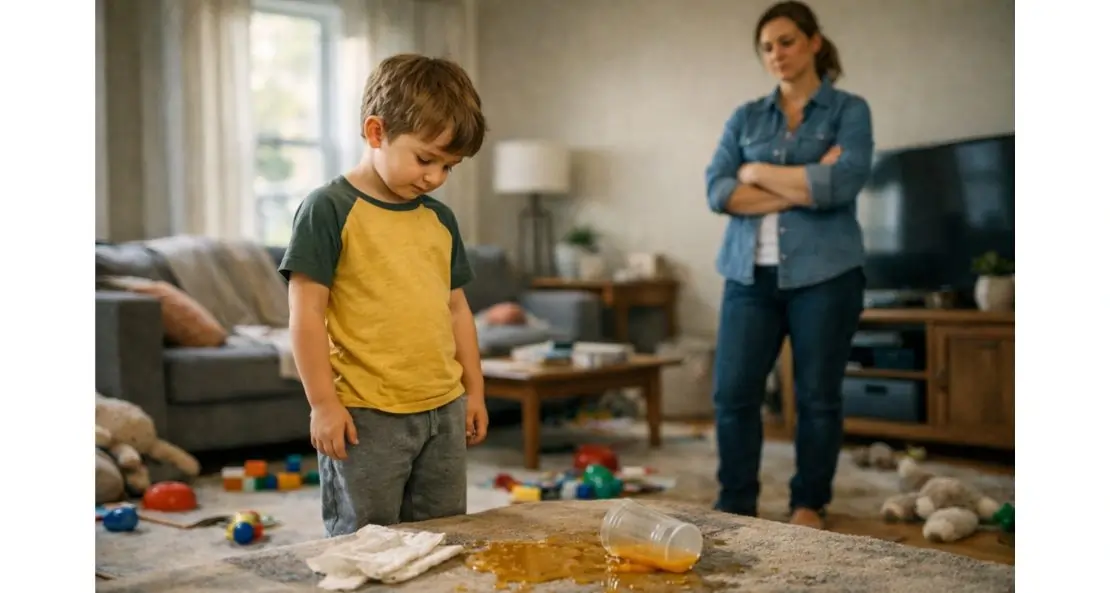
FAFO parenting (short for “F* Around and Find Out”) is the idea that children learn better from natural consequences than from lectures, arguments, or parental rescue missions. It is a direct reaction to gentle parenting. And it went mainstream the moment Kylie Kelce said the words on a podcast.**
In February 2025, Kylie Kelce, wife of former NFL star Jason Kelce and soon-to-be sister-in-law of the most famous woman on the planet, was talking on her podcast about her three-year-old daughter Elliotte, who wanted to go outside in single-digit temperatures with no jacket. Kelce had tried the gentle parenting approach. She had reasoned, explained, validated the feelings. The toddler did not care. So Kelce shrugged, let Elliotte go outside, and let the cold do the talking.
She popularised FAFO parenting via her podcast.
By late 2025, the term was everywhere: parenting subreddits, TikTok comment sections, then suddenly it was in Guardian lifestyle pieces, morning TV panels with people interrupting each other about whether it was revolutionary or just neglect with branding. The Wall Street Journal covered it. Psychology Today covered it. Calm, the meditation app, ran a nine-tip explainer on how to implement it with your toddler. The meme had graduated into a movement.
What those pieces don’t quite say out loud: FAFO parenting is not new. It is not radical. It is the thing your parents did, your grandparents did, and every generation before them did, dressed up in internet slang so that exhausted millennials could feel like they were making a choice rather than admitting they were running out of steam.
That might be the only part of it worth paying attention to.
What FAFO Parenting Actually Means
FAFO stands for “F*** Around and Find Out,” a phrase with roots in African American Vernacular English that spent years as internet meme currency before someone stuck it on a parenting style. In practice it is simple: you warn them once, then step back and let the consequence land. Refused the raincoat? Walk home wet. Left the bike in the rain? Find it rusted. Didn’t do the homework? Explain yourself to the teacher.
No lectures. No second warnings. No dramatic confiscation of privileges that you then have to enforce for a week and secretly regret on Saturday. Just reality, doing what reality does.
The phrase got picked up on TikTok, refined through parenting subreddits, amplified by Kelce’s podcast moment, and repackaged by influencers who built entire content identities around it. What began as AAVE slang moved through meme culture into mainstream parenting discourse in the space of about eighteen months. That pipeline, street language to internet joke to lifestyle content to broadsheet trend piece, is now so well-worn it practically runs on autopilot.
Why Gentle Parenting Broke Down
To understand why FAFO took off, you have to understand what it was reacting to.
Gentle parenting, which peaked as a cultural force somewhere around 2020 to 2023, asked parents to lead every interaction with empathy, validate all feelings before addressing any behaviour, and explain their reasoning to children at every turn. The theory was sound: emotional attunement builds secure attachment, and secure attachment produces children who trust adults and regulate themselves. Most of the research backed it up.
Living it was exhausting.
Parents found themselves crouched at eye level with a screaming four-year-old, voice low and steady, narrating feelings: “I can see you’re frustrated that we have to leave the playground. That makes complete sense. Can you tell me more about what you’re feeling right now?” while the four-year-old screamed louder, the parking meter ran out, and the parent’s own cortisol levels hit historic highs.
Gentle parenting, as it spread through Instagram and mum influencer accounts, had a particular problem: it was demonstrated by people who were very calm, very patient, and almost certainly filming their second or third take. The curated version made every deviation from patience feel like a moral failure. Parents weren’t just tired. They were tired and ashamed of being tired.
FAFO parenting gave them permission to stop. The child doesn’t want to eat dinner? Fine. Be hungry. That’s not cruelty. That’s Tuesday.
The Psychology Behind It (Which Has Been There All Along)
Child psychologists largely support the core idea, with caveats that every mainstream article lists and nobody actually reads past.
Psychologists have a name for it: natural consequences. It has been a documented learning tool in developmental psychology for decades. When a consequence is immediate and clearly tied to what the child just did, it lands differently than a punishment imposed from above. The child understands why it happened. They connect the action to the outcome without needing an intermediary to explain the link.
Dr. Sheryl Ziegler, a child psychologist, puts it this way: what FAFO is actually describing, at its best, is authoritative parenting. Not authoritarian. Not permissive. Authoritative: high expectations, firm boundaries, genuine warmth. The approach that decades of research consistently shows produces the best outcomes. FAFO didn’t invent it. FAFO put a meme-able acronym on it, which is a different kind of achievement.
The caveats are real. Toddlers and preschoolers lack the cognitive wiring to reliably connect actions with outcomes. Their prefrontal cortex, the part responsible for cause-and-effect reasoning, is still years from maturity. Getting cold on the way to school is a good lesson. Getting burned because nobody intervened is not a lesson; it’s a failure. The line between those two things requires judgement, not a philosophy.
Without warmth after the consequence lands, without the parent who let the child get soaked then comes in with dry clothes and no speech, what FAFO produces is not resilience. Psychologists are consistent on this: children who feel unsupported after failure build shame, not capability. Shame shuts kids down. It does not toughen them up.
Kylie Kelce, TikTok, and How a Parenting Style Goes Viral
Most parenting trends have an identifiable moment when they cross from niche to mainstream. FAFO’s was Kylie Kelce. The podcast clip circulated, people recognised themselves in it, and influencers who had already been doing this, calling it authoritative parenting, or old-school parenting, or just parenting, suddenly had a name for it and a content hook to build around.
This is how parenting advice moves now. Not through books, not through paediatricians, but through podcast moments clipped for TikTok, shared to Instagram Reels, covered by lifestyle blogs, then picked up by newspapers looking for a trend piece. The cycle moves fast, and most of the nuance gets lost somewhere along the way. What started as a woman making a pragmatic call about a toddler’s jacket in winter became a parenting identity, a hashtag, a brand, a source of hot takes about whether you’re raising a resilient adult or a traumatised one.
Parenting has always attracted strong opinions. Social media turned those opinions into performance. FAFO parenting, as it exists online, is not really about how you raise your children. It is about which kind of parent you signal yourself to be. That distinction matters more than most of the articles covering the trend are willing to say.
Gen X Had Been Doing This Quietly the Whole Time
The people most vocal about FAFO parenting online are Gen X parents in their forties and fifties, and they are not shy about pointing out that this is just their childhood.
They grew up with house keys at five, summer afternoons on the street until the streetlights came on, dinner instructions left on the fridge. They heated their own food, navigated their own arguments, walked to school in weather that would now prompt a safeguarding referral. The natural consequence of missing the bus was walking. The natural consequence of forgetting your PE kit was doing PE in your pants in front of your class. Nobody rang ahead to warn the teacher.
That experience is not uniformly positive and nobody should pretend it is. Some of what gets nostalgically labelled “independence” was benign neglect. Some children who “learned resilience” this way learned, more precisely, that adults could not be counted on, which is not the same thing and has different long-term effects.
But the Gen X observation holds in one important sense: the thing FAFO is describing is older than the internet, older than millennial parenting discourse, older than gentle parenting, older than the concept of a parenting style at all. It is the baseline gentle parenting consciously moved away from. FAFO is the pendulum swinging back. It always does.
The Political Undertow
Several commentators have noted, and the KTLA5 morning show segment confirmed it with cheerful bluntness, that FAFO parenting carries a political tinge. Tough love as a parenting philosophy skews toward conservative and traditionalist audiences. The gentle parenting wave was associated, fairly or not, with progressive, educated, predominantly millennial parents.
FAFO’s language, meme-native, irreverent, allergic to the vocabulary of emotional processing, sits more comfortably in certain political registers than others. That doesn’t make it right or wrong. It makes it legible as a cultural object, which is worth understanding. Parenting trends are never just about children. They are about adult anxieties, identity, and what people want to signal about how they see the world.
The morning TV panellist who said FAFO is “more popular among MAGA” was being glib, but she was pointing at something real. How you raise your children has become another domain where political identity gets performed. The fact that a parenting acronym can generate that kind of hot take tells you something about where the culture currently is.
What FAFO Actually Gets Right (And What It Quietly Ignores)
The strongest case for FAFO parenting is not about toughening children up. It is about parental bandwidth.
Parents who intervene at every friction point, who negotiate every boundary, who explain every consequence before it happens and then console every outcome, those parents are doing enormous amounts of emotional labour. That labour is not evenly distributed in most households. It is disproportionately carried by mothers, compounded by the pressure to be visibly patient and emotionally attuned at all times, and it produces a particular kind of burnout that doesn’t show up in workplace wellness statistics.
FAFO, when it works, shifts some of that responsibility back to the child. Not cruelly. Not with indifference. But honestly. The child is capable of experiencing the cold. The child is capable of feeling the hunger that follows refusing dinner. Rescuing them from every discomfort is not protecting them. It is preventing them from learning that they can survive discomfort, which is arguably the most important thing they need to know.
What FAFO quietly ignores is that natural consequences are not equally available to all families. The child who forgets their packed lunch and goes hungry at school learns a lesson. The child who forgets their packed lunch and there is nothing at home to replace it is not experiencing a teaching moment. Class shapes what natural consequences look like, and the version circulating online, raincoat standoffs, forgotten backpacks, uncharged phones, operates in a material register that not every family shares.
FAFO Parenting and the Kids Who Won’t Respond to It
The one conversation almost nobody is having in the FAFO discourse is temperament.
Children are not uniformly responsive to consequence-based learning. Some children, anxious children, neurodivergent children, children who already carry disproportionate shame, do not absorb natural consequences as lessons. They absorb them as confirmation of inadequacy. The child who forgot the coat and got cold and came home mortified does not always come home thinking: “Next time I’ll remember.” Sometimes they come home thinking: “I always get things wrong.”
That version of the story doesn’t go on TikTok. It doesn’t fit the content format, which requires a clean arc: warning, consequence, lesson learned. Real children do not always provide clean arcs.
The parents who know their child needs something different are not failing FAFO. They are doing the actual job: reading the child in front of them rather than applying a social media philosophy to a human being.
The Rebrand Nobody Will Admit
Every decade or so, the parenting internet rediscovers something that child development researchers have known for decades, gives it a new name, and cycles it through the content machine until it feels revolutionary. Attachment parenting. Helicopter parenting. Free-range parenting. Gentle parenting. Lighthouse parenting. Panda parenting. Now FAFO parenting.
The names change. The underlying question doesn’t: how much do you protect your child from discomfort, and how much do you step back and let them collide with the world?
There is no final answer. There is only the child in front of you, the situation in the room, the parent’s capacity on that particular day, and a series of judgements nobody is making from a position of perfect information.
FAFO is useful insofar as it gives parents, especially burned-out parents who have been performing patience online for five years, permission to stop over-engineering every moment. That’s the part people seem to respond to. The raincoat lesson is real. The homework lesson is real.
But nobody becomes a good parent by adopting an acronym. The parents getting it right are the ones who already knew that the cold would teach their kid something, who already knew when to step in and when to step back, who already knew that warmth after the consequence matters as much as letting the consequence land. They were doing FAFO before it had a name.
They just weren’t filming it.
You might also like:
- What Does FAFO Mean? From TikTok Slang to Political Power Play
- The iPad Kid Debate: Parenting Crisis or Digital Evolution?
- The Rise of Crunchy Moms: Embracing a Natural Parenting Style
- Beige Mom: The Trend That Won’t Fade
Neon Music covers pop culture, music, and the internet moments that shape how we live. Got a parenting take? We’re not judging. Much.