

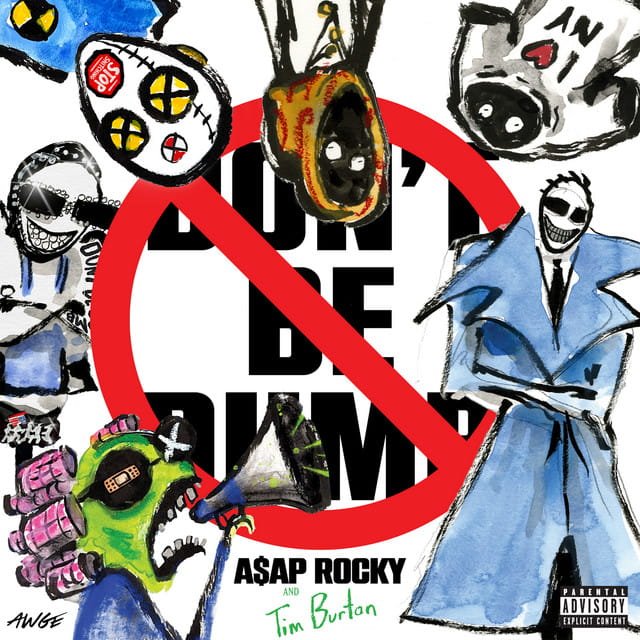
The first words on Don’t Be Dumb aren’t a statement of intent or a flash of menace.
They’re an apology dressed as bravado. “It’s been a lil’ while since I been in the league / A couple lil’ trials, couple of leaks,” Rocky opens on “Order of Protection,” immediately positioning himself as someone who owes you an explanation.
Eight years vanished between Testing and this album, and Rocky cannot stop reminding you why.
The problem isn’t that he left. It’s that he came back unable to stop litigating his absence.
This is an album haunted by its own delay, and that delay now looms larger than any artistic statement.
Rocky spends Don’t Be Dumb shadowboxing with criticism that may not exist, defending against fans allegedly disappointed he settled down with Rihanna, ranting about leaks and trials, and the general injustice of not being worshipped on demand.
On “STFU,” he literally screams at imaginary interrogators: “When are you and Rihanna (Shut the fuck up!) / Like when’s the new album gonna (Shut the fuck up!).”
It would be cathartic if it didn’t sound so defensive. The most unbothered people don’t write songs insisting they’re unbothered.
What made Rocky compelling in 2011 was never technical brilliance or emotional depth. It was the ease with which he occupied space.
He rapped like someone who’d already won and couldn’t be arsed to explain how.
That smugness, borderline obnoxious but undeniably magnetic, is what turned “Peso” and “Purple Swag” into cultural resets.
Long.Live.A$AP worked because Rocky sounded like he was having more fun than you, and if you didn’t get it, that was your problem.
Don’t Be Dumb has flashes of that old swagger. “Helicopter“ rides a Petey Pablo interpolation and trap percussion with confident momentum, while “Stop Snitching“ benefits from a show-stealing feature that briefly restores Rocky’s presence.
There are moments where he sounds like he’s enjoying himself rather than proving a point, and those tracks are where the album feels alive rather than defensive.
Production throughout is adventurous, genre-hopping without apology, and often doing more of the heavy lifting than Rocky’s verses.
Critics note the record is rambling and sprawling rather than tightly structured, with an energy that fluctuates from track to track.
But the album keeps going, and Rocky can’t help himself. The second half is where the restlessness metastasises into overthinking.
“Punk Rocky“ reaches for indie rock nostalgia but often feels like a detour into styles that don’t add thematic weight.
“Air Force (Black Demarco)” throws several half-formed ideas at the wall, none sticking long enough to matter, and even guest appearances (including Damon Albarn and Westside Gunn) don’t always anchor the tracks as intended.
Critics and listeners alike point out that sequencing issues and occasional underwhelming lyrics make the sprawling nature of the record feel cluttered rather than cohesive.
The production, at least, refuses to phone it in. Danny Elfman’s cinematic touches, thunderous strings on “Order of Protection” and eerie textures on other tracks, add weight that the lyrics often lack.
“Robbery” turns a classic jazz sample into a lounge-heist vibe, with guest vocals stealing the spotlight Rocky once commanded effortlessly.
But when the beats outshine the verses, it highlights how much of the album’s impact comes from its sound design rather than its central artistic statement.
What’s missing isn’t technical skill. Rocky can still rap circles around many contemporaries when he chooses to lean into it, but a sense of narrative and cohesion is absent.
Other respected reviews describe the album as generally favourable but uneven, noting that “Don’t Be Dumb” contains enough ingenuity to matter while also struggling under its own weight.
The persona that made “Live.Love.A$AP” feel effortless is here only in fragments, because he seems too preoccupied with justifying his return.
The irony is that Rocky didn’t need to justify the wait at all. He’s with Rihanna, he’s a father, he’s weathered legal battles and personal loss, and he’s returned to a rap landscape that acknowledges his name even if tastes have shifted.
That cultural and personal journey should be compelling enough on its own. Instead of mining that experience for something revelatory, he defaults to surface-level flexing: my girl bad, my kids cool, my flow hard, my genius misunderstood. It all blurs into redundancy.
There’s a reason people still recite entire verses from Live.Love.A$AP years later while Don’t Be Dumb struggles to produce a single universally quotable hook.
Testing was divisive precisely because Rocky took risks without apology; some of it didn’t work, but it felt like genuine artistic exploration.
Don’t Be Dumb attempts to play it safe while masquerading as experimental, and the result is an album that feels like orphaned ideas from different eras rather than a cohesive statement.
It’s not bad (there’s too much talent involved for that), but it’s forgettable in ways his music used to never be.
Critics give the album generally favourable scores, yet the divergence in quality across its length is undeniable.
The biggest disappointment isn’t that the album fails to justify eight years of absence. It’s that Rocky seems to think it needs to.
The man who once rapped “told the judge I wasn’t budgin’ till I see Bahamas” now spends entire songs explaining himself to an audience that didn’t ask for receipts.
Some moments here suggest he’s still capable of brilliance, and those flashes are worth revisiting, but Don’t Be Dumb ultimately feels trapped in its own narrative.
It might grow on you with time (listener and critic sentiment shows it has its defenders), but first listens reveal an artist who spent eight years forgetting the first rule of cool: you can’t explain your way back into it.
We publish this kind of deep-dive music criticism every week. Subscribe to Neon Signals to stay ahead of the noise.
You might also like:


