
Cole sounds hungry on the surface. The rhyme schemes are vicious, locked to that ‘erse/irst/urt’ pattern for almost three minutes without slipping.
The delivery stays controlled even as he navigates a reverse timeline that would trip up most technical rappers.
But underneath the precision, there’s exhaustion. Not the performative weariness rappers deploy when they want you to know how hard they work, but the kind that seeps through when someone has genuinely stopped caring about the race.
“I’m no longer here on this Earth,” he repeats at the end of “DISC 2 TRACK 2”, and the relief in his delivery tells you everything about where he’s actually been these past twenty-one months since he backed away from Kendrick.
The reverse narrative structure borrowed from Nas gets all the attention, but what matters more is what the rewind reveals.
When you watch a life play backwards, every achievement becomes a subtraction.
He starts at his funeral, grandkids carrying his coffin, tears rising back into their eyes instead of falling.
Fast forward sixty years and he’s won verse of the year, his purpose clear: “to murk whoever dare flirt with death”.
The proximity of those two moments, posthumous honour and competitive hunger, shows you the trap. Even the accolades feel like labour.
The technique forces a brutal efficiency. He can’t luxuriate in any moment because time keeps pulling him away from it.
Marriage dissolves in a handful of bars. He takes the wedding ring off her finger, walks backwards up the aisle “to a narrower dirt”.
That preposition does the damage. Not towards freedom or possibility, but to something that shrinks.
The path gets smaller as commitment unravels. Then the son disappearing as he stares at his birth, returning to the womb, his wife’s stomach “growin’ greater in girth and then declinin'”.
He’s describing hospital visits in reverse but it lands like watching fatherhood get revoked.
What nobody’s talking about: the single life section sounds miserable. Clubs, cameras, blogs yappin’, seeing through a woman’s skirt, the squad hunting “new hoes” who are “unaware of their worth”.
You might also like:
- Fabolous Goes Nuclear on 50 Cent’s “Squatter’s Rights
- A$AP Rocky Goes Psychedelic on ‘Punk Rocky’
- Drake THATS JUST HOW I FEEL Lyrics Meaning: Iceman-Era Cool and Sly Shots
- Tyler’s SAG HARBOR Caps 2025 Victory with Soul
- The Game “Chrome Hearts”: Compton King’s Bold Challenge
He writes it with the emotional temperature of someone describing a commute. No nostalgia, no wildness, just the mechanics of a lifestyle that was probably joyless even when time ran forward.
The encore cheers from fans wearing his merch might as well be feedback from a focus group.
When he says “with each day that passes, I could feel my career comin’ first”, he means it as diagnosis, not flex.
The line that cracks the whole thing open: “I watch my father walk back in my life and it clears up a hurt.”
If time runs backwards, his father leaving becomes his father arriving. The reversal makes reunion feel like abandonment in slow motion.
Cole gets handed to his mother, gets named, gets passed to a doctor, watches his spirit revert. Pre-birth rendered as the only honest peace he’s known.
The O’Jays sample underneath carries its own weight. “Cry Together” was about romantic devotion, two people promising to weather everything as one.
Cole flips it into the soundtrack for a life unwinding in solitude, every bond dissolving into what preceded it.
The consistency of the rhyme scheme technically impresses but also traps him.
He can’t break free from the sound even as he’s trying to narrate liberation from the life.
That’s what makes the technical dominance feel like imprisonment rather than mastery.
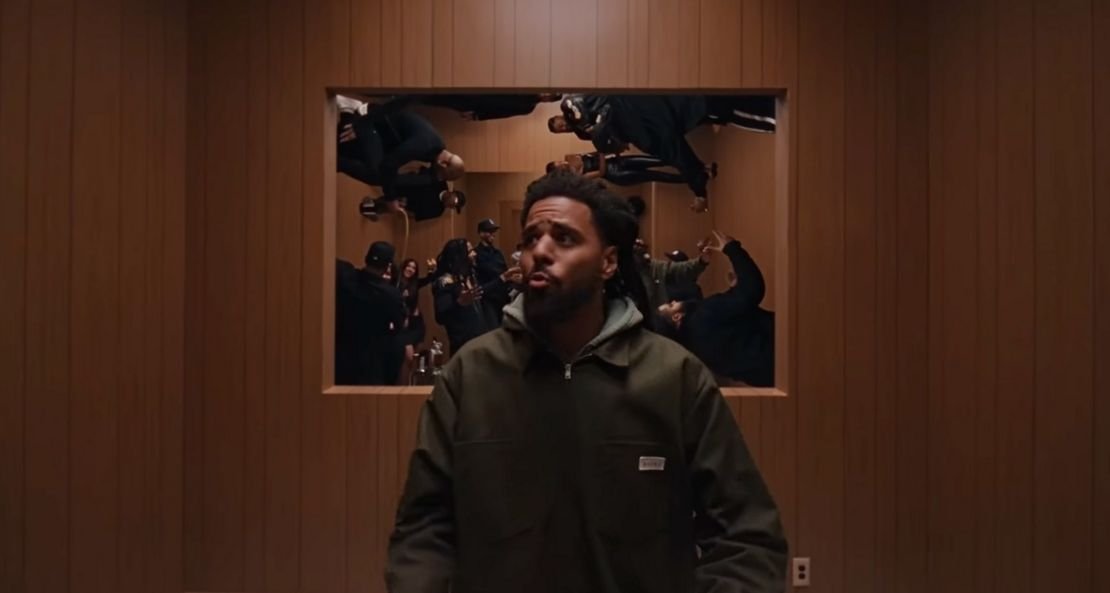
Ryan Doubiago’s video makes the concept literal without adding much. The clock runs backwards, the camera perspective shifts from horizontal to vertical when we’re in the coffin, flowers get thrown in reverse.
It’s clean but it’s also just illustrating what the bars already do. The only moment the visuals earn their keep: when Cole’s actually writing in the background and the clock on the wall reverses direction. Not time travel as fantasy, but as condition.
That snippet at the end, though. Mobb Deep’s “Drop a Gem on Em” chopped into aggression, Cole asking “who the f*ck is you?” over and over, energy facing forward for the first time in four minutes. It breaks the spell of the main track.
If the album trailer promised an examination of the fall-off as natural, as something to accept rather than fight, that outro says he’s not done resenting the people who want to speed up his exit.
The double disc reveal feels almost spiteful in that context. Two years after saying he’d drop this, twenty-one months after the most public retreat of his career, he comes back not with a statement single but with life as subtraction, then announces he’s giving you twice as much as expected.
We publish this kind of deep-dive music criticism every week. Subscribe to NeonMusic.co.uk to stay ahead of the noise.
The contradiction is the point. He’s telling you he’s exhausted and irrelevant while proving he can still outwork everyone. The hunger people hear in the delivery isn’t ambition, it’s spite.
What makes “DISC 2 TRACK 2” linger isn’t the technical execution or the Nas homage, though both are undeniable.
It’s how thoroughly it reframes ambition as slow death. Every achievement in reverse is a loss.
Every relationship unmakes itself. The closer he gets to birth, the more peace enters his voice.
He’s not celebrating the climb. He’s showing you what it cost to stand at the top of a hill he never wanted to be on in the first place.
Watching everything he built pull itself apart in reverse until there’s nothing left but the pre-birth silence where motivation hasn’t started yet and hurt hasn’t learned language.