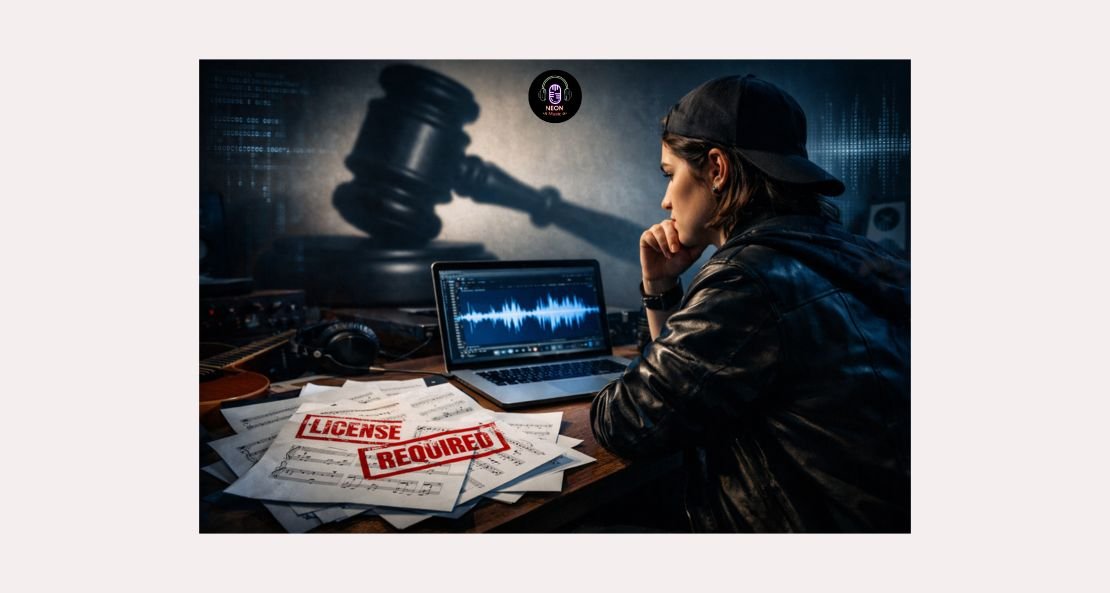
Most musicians assume the hard part is the performance. Record it well, upload it, move on. The legal part, they figure, is somebody else’s problem or handled automatically by the platform. It isn’t. And 2025 made that clearer than any previous year.
The Licence Nobody Thinks About
When you record someone else’s song and release it, you need a mechanical licence. This isn’t a formality.
Under US copyright law, a composition (its melody, its lyrics, its arrangement) is protected from the moment it’s fixed in a tangible form, and reproducing it without authorisation is infringement regardless of how good the cover is.
The compulsory mechanical licence in the US allows anyone to record and distribute a previously released composition, provided they notify the copyright owner and pay the statutory royalty rate.
The Phonorecords IV ruling, published in the Federal Register in December 2022, raised the physical and download rate from 9.1 cents to 12 cents per copy for songs under five minutes, effective January 2023.
That obligation doesn’t disappear because Spotify or DistroKid processes the distribution. The Mechanical Licensing Collective (MLC), established under the Music Modernisation Act of 2018, now handles royalty collection and distribution for digital audio transmissions in the US, but using it doesn’t substitute for clearing rights in the first place.
Miss the licence and you have a problem. Upload the cover and that problem becomes a paper trail.
Do I Need a Licence to Cover a Song?
Yes, almost certainly more than one.
A mechanical licence covers reproduction and distribution of the underlying composition: streaming, downloads, physical releases.
A synchronisation (sync) licence covers pairing a composition with moving image: a YouTube upload, a TikTok clip, a livestream.
Platforms’ automated content-matching systems (YouTube’s Content ID is the main example) are not licences. They’re enforcement tools.
A rights holder can use Content ID to claim your video’s ad revenue, restrict it in specific territories, or remove it entirely, whether or not you thought you were covered.
Performance rights are the third category. Live and broadcast performances are administered through PROs: PRS for Music in the UK, ASCAP and BMI in the US. In practice, individual performers rarely get sued for live covers when the venue holds a blanket licence.
But streaming a performance publicly sits in different territory, and the assumption that “the venue handles it” doesn’t extend to your own broadcast.
The short version: mechanical licence for the recording, sync licence for any video, performance rights for public performance. Each one is separate and none of them is automatic.
What Happens When You Skip Them
In 2013, the National Music Publishers’ Association filed suit against Fullscreen, a YouTube multi-channel network generating over 2.5 billion monthly views at the time, on behalf of Warner/Chappell and 15 other publishers.
The allegation: Fullscreen had “willfully ignored their obligation to obtain licenses and pay royalties,” profiting from unlicensed covers of songs including tracks by Justin Bieber, Kesha, Kanye West and Katy Perry. Fullscreen settled.
The network then had to build proper licensing arrangements before any of those channels could continue operating as a business.
The case mattered because it established that the entity distributing unlicensed cover content bears liability, not just the individual performer.
Multi-channel networks, labels, and distributors all had to reconsider what their contracts actually covered.
YouTube subsequently expanded direct licensing with major publishers, but MCNs outside those agreements remained exposed.
That’s still the reality in 2026. If you’re building a brand, a channel, or a catalogue around covers, the licensing gap is a liability: yours, and potentially your distributor’s.
AI and the Cover Question
The more complicated situation involves AI, and it moved fast in 2025.
In June 2024, the RIAA filed lawsuits against Suno and Udio on behalf of the major labels, alleging mass copyright infringement through the unlicensed use of sound recordings to train their generative models.
RIAA Chief Legal Officer Ken Doroshow described it plainly: “These are straightforward cases of copyright infringement involving unlicensed copying of sound recordings on a massive scale.”
Both platforms had argued their training practices were protected under fair use. Neither defence survived the settlement pressure.
By the end of 2025, the landscape had shifted substantially. Universal Music Group settled with Udio on October 29, 2025, reaching a licensing agreement for UMG’s recorded music and publishing catalogues.
Warner Music Group settled with Udio in November, then with Suno in December, a deal that included WMG selling the concert-discovery platform Songkick to Suno for an undisclosed sum.
Under WMG’s settlement terms, Suno dropped its fair use argument, committed to an opt-in model for Warner artists and songwriters, and announced that fully licensed models would replace its existing ones in 2026.
Users on the free tier lost the ability to download their creations off-platform.
Sony Music Entertainment had not settled with either platform as of early 2026. In June 2025, independent artist Anthony Justice (Tony Justice) filed a separate class action against Suno, followed by a similar filing against Udio, arguing that AI outputs substantially replicate his original recordings.
Suno filed a motion to dismiss in August, arguing under Section 114(b) of the Copyright Act that its outputs cannot infringe sound recordings because they generate entirely new audio rather than sampling. That motion was pending in early 2026.
The US Copyright Office’s May 2025 report added a further layer. Its conclusion: fair use does not excuse unlicensed training on expressive works “particularly when those works are used to generate substitutional outputs that may replace the originals in the relevant marketplace.”
Courts are not bound by that conclusion, and Suno’s legal team cited subsequent rulings that sided with AI companies.
But it’s the framing that matters: regulators are treating AI-generated music as a market competitor to the originals, not a transformation of them.
The No Fakes Act: Not Law Yet
The article you may have read elsewhere probably describes the No Fakes Act as existing legislation. It isn’t, at least not yet.
The NO FAKES Act (Nurture Originals, Foster Art, and Keep Entertainment Safe) was reintroduced in the Senate and House in April 2025 by Senators Klobuchar, Coons, Blackburn and Tillis, with bipartisan support from SAG-AFTRA, the RIAA, UMG, WMG, OpenAI, Google, and YouTube among others.
As of early 2026, it remained in committee with a 5% chance of enactment according to GovTrack.us. If passed, the bill would establish a federal right of publicity, giving individuals control over AI-generated digital replicas of their voice and likeness.
The definition of “digital replica” under the Act is specific: a newly created, computer-generated representation that is “readily identifiable” as an individual’s voice or appearance, in a work where they did not perform.
The practical gap here is real. Several states already have their own digital replica legislation. California’s protections took effect January 2025, Tennessee’s ELVIS Act was signed into law in March 2024, but without federal law, the rules depend on where a rights dispute lands.
Artists whose voices are being cloned by AI tools can currently pursue claims under state right-of-publicity law or existing copyright doctrine. A federal framework would standardise that. It hasn’t arrived yet.
What This Means If You’re Making Music in 2026
For anyone recording and releasing covers the traditional way, the obligations haven’t changed: mechanical licence before distribution, sync clearance before any video upload, and confirmation that your venue or platform has performance rights covered.
Services like Songfile (Harry Fox Agency) and Easy Song Licensing exist specifically to simplify mechanical licensing for independent artists. For UK releases, the MCPS handles mechanical rights domestically.
For anyone using AI tools in the creative process (whether generating backing tracks, producing stems, or using voice-processing software), the licensing landscape is still being built.
WMG and UMG’s deals with Suno and Udio represent the beginning of a licensed model framework, but they only cover those labels’ catalogues.
An AI tool trained on unlicensed independent music is in a different position from one operating under a label agreement. The distinction matters.
RIAA CEO Mitch Glazier put it bluntly during the Suno/Udio lawsuit proceedings: the question isn’t whether AI-generated music sounds original. The question is what it was built on.
For artists using AI to generate covers or cover-adjacent material, the safest position in 2026 is to use platforms operating under confirmed licensing agreements, and to stay aware that the independent artist class actions against Suno and Udio are still moving. The legal framework around AI-generated music is tightening, not relaxing.
In the meantime, Suno’s website still lets you type in a style prompt and receive a finished track in seconds. The WMG settlement requires those tracks to come from licensed models in 2026.
Whether that promise holds, and what it means for the thousands of pre-settlement outputs already circulating on streaming platforms, is a question nobody has answered cleanly yet.
You might also like:
- Do You Own Suno AI Music? Terms of Service Explained
- AI Music Settlements: Labels Partner With Suno & Udio
- AI Music Lawsuits and Backlash: What Artists Need to Know
- AI Music’s Dark Secret: 7 Million Daily Tracks and Zero Legal Cover
- How Independent Artists Make Money in 2025: Direct-to-Fan Guide
- The Invisible Cost of Being Everywhere: Why Music Marketing Fails