

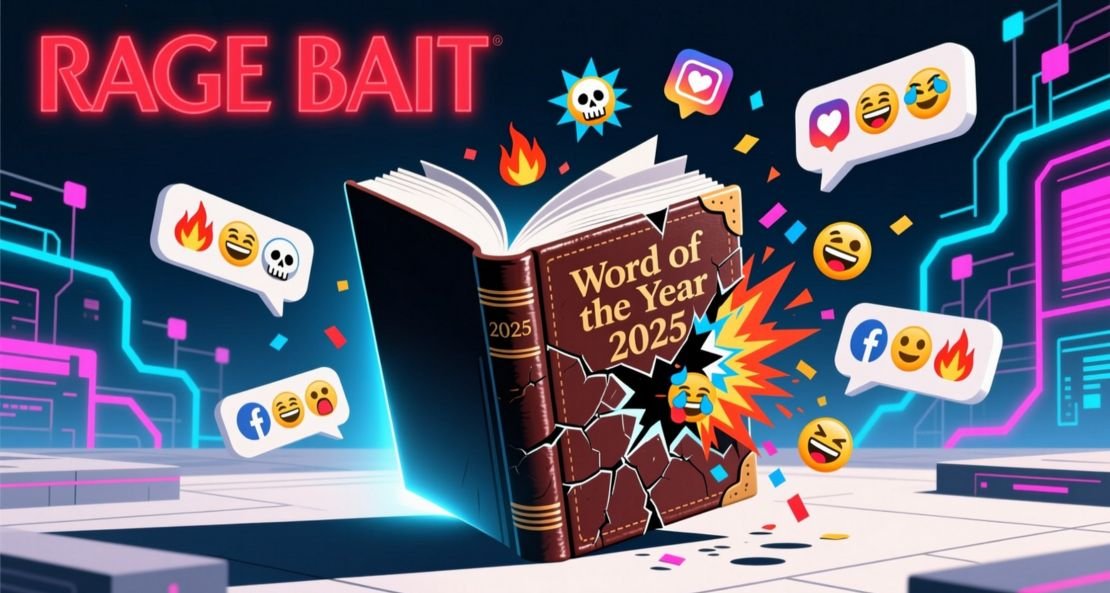
You know that sinking feeling when you’re three comments deep in an argument about something you didn’t even care about five minutes ago? That’s not accidental. Oxford University Press just made it official: “rage bait” is the Word of the Year for 2025, and if you’ve spent any time online lately, you already know why.
After more than 30,000 people voted across three days, linguistic experts chose rage bait over “aura farming” (the art of cultivating an impossibly cool persona) and “biohack” (optimising yourself into oblivion). The winner? The thing that’s been making us miserable all year. Usage has tripled in twelve months, which tells you everything about how 2025 has felt online.
What Exactly Is Rage Bait?
Oxford’s official definition calls it online content deliberately designed to elicit anger or outrage by being frustrating, provocative, or offensive, typically posted to increase traffic or engagement. Translation: those posts that make your blood boil, the ones you simply cannot scroll past without commenting. That visceral reaction? Someone engineered it, probably while drinking a flat white.
@influicity Have you ever noticed how rage bait posts keep popping up in your feed? 🤔 It’s a tactic some creators use to boost engagement by sparking strong reactions and heated debates. The more you react, the more their content spreads, gaining visibility and driving up their metrics. While it can drive views and comments, it often spreads negativity, misinformation, and can be quite manipulative. Understanding this strategy helps you recognize and resist the urge to engage. #socialmediamarketing #socialmediamanager #socialmediatips #socialmediastrategy #tiktoktips #socialmediaexpert #ragebait ♬ original sound – Influicity
The compound marries two ancient words with modern intent. “Rage” (violent outburst of anger) and “bait” (attractive morsel of food) both date back to Middle English. Their union creates something distinctly 21st century: content that looks like participation but functions as manipulation.
Lexicographer Susie Dent told the BBC what we all suspected: the person producing rage bait will bask in millions of comments, shares, and even likes. Why? Because social media algorithms reward negative engagement. We might love fluffy cats, but we engage more with content that genuinely provokes us. The platforms know this. They’ve always known this.
From Usenet to TikTok: A Brief History
The phrase first appeared in 2002 on Usenet (remember Usenet?), initially describing aggressive driver behaviour. Someone would flash their headlights to pass, the other driver would deliberately slow down out of spite. Rage bait: deliberately agitating someone for no good reason beyond the satisfaction of watching them lose it.
Fast-forward two decades. The internet’s currency shifted from curiosity to fury. Casper Grathwohl, President of Oxford Languages, notes the transformation: “Before, the internet was focused on grabbing our attention by sparking curiosity in exchange for clicks. Now we’ve seen a dramatic shift to it hijacking and influencing our emotions.”
Clickbait wanted you curious. Rage bait wants you furious. The former aimed for your attention; the latter targets your amygdala. As social media algorithms began rewarding provocative content, this evolved into “rage-farming,” the consistent practice of seeding inflammatory content to harvest engagement over time. Usually through deliberate misinformation or conspiracy theories, because why be subtle when outrage is the point?
The Mechanics of Manufactured Outrage
Here’s the uncomfortable truth: rage bait works because we’re wired wrong for the internet age. Humans have a negativity bias, an evolutionary hangover that made our ancestors notice the rustling bushes (potential tiger) over the pretty flowers (not going to eat you). Great for survival on the savannah. Terrible for your Twitter timeline.
Social media platforms exploit this ruthlessly. Their algorithms don’t simply surface content; they conduct thousands of A/B tests per second, optimising for one metric: engagement. A post generating 1,000 angry comments outperforms one attracting 1,000 likes. Every single time. The system rewards discord over harmony because discord keeps you scrolling.
This creates what researchers call an engagement trap. You see rage bait, you respond emotionally, the algorithm takes notes, and suddenly your feed fills with similar provocations. It’s like telling a bartender you enjoyed one pint of bitter and they respond by force-feeding you thirty.
TikTok influencers have turned this into a cottage industry. Some creators reportedly earn six figures annually from rage bait alone. The business model? Post deliberately offensive content (cooking steak in the dishwasher, cutting pizza with scissors, whatever makes people lose their minds), harvest the outraged responses, monetise the attention. Rinse, repeat, buy a house.
Why 2025 Was Peak Rage Bait
Oxford didn’t pull this term from a hat. The year 2025 delivered unprecedented social unrest, endless debates about content regulation, and a collective realisation that maybe, just maybe, our phones are making us miserable. The threefold increase in “rage bait” usage reflects millions of people simultaneously arriving at the same conclusion: we’re being played.
Grathwohl observes that 2025 has been “a year defined by questions around who we truly are, both online and offline.” Deepfake celebrities, AI-generated influencers hawking products they’ve never touched, virtual companions offering intimacy through algorithms. The fact that “rage bait” exists and has seen such dramatic surge in usage means we’re increasingly aware of the manipulation tactics deployed against us.
Last year’s winner was “brain rot,” which captured the mental drain of endless scrolling. Put them together and you get a perfect feedback loop: outrage sparks engagement, algorithms amplify it, constant exposure leaves us mentally exhausted. These aren’t just words; they’re diagnostic tools for understanding how digital platforms reshape our thinking.
The Cultural Cost (Or: What Happens When Outrage Becomes Currency)
The implications go beyond individual annoyance. Rage bait doesn’t just make you angry; it warps your perception of reality. When algorithms prioritise sensational content, a handful of inflammatory voices can dominate your feed, creating the illusion they represent mainstream opinion. They don’t. They just learned to game the system.
The mental health toll keeps mounting. Chronic exposure to rage-inducing content contributes to anxiety, depression, and what researchers term “anhedonia,” the inability to feel pleasure from activities you used to enjoy. The dopamine hit from engaging with outrage lasts seconds. The psychological aftermath persists for hours, sometimes days.
TikTok’s algorithm particularly demonstrates the problem. Multiple users report that marking content as “not interested” sometimes triggers more of the same toxic material, not less. The platform isn’t asking what you want; it’s learned what holds your attention. And anger holds attention better than almost anything else.
Research from The Mancunion highlights how rage bait content particularly affects vulnerable populations, with eating disorder content, self-harm material, and conspiracy theories all using rage mechanics to spread. The algorithm doesn’t care if the engagement comes from concern, horror, or genuine interest. It just cares that you engaged.
Recognising and Resisting (Without Becoming a Digital Hermit)
The surge in rage bait usage offers a silver lining: awareness. Naming a phenomenon represents the first step toward managing it. When you recognise content designed to manipulate your emotions, you gain power to disengage. Not always. Not perfectly. But more often.
Start with the sixty-second rule. That immediate urge to comment? Wait. Count to sixty. Reassess whether this random person’s deliberately terrible opinion deserves your finite emotional energy. Usually, it doesn’t. The bait loses power when you see the hook.
Question the source, always. Who benefits from your anger? Scroll up to the account. Check their other posts. If everything they share seems calculated to provoke, congratulations, you’ve found a rage farmer. Block liberally. Your timeline will thank you.
Curate ruthlessly. Social media platforms offer filtering tools that most people ignore. Use them. Mute keywords. Block accounts. Unfollow people whose entire personality involves being wrong loudly. Yes, even that cousin. Especially that cousin.
Seek primary sources before forming opinions. Rage bait often distorts information or strips away context that would make the outrageous seem reasonable. Someone posts an inflammatory quote? Find the original interview. Usually, the reality proves far less dramatic.
Take breaks. Regular digital detoxes aren’t just trendy advice; they’re neurological necessity. Your nervous system needs time to recalibrate away from the constant low-level stress of curated outrage. Start small: one screen-free hour daily. Build from there.
The Language of Our Moment
Oxford’s annual word selection functions as cultural diagnosis, capturing societal preoccupations in a single term. Previous winners tell their own story: “podcast” in 2005 (optimism about new media), the laughing emoji in 2015 (peak millennial irony), “goblin mode” in 2022 (post-pandemic feral energy), and “brain rot” in 2024 (the beginning of the end).
“Rage bait” fits this lineage but feels different. Earlier selections often celebrated innovation or cultural shifts. This one names a wound. It acknowledges how platform design and human psychology combine to create toxic digital environments where manipulation becomes business model.
The recognition matters because language shapes reality. When millions share vocabulary for manipulation tactics, those tactics lose some power. The manipulators rely on unawareness. Understanding the game changes how you play it.
Cambridge Dictionary chose “parasocial” for 2025, highlighting the one-sided relationships fans develop with influencers. Collins went with “vibe coding.” Dictionary.com selected “6-7.” The pattern proves consistent: our words increasingly describe digital dysfunction rather than digital possibility. We’ve moved from naming innovations to naming injuries.
Much like how “FR” evolved from AAVE into mainstream usage, rage bait represents language adapting to describe new realities. The difference? “FR” signals authenticity. “Rage bait” signals manipulation. One builds connection. The other weaponises it.
What Comes Next (Probably More Rage, Honestly)
The rage bait era won’t end because Oxford named it. The economic incentives remain too strong, the psychological hooks too effective. Platforms profit from engagement regardless of emotional tone. Content creators learned that outrage pays better than quality. That’s not changing tomorrow.
But awareness creates possibilities. Users demanding better experiences can pressure platforms to adjust algorithms. Regulators considering online safety legislation now possess language to describe specific harms. Researchers studying digital wellbeing have vocabulary that captures particular forms of manipulation.
The music industry navigates these same waters. Artists building their careers on social media face a choice: join the outrage economy or resist it. Controversy might generate quick viral moments, but authentic connection builds sustainable careers. The difference between a flash-in-the-pan TikTok sensation and an artist with staying power often comes down to that choice.
TikTok’s influence on music discovery demonstrates both platform power and platform problems. A song can go viral through genuine appreciation or manufactured controversy. The former builds fanbases. The latter burns bright, generates think pieces, then disappears. Ask yourself: can you name three “controversy artists” from 2023? Exactly.
Musicians releasing new work increasingly understand this dynamic. The pressure exists to participate in rage cycles, to court controversy for attention. Some resist. They focus on craft, build communities slowly, prioritise connection over metrics. It’s harder. It takes longer. It tends to last.
The Verdict (Such As It Is)
Oxford naming rage bait as Word of the Year 2025 captures something essential: we’ve moved past the internet’s optimistic early days, past the social media honeymoon, into an era where manipulation and exploitation function as business models. That’s not cynicism; that’s assessment.
The good news? We’re naming it. Talking about it. The term’s explosive growth demonstrates collective recognition. That recognition won’t solve everything, but it provides vocabulary for resistance, for demanding better, for building alternatives that don’t require constant emotional exhaustion as the price of participation.
Language evolves to meet our needs. We needed a term for content deliberately designed to make us angry, and now we have one. What we do with that knowledge determines whether rage bait becomes permanent infrastructure or a problem we collectively outgrow.
Maybe that’s optimistic. Maybe we’re locked into these platforms and their incentive structures forever. Maybe the next decade delivers more sophisticated manipulation tactics we haven’t even imagined yet. Maybe Oxford’s 2035 Word of the Year will be whatever we call the thing that makes rage bait look quaint.
Or maybe, just maybe, enough people learn to spot the bait and refuse to bite. Stranger things have happened. Not many. But some.
The choice, as they say, belongs to us. Though increasingly, it feels like the choice belongs to whoever designed the algorithm. But that’s another article entirely.
You might also like:
- How Stars Get Famous on Social Media
- FR Explained: Why Gen Z’s Favourite Two-Letter Phrase is Taking Over Your Feed, For Real
- Dopamine Nation: The Unseen Addiction of Social Media
- The 2024 Music Industry Trends Guide: What’s Really Changing and Why You Should Care
- What Does WSG Mean? Decoding the Popular Acronym
- Hear Me Outs: Exploring the Viral Trend Taking Over the Internet