


Bing Crosby didn’t think much of the song when he first heard it. “I don’t think we have any problems with that one, Irving,” he told Berlin after the initial run-through.
Just another tune for the Holiday Inn soundtrack. He expected a different song from the film to become the hit.
The song was “White Christmas.” Released July 1942. Eventually sold 50 million physical copies. Became the best-selling single in recording history. Changed how America thought about Christmas music. Accidentally invented a genre.
Nobody planned Christmas jazz. It happened because circumstances aligned: new songs needed interpreting, radio needed content, musicians needed December work.
What started as commercial necessity became something stranger. Jazz musicians discovered holiday material contained genuine musical possibilities.
Audiences responded to sophisticated approaches without requiring dumbed-down versions. The whole thing worked despite making no obvious sense.
Christmas represents tradition and nostalgia. Jazz means improvisation and innovation. These shouldn’t combine naturally.
Yet here we are, 80 years later, still listening to albums that prove opposites sometimes attract.
How Jewish Songwriters Accidentally Invented American Christmas
Irving Berlin was born Israel Baline in Siberia. His father was a cantor. The family celebrated Hanukkah, not Christmas.
By the 1940s, Berlin had written nearly a thousand songs and was among America’s most successful songwriters. He also had Christmas trees in his Manhattan home and had married an Irish Catholic woman.
When he wrote what he called the best song anybody ever wrote in January 1940, he was crafting music for a holiday he didn’t grow up celebrating.
That outsider perspective mattered. Berlin and other Tin Pan Alley composers (many of them Jewish immigrants) approached Christmas as cultural phenomenon rather than religious observance.
Their songs featured snow, nostalgia, secular celebration. No nativity. No theology. Just winter imagery and emotional longing.
This wasn’t cynical calculation. These songwriters genuinely engaged with Christmas as American cultural tradition.
They’d assimilated into a country where Christmas had become national holiday regardless of religious affiliation.
Their songs reflected that cultural Christmas: secular, commercial, emotionally resonant without requiring theological commitment.
For jazz musicians, this mattered enormously. Secular Christmas songs presented no religious barriers. A Jewish saxophonist could interpret Christmas standards as easily as a Christian vocalist.
The material functioned as American popular music that happened to reference December 25th. No faith required, just musical competence.
The Song That Changed Everything Premiered Three Weeks After Pearl Harbor
Crosby sang it on Christmas Day 1941 during his NBC radio show. The timing couldn’t have been more accidentally perfect.
America had entered World War II three weeks earlier. Thousands of young men would soon spend Christmas far from home, in Pacific islands and European battlefields.
The recording session happened six months later: May 29, 1942, at Radio Recorders in Los Angeles. Took 18 minutes. John Scott Trotter’s orchestra backing Crosby’s vocals. Ken Darby Singers adding harmonies.
Nobody thought much about it. Berlin expected a Valentine’s Day song from the same film to become the hit. Crosby found “White Christmas” adequate, nothing special.
Released July 1942 as part of the Holiday Inn soundtrack. Flopped initially.
Then October arrived. The song topped charts. Stayed there for 11 weeks. Armed Forces Radio played it constantly because troops requested it at every opportunity.
The melancholy tone (dreaming of Christmases “just like the ones I used to know”) captured homesickness better than cheerful celebration songs could manage.
Soldiers cried when Crosby performed it live in Europe. The emotional connection was immediate and visceral.
By war’s end, the song had sold millions. Over subsequent decades: 50 million physical copies. Best-selling single in recording history. Added to the Library of Congress National Recording Registry. Grammy Hall of Fame. The whole nine yards.
What made this matter for jazz? It proved secular Christmas songs could achieve massive commercial success.
More importantly, it demonstrated Tin Pan Alley’s 32-bar song structure worked for holiday material. Jazz musicians already knew how to navigate those forms.
They’d spent decades improvising over Broadway standards with identical structures. Christmas songs written by Berlin, the Gershwins, Cole Porter functioned musically like any other popular song. Seasonal lyrics didn’t change harmonic possibilities or improvisational approaches.
You might also like:
- Essential Christmas Jazz Songs and Their Stories
- Classic and Contemporary Christmas Jazz Albums
- Creating the Perfect Christmas Jazz Playlist
- Nat King Cole’s The Christmas Song: A Timeless Treasure
- The History and Evolution of Jazz Music
Radio Made Stars, Jazz Musicians Needed Work
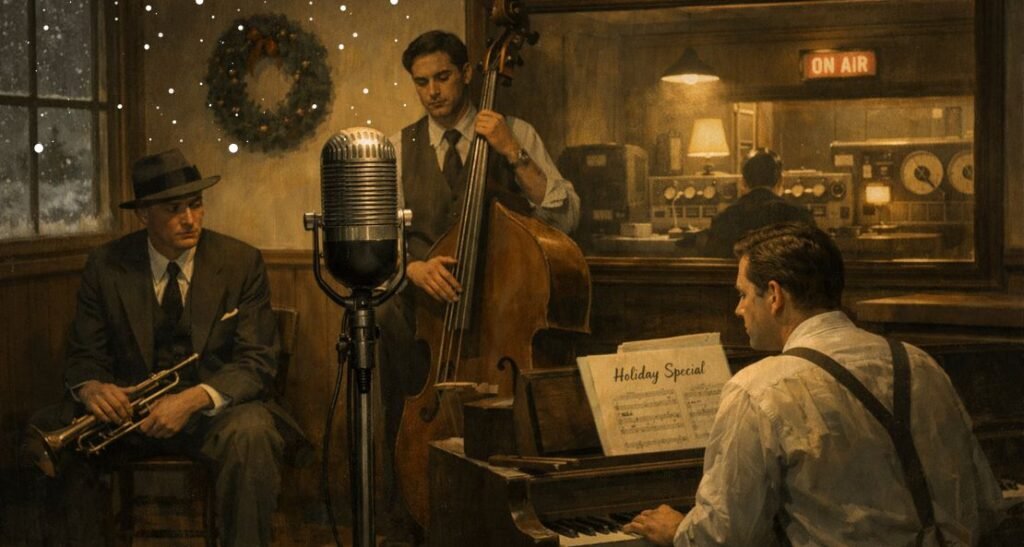
Understanding Christmas jazz requires understanding mid-century media economics. Radio needed constant programming. Networks produced holiday specials. Local stations needed cheap seasonal content.
All of this required music, specifically music performed live or recorded specifically for broadcast.
Crosby’s Kraft Music Hall reached millions of listeners weekly. When he sang the new song Christmas 1941, he introduced it to a national audience simultaneously.
That scale didn’t exist before radio. Sheet music built audiences regionally. Live performances reached limited crowds. Radio delivered instant mass distribution.
Jazz musicians benefited from identical infrastructure. Duke Ellington’s orchestra broadcast regularly. Louis Armstrong appeared on variety shows. Local stations hired combos for live performances.
These broadcasts needed seasonal programming every December. Jazz musicians played Christmas material because work required it, not because they felt particular affinity for holiday music.
The economic incentive drove everything. Radio paid. Holiday specials meant additional income during slow winter months. Jazz musicians who delivered competent Christmas performances stayed employed. Market forces shaped repertoire as much as artistic preference.
Armstrong figured this out early. His first Christmas recordings came in 1953 for Decca: a humorous Santa Claus song paired with “Cool Yule.”
Two years later he recorded “Christmas in New Orleans,” written by Richard M. Sherman (yes, the Disney guy who later wrote “It’s a Small World”) and Joe Van Winkle. Produced by Benny Carter.
The track became a New Orleans holiday standard, still gets played constantly in the Crescent City every December.
Listen to Armstrong’s approach. He takes the music seriously while maintaining emotional lightness. The horn arrangements swing.
His gravelly vocals sell the regional imagery (magnolia trees, cotton fields, Dixieland bands). Nothing sounds condescending or cynical.
Armstrong applied the same instrumental skill to holiday standards as to any other material. That professionalism elevated the songs without removing celebratory spirit.
This became the template: sophisticated musical treatment of material others dismissed as novelty. No grand artistic statement motivated these recordings. Economic necessity and professional pride sufficed.
Albums Changed the Game
Christmas music existed as individual songs until the LP format arrived in the 1950s. Singles dominated. Radio played individual tracks. Sheet music sold song by song.
Albums allowed something different: thematic coherence, sustained atmosphere, deliberate sequencing.
An artist could record ten Christmas songs and create a complete statement rather than isolated tracks. Jazz musicians already thought this way, building albums as coherent works.
The format particularly benefited instrumental jazz. Vocal versions dominated radio and singles sales. But albums created space for instrumental interpretation.
A piano trio could record an entire Christmas album without vocals, something singles-focused markets wouldn’t support. Albums validated instrumental Christmas jazz as commercially viable.
Economic incentives sweetened the deal. Christmas albums sold modestly first year but continued selling every subsequent December.
This long-tail revenue made them uniquely profitable. Record one Christmas album, generate income from it for decades. Even bebop musicians skeptical of commercial music recognised this financial logic.
Labels scheduled Christmas sessions for summer when studio time cost less. Musicians recorded entire albums in single days. Production stayed minimal.
This efficiency reduced risk while allowing experimentation. Christmas albums became low-risk, high-reward propositions.
The Moment Jazz Musicians Realized Christmas Songs Were Actually Good
Somewhere in the late 1950s, jazz musicians stopped treating Christmas albums as commercial obligations and started approaching them as creative projects.
You can hear the shift in the recordings. Earlier Christmas albums often sound perfunctory, like musicians fulfilling contracts. Later ones reveal genuine engagement.
What changed? Musicians discovered the better Christmas songs contained real harmonic interest. Berlin, the Gershwins, Cole Porter wrote Christmas material using the same sophisticated chord progressions as their non-seasonal standards.
A pianist trying to reharmonise a Christmas standard during a December gig would discover unexpected possibilities.
A saxophonist would apply bebop phrasing to familiar melodies and hear new angles. Word spread informally: this material could sustain serious musical attention.
The realisation didn’t spread through manifestos or critical essays. It spread through musicians talking to each other, sharing discoveries, hearing what others were doing with Christmas repertoire.
By the early 1960s, some artists started treating Christmas recordings as genuine creative challenges rather than seasonal work.
Then Vince Guaraldi proved what was possible.
1965: Everything Clicks
Guaraldi’s A Charlie Brown Christmas didn’t invent Christmas jazz, but it showed what the genre could achieve when taken absolutely seriously as music.
We covered this album extensively elsewhere, but its importance to the genre’s origins matters.
Recorded mostly in spring 1965 for the animated television special. Piano trio: Guaraldi, bass, drums. Children’s choir from St. Paul’s Episcopal Church in San Rafael for a few tracks.
Simple production throughout. No orchestral sweetening. No vocal stars. Just a working jazz trio playing material Guaraldi composed and arranged.
The television special premiered December 1965. CBS executives hated it. Thought the jazz was too sophisticated for children. Worried it would fail. It became one of the most-watched Christmas specials in television history.
The album sold millions. Became the second best-selling jazz album ever recorded (only Miles Davis’ Kind of Blue sold more).
What Guaraldi proved: Christmas jazz worked best when you stopped trying to make it sound Christmassy and focused on making it sound like jazz. His original compositions used sophisticated harmonies.
His arrangements of carols found the implicit swing within familiar melodies. The children’s choir added warmth without sentimentality.
Everything worked because Guaraldi treated it as serious musical project rather than commercial product.
The album’s influence went beyond commercial success. It showed younger musicians that Christmas material could sustain the same creative engagement as any jazz repertoire.
You didn’t need to condescend to it or dumb it down. Respect the material musically, and audiences would respond.
Television Helped, Economics Drove Everything
Television’s rise provided new platforms. Networks needed holiday specials. Variety shows featured Christmas episodes.
Jazz musicians appeared regularly, introducing Christmas jazz to audiences who’d never visit clubs or buy albums.
But economics mattered more than exposure. Christmas albums made financial sense for everyone: labels could sell albums November-December that wouldn’t move other months, musicians needed winter employment, consumers wanted new Christmas music without abandoning familiar songs.
The seasonal sales pattern created unusual dynamics. A Christmas album might sell modestly its first year but continue selling every subsequent December forever.
This long-tail revenue made Christmas albums uniquely profitable across decades.
These economic incentives encouraged participation even from artists skeptical of commercial music.
Recording one Christmas album provided ongoing revenue without compromising artistic reputation.
Practical, not artistic, considerations drove most Christmas jazz into existence.
The Difference Between Christmas Music and Christmas Jazz
Plenty of artists with jazz backgrounds recorded Christmas material without creating anything particularly jazz about it. What separated actual Christmas jazz from competent seasonal performances?
Listen for reharmonisation. Jazz versions added substitute chords, altered progressions, revealed harmonic possibilities conventional versions ignored.
Where normal arrangements used simple progressions, jazz versions explored modal interchange and tritone substitutions.
Listen for rhythm. Jazz musicians swung everything, adding syncopation and polyrhythmic elements. Even ballads received subtle rhythmic sophistication through phrasing choices.
Listen for improvisation. True Christmas jazz included solos treating melodies as jumping-off points for spontaneous creation rather than sacred texts requiring faithful reproduction.
Listen for musicianship. Jazz Christmas recordings showcased virtuosity and ensemble interplay. Musicians listened to each other, responded in real time, created conversations within the material’s framework.
The difference: Louis Armstrong singing a Christmas song versus Louis Armstrong playing jazz using Christmas songs as source material. Always audible if you know what to hear.
Why Any of This Still Matters
Christmas jazz stuck around for reasons beyond nostalgia. It provided entry point for listeners intimidated by jazz’s reputation.
Someone buying their first jazz album might start with Christmas material’s familiar melodies before exploring challenging repertoire. Gateway drug, basically.
It offered jazz musicians creative challenge without alienating audiences. Reharmonising well-known songs required sophistication but remained accessible to listeners unfamiliar with jazz conventions. Musicians could demonstrate skill without sacrificing listenability.
It created intergenerational connections that marketing departments dream about. Parents who grew up hearing Guaraldi introduced their children to the same music.
Those children later played A Charlie Brown Christmas for their own kids. The tradition perpetuated through family ritual rather than industry promotion.
Most important: it proved jazz could engage popular culture without compromising musical integrity. The best Christmas jazz maintained both accessibility and sophistication simultaneously. That balance showed jazz’s ongoing relevance beyond academic or specialist appreciation.
The origins story reveals more about American popular music’s mid-century mechanics than about Christmas traditions or jazz innovation. T
he genre emerged from practical circumstances: musicians needed work, labels needed product, audiences needed seasonal entertainment. Nobody set out to create new art form. They were trying to pay rent in December.
Yet something unexpected happened within commercial constraints. Musicians discovered Christmas material contained genuine musical interest.
Audiences responded to sophisticated approaches without requiring simplification. The format proved sustainable economically and creatively.
What began as necessity became tradition. Tin Pan Alley songs written for profit became vehicles for genuine exploration.
Bing Crosby’s radio performance launched an entire genre. Louis Armstrong’s pragmatic seasonal recordings established template others refined. Vince Guaraldi’s television soundtrack showed Christmas jazz’s full potential.
Today’s modern Christmas jazz artists build on foundations laid 80 years ago. They use identical song structures, approach material with similar respect and creativity, recognise Christmas jazz’s dual nature: commercial entertainment allowing musical sophistication.
Not bad for something that started with a Jewish songwriter’s secular Christmas song performed by a radio crooner three weeks after Pearl Harbor.