

On an album full of armour, “Agora Hills” is the one track where Doja Cat takes it off. It is widely understood as a love song about comedian and internet personality Jeffrey “J” Cyrus, and its premise is simple: she wants to go public with the relationship, in front of the crowd telling her not to, and she’s not asking permission. The chorus says it plainly. Everything else in the lyrics is the argument for why.
What does “Agora Hills” mean? The song is about Doja Cat choosing to publicly claim a controversial relationship despite widespread backlash, using the name of her childhood neighbourhood and the Greek concept of public life to frame private feeling as a deliberate statement.
The title is a misspelling of Agoura Hills, California, where she grew up, and every element of the song, the sample, the lyrics, the video, pulls back toward that origin.
What Does the Title “Agora Hills” Mean?
The title is a deliberate misspelling of Agoura Hills, the suburb in the Santa Monica Mountains where Doja Cat grew up. That area is home to the Sai Anantam Ashram, founded and led by jazz musician Alice Coltrane.
Doja lived there during her formative years, and the environment ran deep: she has credited the ashram with introducing her to instrumentation, ethnic dance, performance, and spirituality before music itself became her focus. It was the place that gave her physical confidence before it gave her a stage.
By dropping the “u” from Agoura, Doja does two things at once. The spelling shifts the word toward “agora,” the ancient Greek term for the bustling public centre of a city-state, where civic life converged.
It also inverts the anxiety associated with that space: agoraphobia is the fear of public places, while the love of them is agoraphilia. The song is about wanting to occupy public space with her partner. Without “u,” Agora Hills is incomplete. That’s the wordplay, and it isn’t accidental.
Who Is “Agora Hills” Written About?
The song is addressed to Jeffrey “J” Cyrus, who had faced public accusations of grooming and sexual misconduct. Doja has not spoken directly about those allegations in relation to the song.
What the lyrics do instead is place her own experience at the centre: she dismisses outside criticism, brushes off detractors, and proceeds. The verse that promises to travel the world regardless of public opinion is doing the same work as the line writing off critics. She isn’t defending the choice. She’s making it.
A love song structured around defying public judgment looks different when the public’s objection concerns the person she’s defending. Whether listeners read it as romantic conviction or willful blind spot depends on what they bring to it. The lyrics don’t resolve that question, and there’s no indication they were meant to.
The Lyrics and What They’re Actually Saying
Doja has described the love songs on Scarlet as more personal than her earlier pop material, closer to lived experience than anything she’d made before.
She also acknowledged the discomfort of that exposure, describing herself as someone who can be “really mean,” whose real orientation is toward harmony: when a whole room is in unison, everyone in the same spot.
The song shifts between two distinct vocal modes across its verses. One is confessional and domestic. The other is sharper and more public-facing. The effect is two versions of the same person in dialogue: the private Doja and the persona the world has built. Both are claiming this relationship as real.
The verse line “Be my security, it’s your therapy / With you, I ain’t holding shit back” is the clearest statement of what she actually wants from the relationship, and the construction is worth looking at. She’s not asking for safety in vague terms. She’s naming a specific exchange: his steadiness in return for her openness.
The following lines make it biographical rather than abstract: “When he broke my heart, you fixed that.” There was someone before. This person is the answer to something specific. That context reframes the whole song’s insistence on going public. It isn’t just pride. It’s relief she’s decided to show.
The other line that earns its place is in the verse where she narrates their public presence from an outsider’s perspective: “Who that man with the big strong hands / On her ass in the club with the paps? / Baby, that’s you.”
She’s describing them being seen before she’s celebrating it, adopting the stranger’s point of view for a moment and then answering it herself. It’s the verbal equivalent of a tagged photo. The act of imagining how they look to others, and naming him as the answer, is the whole song’s argument compressed into three lines.
What she’s asking from a partner is spelled out: someone who can handle her fan base watching them, whose name she can put in the streets. The marriage signal, “I wanna tie the knot,” and the promise to travel the world and put a ring on her hand make the long-term intent explicit. The song doesn’t hedge on any of this.
The Sample: Where Does the Music Come From?
“Agora Hills” samples Troop’s cover of “All I Do Is Think of You,” a Jackson 5 original from 1975 that the R&B group reworked in 1990.
The original is a song about obsessive longing: a narrator who can’t stop thinking about someone regardless of what else is happening around them. That longing is exactly what “Agora Hills” picks up and redirects.
Where the Jackson 5 version is passive, all yearning and no action, Doja’s track converts the same feeling into something declarative. She’s not thinking about him privately. She’s announcing it. The sample carries that emotional weight into a song about refusing to keep it quiet, which gives the borrowed material more purpose than a texture lift.
The song was produced by Earl On The Beat, Gentuar Memishi, Jean Baptiste, and Bangs, the same team behind Paint the Town Red. That production connection matters.
Paint the Town Red was built for impact: hard, combative, designed to make a point about who Doja was repositioning herself as on Scarlet.
“Agora Hills” uses the same hands to build something quieter, which suggests the contrast between the two tracks was deliberate rather than incidental. The production team gave both songs exactly what each one needed, which says something about the range of what was being made during the Scarlet sessions.
Where Does “Agora Hills” Sit on Scarlet?

“Agora Hills” is track nine on Scarlet, Doja Cat’s fourth studio album. It arrived alongside its music video on September 22, 2023 as the fifth single from the Scarlet campaign. It peaked at number 7 on the Billboard Hot 100.
The album’s opening run positions Doja Cat as an artist responding to critics who had questioned her rap credentials during the Planet Her era. “Agora Hills” arrives as a pivot.
Doja has spoken about the album having two distinct halves: the first made during a difficult period, the second recorded in Malibu across ten days and sonically different in character. “Agora Hills” belongs to that second half.
The Music Video: What’s Actually Going On?
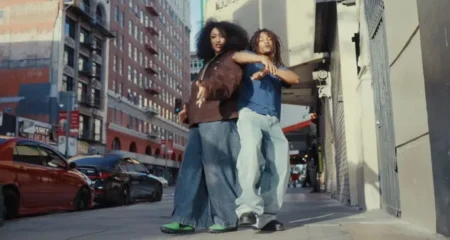
The video, co-directed by Hannah Lux Davis and Doja Cat and shot across Pomona and Koreatown in Los Angeles, works as a companion piece rather than a literal illustration of the lyrics.
It opens with Doja levitating, her ballet shoes sparking as she descends into a crowd of followers moving through the neighbourhood. Early imagery of washing off red reads as shedding the harder Scarlet persona to make room for something more interior.
From there the video sets up a horror premise, the title gestures toward The Hills Have Eyes, then quietly drops it in favour of intimate domestic settings: Doja on her bed, elongated toenails in unsettling close-up, a tanning bath in orange light. She wears red heels and clicks them three times, a Wizard of Oz nod that also signals a return to the origin the song’s title names.
The domestic close-ups are the visual equivalent of what the second verse does with language: both refuse to keep anything at a comfortable distance. The lyric that admits “when he broke my heart, you fixed that” and the camera that holds on something as private as a body resting alone are doing the same thing. Both drop the performance briefly and show you what’s underneath it.
The Agora Hills Lyrics Meaning: Putting It Together
The biographical detail and the song pull toward the same place. The Alice Coltrane ashram in Agoura Hills taught Doja performance as discipline, music, dance, and movement as a unified practice, long before she had an audience. The Troop sample reaches back into an R&B tradition she grew up inside. The title drops the “u” from the place that made her, turning a childhood address into a word about public life.
What the song is doing is using all of that to authorise a choice that everyone around her is questioning. The defiance in the lyrics isn’t performed. It’s structural. The private self and the public figure are both present in the song, and both of them are claiming the same person.
Scarlet is largely about controlling what you show. “Agora Hills” is the crack in that control, and Doja put it at track nine, deep enough into the album that you’ve already accepted the hard exterior before she lets it go. Whether that reads as vulnerability or strategy probably says more about the listener than the song.
You might also like:
- Decoding the Magic: An In-Depth Analysis of Open Arms Lyrics
- Juice Wrld’s All Girls Are the Same: A Masterpiece of Emo Rap and Pop Culture
- Exploring the Harmonic Convergence: Guitar In My Room by Lyrical Lemonade, Lil Durk & Kid Cudi
- Lil Mabu’s Mathematical Disrespect: A Critical Analysis of a Rap Phenomenon
- Paint the Town Red: Exploring Doja Cat’s Empowering Lyrics and Unique Artistry