
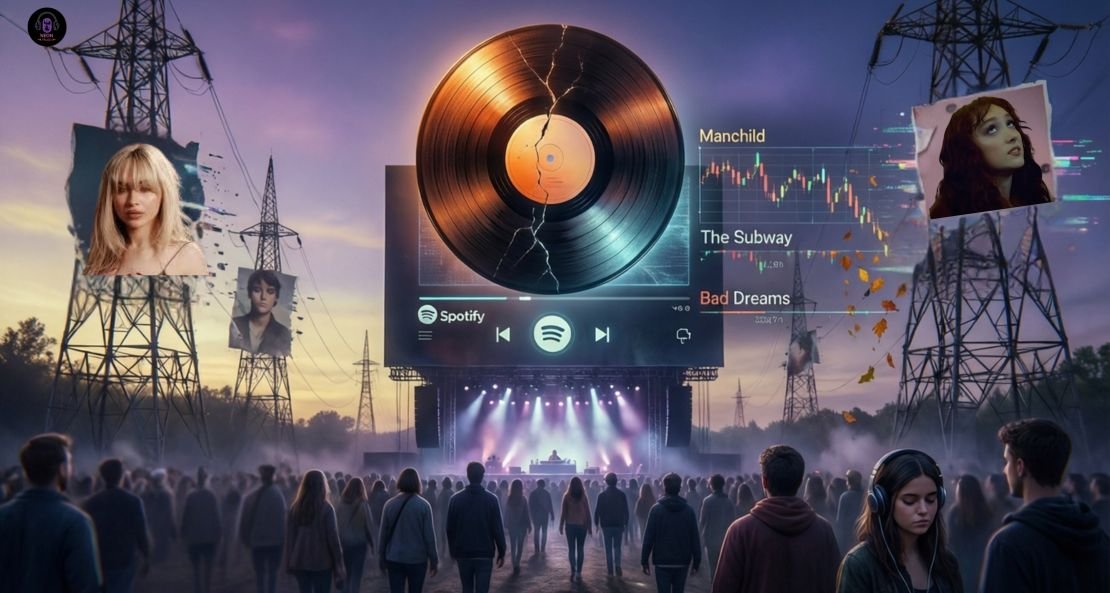
Here’s a sentence nobody in the music industry wanted to write: 2025 might be the year pop music forgot how to follow through.
Sabrina Carpenter’s “Manchild” debuted with more Spotify plays than “Espresso” did. Then it haemorrhaged streams week after week, despite Top 40 radio playing it over 14,000 times weekly.
Chappell Roan’s “The Subway” launched with 16 million first-week plays (one of the 100 biggest song debuts in US Spotify history) before dropping 40% in week two. By week six, it barely scraped together a quarter of those initial streams.
The pattern repeated itself across pop’s biggest names throughout the year. Massive anticipation. Solid debuts. Then nothing. Fans pressed play once, shrugged, and moved on.
Look, everyone loves a good “the music industry is broken” thinkpiece. But the streaming data from 2025 tells a weirder, more specific story: fans still showed up for their favourite artists. They just didn’t stick around for the songs.
Sabrina Carpenter and the Radio Paradox
“Manchild” should have worked. It had everything “Espresso” didn’t: a slightly higher debut week, relentless radio support, and the full weight of a major label promotional campaign behind it.
Radio programmers championed it. Playlist curators added it everywhere. The song became the second most-played track on US Top 40 radio.
None of it mattered.
By week five, “Manchild” pulled in half the streams it got during release week. The people who made “Espresso” the seventh biggest song of 2024 on Billboard’s year-end chart simply weren’t interested in what came next.
Not because they didn’t know about it (how could they not, with 14,000 weekly spins?) but because something about the listening experience failed to connect.
This is where the usual music journalism script falls apart. We’re supposed to analyse the songwriting, dissect the production choices, maybe throw in some cultural commentary about attention spans.
But none of that explains why radio exposure, which historically converts awareness into streams, suddenly stopped working for one of pop’s hottest artists.
The boring truth might be simpler: “Manchild” isn’t “Espresso,” and fans noticed.
Chappell Roan’s Two Very Different Stories
“The Subway” and “The Giver” both proved that Chappell Roan built a proper fanbase in 2024. Both songs debuted with massive numbers (16 million and 11 million plays respectively).
Roan’s breakthrough year created millions of people genuinely excited to hear whatever came next.
Then those people heard it and quietly logged off.
“The Subway” got modest airplay. The streams kept falling. Week five saw it pull fewer weekly plays than “Pink Pony Club” had during its own week five, despite “Pink Pony Club” being an album track with less prominent single support. That’s not a small difference, that’s a reversal.
“The Giver” took a different approach entirely, swerving into country music with fiddles and twang and Roan’s whole “cuntry” aesthetic.
It debuted at number five on the Hot 100, then fell out of the Top 10 entirely the following week. Critics loved it. Queer country Twitter went wild for it.
The broader pop audience that made “Good Luck, Babe!” a phenomenon? They tried it, decided lesbian country wasn’t their thing, and went back to streaming “Pink Pony Club.”
Here’s what’s fascinating about Roan’s situation: her fans absolutely exist. They’re just incredibly specific about which Chappell Roan songs they want to hear.
“Good Luck, Babe!” spent 14 weeks in the Hot 100’s top 10. “Pink Pony Club” became bigger in 2025 than it was when it originally released.
But “The Subway” and “The Giver” couldn’t replicate that staying power, despite debuting with numbers that would make most artists weep with gratitude.
It’s almost like Roan built her fanbase on a very particular sonic and emotional palette, then tried to expand beyond it.
The fans who loved her baroque pop maximalism weren’t necessarily interested in moody Taylor Swift-adjacent introspection or boot-stomping country anthems. They wanted more “Good Luck, Babe!” They didn’t get it, so they bounced.
When You’re a Song, Not an Artist
Benson Boone and Teddy Swims faced a completely different problem in 2025: their massive hits never converted casual listeners into actual fans.
“Beautiful Things” was the third biggest song of 2024. It didn’t debut with overwhelming numbers, but it built and built, eventually hitting 10 million weekly Spotify plays and staying on the Spotify 200 for the entire year. Proper staying power.
When Boone released “Sorry, I’m Here for Someone Else” and “Mystical Magical,” both got less than half the debut week plays “Beautiful Things” had received.
The millions of people who fell in love with that breakthrough ballad didn’t become Benson Boone fans. They became “Beautiful Things” fans. There’s a difference, and the streaming data knows it.
Teddy Swims’ “Lose Control” spent a record 77 weeks in the Hot 100’s top 10. Billboard named it song of the year for 2024. “Bad Dreams” debuted with under 3 million Spotify plays.
The maths is brutal: millions of people loved “Lose Control” enough to stream it for over a year straight, but fewer than 3 million bothered checking out what came next.
Those few who did try “Bad Dreams” apparently liked it. The song consistently pulled around 2.5 million weekly plays for weeks.
That’s not rejection, that’s a small, devoted audience. The problem is that “small devoted audience” doesn’t sustain pop careers in 2025’s streaming economy.
The distinction matters. When Chappell Roan or Sabrina Carpenter release new music, millions show up to try it.
When Benson Boone or Teddy Swims do the same, most of their previous hit’s audience doesn’t even bother. One problem is about conversion, the other is about awareness. Both are career killers, just in different ways.
The Established Stars Losing Their Grip
Then we’ve got the legacy acts watching their commercial viability crumble in real time.
Ariana Grande released “Twilight Zone” to fewer than 9 million first-week Spotify plays. It fell out of the Spotify 200 after five weeks.
This is an artist who could debut with 13 million plays and stay on the charts for almost a year as recently as 2020-2021 with “Positions.” Four years later, her core fanbase has either moved on or stopped caring enough to keep streaming.
Lady Gaga scored a massive hit with Bruno Mars on “Die With A Smile.” You’d think that success would create momentum for “Abracadabra.” It didn’t.
The retro dance track debuted smaller and faded faster, despite “Die With A Smile” still pulling huge numbers when “Abracadabra” dropped.
Ed Sheeran’s decline might be the starkest. “Shape of You” topped 2 billion Spotify streams first, remains the platform’s second most-played song ever, and defined 2017’s pop landscape.
“Azizam” got significant Adult Contemporary radio play in 2025 and never reached the Spotify 200. Not even close.
Teenagers now view Sheeran the way Gen X kids viewed Barry Manilow in 1982: hopelessly uncool, music for people who don’t know any better, the soundtrack to waiting rooms and shopping centres. That’s not coming back.
You might also like:
- How Streaming & TikTok Shape 2025’s Biggest Hits
- Playlist Hits: How Streaming Changed Music Discovery
- Spotify Streaming Chart Watch: December 2025 Rankings
- Streaming Payouts 2025: Which Platform Pays Artists the Most
- The 2024 Music Industry Trends Guide
- Top 30 TikTok Trends & Viral Songs of 2025
What the Streaming Data Actually Reveals
Music analyst Matt Bailey broke down the 2025 follow-up phenomenon into patterns, and whilst I hate reducing complex artistic struggles to categories, the data supports his framework.
Some artists (Carpenter, Roan, Bieber) saw fans try their new releases then bail. Others (Boone, Swims) watched their previous hit’s audience never show up in the first place.
Legacy acts (Grande, Gaga, Sheeran) experienced both problems simultaneously, losing audience size whilst also failing to connect with whoever remained.
What ties these different failures together is this: massive 2024 hits created awareness and initial curiosity. They didn’t create deep artist-fan relationships that could sustain future releases.
Casual listeners will press play once out of curiosity or algorithmic recommendation. They won’t come back if the new song doesn’t hit the same way the breakthrough did.
The streaming economy makes this pattern particularly brutal. A song needs millions of weekly plays to remain viable in playlist ecosystems and algorithmic recommendations.
Once your weekly numbers start dropping, the platforms bury you. Discovery surfaces stop showing your track to new listeners. Radio follows the streaming numbers downward.
The whole system creates a feedback loop that turns “fans aren’t returning to this song” into “nobody can find this song anymore.”
Matt Bailey documented how radio can still boost streaming, but in 2025, even sustained radio exposure couldn’t convert awareness into genuine engagement for these follow-ups. “Manchild” got 14,000 weekly spins and still bled streams. Something fundamental stopped working.
The Songs Themselves Weren’t the Problem
Here’s where music criticism usually goes: the songs weren’t good enough. The production was wrong. The lyrics missed. The vibe was off.
Except reviews for most of these tracks ranged from positive to glowing. Critics liked “The Giver.” They praised “Manchild.” “The Subway” got solid notices. The professional music press didn’t hate these songs.
Fans did. Or more accurately, fans tried them once and decided not to return. That’s different from actively disliking something. It’s closer to indifference, which might be worse.
You can fight against people hating your music. Indifference kills quietly, one lost stream at a time, until your song vanishes from the Spotify 200 after five weeks and nobody particularly notices or cares.
The quality of individual songs matters less than whether those songs create whatever emotional or sonic connection made the previous hit work.
“Espresso” worked for millions of people. “Manchild” didn’t, despite being professionally competent pop music with major label production and radio support.
The difference between “worked” and “didn’t” shows up in the streaming data as a 50% week-over-week decline. The reasons why are harder to pin down.
Where Pop Might Be Headed (Or Not)
Pop music desperately needs Gen Z to do what Boomers did with Beatlemania, what Gen X did with New Wave, what Millennials did with crunk: take existing sounds and update them in ways that feel both fresh and accessible across generations.
Tyler, The Creator sits in that space right now. His music sounds nothing like mainstream pop, yet he’s become a genuine superstar amongst Gen Z whilst maintaining credibility with older listeners who appreciate his artistic vision. That crossover appeal is what pop needs more of.
Bailey’s research points to nine songs already living in the Spotify 200 despite getting zero radio play. These tracks exist outside traditional promotional pathways, building audiences through mechanisms that have nothing to do with the infrastructure that made Sabrina Carpenter or Chappell Roan famous.
Maybe that’s where the next evolution is happening. Not in radio-supported singles with major label backing, but in weird pockets of streaming where fans find music the algorithms can’t quite categorise yet.
Or maybe we’re just in a transitional period where the old systems (radio, playlists, major label promotional campaigns) are losing effectiveness faster than new systems are gaining traction.
That in-between space is where 2025’s follow-up struggles live: too big to ignore, too disconnected from fan behaviour to succeed.
The broader music industry context makes everything harder. TikTok virality doesn’t automatically translate to sustained listening.
A MIDiA Research study from September 2025 found that 28% of 16-24-year-olds said their biggest barrier to streaming music from social media was hearing it enough there already. The platform becomes an endpoint rather than a gateway.
Meanwhile, streaming payouts remain poverty-level even for songs with millions of plays, putting pressure on artists to maintain absurd streaming numbers just to pay rent.
The artists who struggled with follow-ups in 2025 aren’t just watching their artistic momentum stall, they’re watching their income dry up.
🔍 NeonSignal: Catalogue Momentum Over Novelty
Signal: Legacy and Consistency as Success Engines
Status: Rising
Timeframe: Next 3–6 months
Why this matters:
Some of the biggest artists of 2025 – like Taylor Swift and Bad Bunny – didn’t succeed just because of new releases; they built momentum through catalogue strength and sustained engagement, turning back catalogues into evergreen cultural assets.
What happens next:
Artists will increasingly treat catalogue optimisation as a strategic priority, finding ways to surface older material that matches current listening moods.
What Comes Next
Taylor Swift and Bad Bunny dominated Spotify Wrapped 2025 by building audiences through catalogue consistency rather than single-song virality.
Their fans treat entire discographies like libraries, returning to deep cuts and album tracks years after release. That’s the model that works in streaming’s current iteration.
The artists who struggled in 2025 built their breakthroughs on individual viral moments. One massive song that connected with millions.
Then the follow-up didn’t connect the same way, and the whole thing collapsed. Creating lightning-in-a-bottle twice is nearly impossible. Creating a deep catalogue that rewards repeated listening is hard but achievable.
Some songs do need time. “Beautiful Things” took 17 weeks to reach its Spotify peak. “Lose Control” built glacially by streaming standards. But both those songs were the breakthroughs, not the follow-ups.
Whether Benson Boone or Teddy Swims can replicate that slow build with their next releases remains to be seen.
The question that matters: in an era where exposure comes easily but genuine connection comes hard, what actually creates lasting fan relationships?
The 2025 follow-up struggles suggest that massive hit songs don’t automatically create devoted fanbases.
Casual listeners will try a new release from an artist whose previous song they loved, but they won’t return if the new song doesn’t create a similar emotional connection.
That places artists in an impossible position: recreate the magic of your breakthrough hit, or watch your streaming numbers crater and your career stall.
Nobody has a good answer yet. But the streaming data from 2025 makes one thing clear: whatever pop music was doing to build artist-fan relationships in the 2010s stopped working.
We’re watching the old model break in real time. Whether a new one emerges to replace it, or whether we’re headed toward a future of one-hit wonders and disposable viral moments, remains genuinely uncertain.