

What Is “Kill Bill” by SZA About?
“Kill Bill” is a darkly comic revenge fantasy in which SZA imagines murdering her ex-boyfriend and his new girlfriend after their breakup, framing her obsession through the lens of Quentin Tarantino’s 2003 film of the same name. The song was released as the lead single from her sophomore album SOS (December 9, 2022) and became her first ever Hot 100 number one.
The song works because the rage is completely sober and the love is still intact. SZA never pretends either of those things is the problem. The murder fantasy is not the point. The loneliness is.
“I might kill my ex / Not the best idea…”
The Tarantino Connection
The song’s title is a direct reference to Tarantino’s two-part revenge film starring Uma Thurman, whose character, known as The Bride, is shot on her wedding day by her boss and former lover Bill, then hunts him down across both films to settle the score.
SZA uses the film’s emotional logic rather than just its iconography. She told Glamour: “In the movie Kill Bill, if you think about the relationship with Bill and how The Bride loved him. They were getting married, and he turned on her and became a stranger and a villain. She had to do what she needed to do to free herself.”
What she identified in that relationship was its complexity, not its violence. She told Entertainment Weekly: “I love Bill because he’s super complex. I feel like he doesn’t understand why he did what he did. He’s void of emotion, but he loved The Bride so much that he couldn’t stand her to be with anyone else. That was really complex and cool to me. It’s a love story.”
In the opening verse SZA is closer to Bill, consumed by jealousy, watching her ex move on. In the chorus she shifts into The Bride’s position, the one who has been wronged and now wants retribution.
The song holds both perspectives simultaneously, which is why the emotional logic feels true even when the content is absurd.
The Real Breakup Behind It
SZA was unambiguous about the real-world catalyst. She told Glamour: “When I first heard that my ex had a new girlfriend, I was like, ‘I can’t believe I wasted all that time with this person. I could kill him for it, and f*ck her too.’ That’s just how I felt naturally. I stopped smoking weed and wanted people to know that I’m very clearheaded and not distorted by alcohol, drugs, or anything else and yet I still feel rage.”
That detail, the sobriety, matters because the bridge hammers on it. The rage is clear-eyed and deliberate, which makes it both funnier and more unsettling than if she had written it drunk.
The Chorus Arc: How the Story Moves
One of the structural achievements of “Kill Bill” that rarely gets discussed is how the chorus changes across the song’s runtime to track a complete narrative arc.
The first chorus sits in fantasy: she might kill her ex. The closing chorus has passed through it: she just killed her ex. Alongside that, the closing line shifts from “rather be in jail than alone” to “rather be in hell than alone,” escalating the cost she claims she is willing to pay.
By the final refrain, the fantasy has become a completed act in the song’s internal logic, and the price has gone from prison to damnation. The song ends having consumed itself.
Second Verse: Where the Darkest Writing Is
The second verse is where the songwriting gets specific in a way the chorus’s dark humour does not. The narrator acknowledges the relationship is genuinely over, that her ex might actually love the new girlfriend, that any text she sends will become evidence, and that she has tried to talk herself out of violence. Then:
You was at the farmer’s market with your perfect peach
That line lands differently from everything around it because it is so mundane and so precise. The domestic normality of the image, a Saturday morning, a market, contentment she is not part of, is what tips her over into planning a home invasion. The fantasy escalates not from passion but from a glimpse of ordinary happiness she has been excluded from.
The Beat That Makes Obsession Feel Reasonable
“Kill Bill” was produced by Carter Lang and Rob Bisel, who co-wrote the song with SZA. The beat originated as a chord progression Bisel had recorded on his synth at home, which Lang then built around using sounds pulled from vintage drum machines.
The result was a rhythm with a slight swing to it, loose enough to feel organic, controlled enough to feel deliberate. They called the original instrumental “Igloo.”
The choice to keep the production sparse was not incidental. The arrangement sits deliberately low around SZA’s vocal, giving it almost no melodic competition.
There are no dramatic builds, no big drops signalling how to feel. What fills that space instead is the swing of the rhythm, slightly off-kilter, slightly hypnotic, sitting at the exact midpoint between seductive and unsettling. It is the kind of beat that makes obsessive thinking feel natural rather than alarming.
SZA’s vocal performance does the rest. She does not play the character for laughs or for tragedy but for both at once, keeping her delivery conversational even when the content tips into absurdity.
The line about the farmer’s market is delivered with the same measured calm as the lines about planning a home invasion.
That tonal flatness is where most of the song’s tension lives. When she finally lands the bridge, insisting she did all of this sober, for love, without drugs, the repetition has the quality of someone convincing themselves rather than confessing to anyone else.
The entire vocal melody and lyric was written in under an hour in the studio, and the finished record uses vocals from one or two takes that same night. That immediacy is audible. The performance does not sound constructed. It sounds like a thought she had and followed all the way through.
Does the Gimmick Hold Up?
It is worth asking, because the song’s premise is fundamentally a dark joke with emotional depth underneath it, whether that structure becomes limiting on repeated listens. The answer is mostly no, for a specific reason: SZA never lets the joke fully resolve.
Songs with a premise this extreme usually burn out by the second chorus. “Kill Bill” avoids that by taking the premise literally in its structure, completing the murder, escalating the stakes, and then refusing to offer any ironic distance at the end. The narrator does not wink at the audience or pull back into self-awareness. She ends in hell, still in love, alone. That is what stops it becoming a one-listen joke. You can’t quite shake it off.
Where it is marginally less effective is in the pre-chorus, where the therapist line, while funny, slightly interrupts the emotional momentum with self-commentary that the rest of the song is too controlled to need. It explains what the listener has already understood. It is a small thing, but in a song this economical, small things register.
The Music Video and the Visual Argument
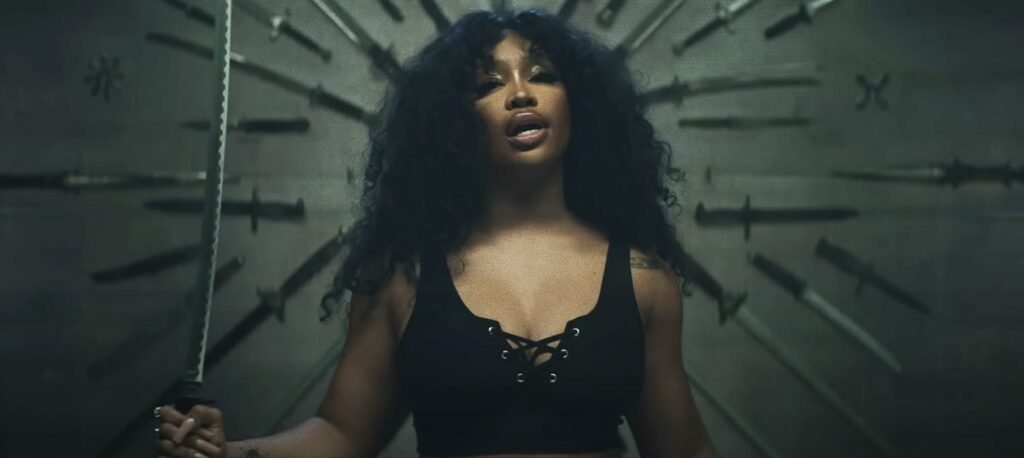
Directed by Christian Breslauer, the video does not simply recreate the Tarantino film. It makes an argument about what kind of woman gets to inhabit this kind of story.
SZA opens in the middle of a shootout, suits up in latex mirroring Uma Thurman’s look, rides a motorcycle, fights with a katana, and ends by cutting out her ex’s heart. The O-Ren Ishii anime sequence from the original film gets its own nod.
What the video adds to the song is visibility. The Bride in Tarantino’s film is white, blonde, and operating in a genre with an established template for who gets to be the wronged avenger. SZA’s version puts a Black woman inside that same narrative without comment or caveat, which is its own kind of statement.
The violence is not framed as exceptional or transgressive. It is treated as something she is simply entitled to, which sits in quiet conversation with the song’s refusal to apologise for anything it feels.
To understand what “Kill Bill” represents, it helps to place it against Ctrl, the 2017 debut that established SZA’s critical reputation. That album dealt with insecurity, longing, and the anxiety of not being enough, emotions directed largely inward. The narrator of Ctrl doubted herself. The narrator of “Kill Bill” has redirected that energy outward, with extreme prejudice.
This is the shift SZA described to Glamour as her villain era. Where Ctrl processed pain through vulnerability, SOS processes it through aggression, and “Kill Bill” is the purest version of that inversion.
The insecurity has not disappeared, it is legible in the pre-chorus admission that she got a therapist, in the acknowledgment that her ex might genuinely love his new partner, in the closing admission that hell is preferable to being alone.
But the mode of expressing it has changed entirely. The woman who spent Ctrl asking whether she was enough has stopped asking.
That trajectory is part of why the song landed so hard commercially. It gave listeners who had grown up with Ctrl a version of SZA who had processed the same pain and come out the other side angrier rather than wiser, which turned out to be exactly what they needed to hear.
“Kill Bill” and Contemporary Pop’s Appetite for Dark Material
“Kill Bill” arrived at a specific cultural moment. In the years preceding it, the dominant mode of pop confessionalism was therapeutic, songs that modelled healthy processing, self-acceptance, and moving on.
What SZA offered instead was a chart-ready fantasy about not moving on at all, packaged in production smooth enough to play anywhere.
Its commercial success, number one on the Hot 100, three weeks atop Streaming Songs, was not incidental to that contrast. It suggested that pop audiences were more comfortable with darkness than the industry had assumed, provided that darkness was honest rather than performed.
The song does not glorify what it describes. It does not reassure the listener that these feelings are wrong. It simply presents them accurately and trusts the audience to know the difference between recognition and endorsement.
That trust is increasingly rare. Most dark pop hedges. “Kill Bill” does not, and the audience responded accordingly.
What it charts, underneath the katanas and the murder fantasy, is the specific texture of loving someone you cannot have and being clear-eyed enough to know exactly how badly that has broken your judgment. That is not a gimmick. That is the whole song.
SZA Kill Bill Lyrics
Verse 1
I’m still a fan even though I was salty
Hate to see you with some other broad, know you happy
Hate to see you happy if I’m not the one drivin’
Pre-Chorus
I’m so mature, I’m so mature
I’m so mature, I got me a therapist to tell me there’s other men
I don’t want none, I just want you
If I can’t have you, no one should, I might
Chorus
I might kill my ex, not the best idea
His new girlfriend’s next, how’d I get here?
I might kill my ex, I still love him, though
Rather be in jail than alone
Verse 2
I get the sense that it’s a lost cause
I get the sense that you might really love her
The text gon’ be evidence, this text is evidence
I try to ration with you, no murders, no crime of passion
But, damn, you was out of reach
You was at the farmer’s market with your perfect peach
Now I’m in amazement, playin’ on my patience
Now you layin’ face-down, got me singin’ over a beat
Pre-Chorus
I’m so mature, I’m so mature
I’m so mature, I got me a therapist to tell me there’s other men
I don’t want none, I just want you
If I can’t have you, no one will, I (I might)
Chorus
I might kill my ex, not the best idea
His new girlfriend’s next, how’d I get here?
I might kill my ex, I still love him, though
Rather be in jail than alone
Bridge
I did it all for love (Love)
I did it all on no drugs (Drugs)
I did all of this sober
I did it all for us, oh
I did it all for love (Love)
I did all of this on no drugs (Drugs)
I did all of this sober
Don’t you know I did it all for us? (I’m gon’ kill your ass tonight)
Chorus
Oh, I just killed my ex, not the best idea (Idea)
Killed his girlfriend next, how’d I get here?
I just killed my ex, I still love him, though (I do)
Rather be in hell than alone