
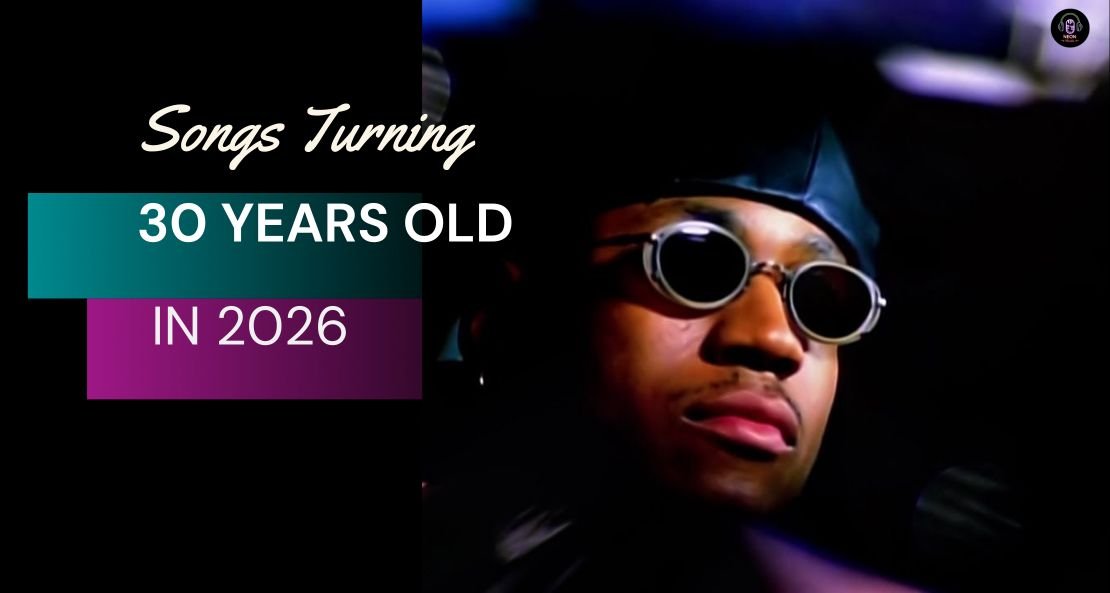
Thirty years. Three full decades. The songs that soundtracked 1996 are hitting that milestone in 2026, and they’re still everywhere.
Not archived, not rediscovered ironically on TikTok, not trotted out for nostalgic listicles. They’re active parts of the rotation, moving through streaming algorithms, DJ sets, and collective muscle memory like they never left.
1996 gave us peak R&B smoothness, hip-hop swagger at its finest, and pop that refused apology.
The year sat in that sweet spot where artists were perfecting sounds that had emerged in the early 90s whilst simultaneously pushing forward into territory nobody had mapped yet.
Production had gotten cleaner, bolder, more willing to break its own rules. Lyrics didn’t hint or suggest. They declared.
Looking back at these songs, what strikes you first is the confidence. Nobody was trying to sound like the competition. Production wasn’t chasing trends because these tracks were establishing them.
From Blackstreet’s sample-heavy audacity to the Spice Girls’ anarchic pop energy, from Fugees’ genre-collapsing ambition to Ginuwine’s futuristic seduction, 1996 established templates that music keeps returning to, whether it admits it or not.
Here are the songs celebrating their 30th birthday in 2026, and why they refuse to age.
When R&B Stopped Asking Permission
“No Diggity” – Blackstreet ft. Dr. Dre
This track almost never happened. None of Blackstreet’s members wanted to record it initially. Teddy Riley ended up singing the first verse because he couldn’t convince anyone else to touch it.
The group thought the Bill Withers sample from “Grandma’s Hands” sounded too weird. Virgin Records executives wanted a different lead single. Even producer Richard Stannard called it anarchic.
Then Dr. Dre added his verse, Queen Pen brought that Brooklyn bite, and suddenly you had an R&B masterpiece that topped the Billboard Hot 100 for four weeks, ended the “Macarena” reign, and sold 1.6 million copies in 1996 alone.
The track won Best R&B Performance by a Duo or Group with Vocals at the 1998 Grammys and has been covered by everyone from Cher Lloyd to Ed Sheeran.
What nobody expected to last was that production choice. Teddy Riley’s new jack swing DNA meets Dr. Dre’s G-funk precision over a sample that sounds simultaneously wrong and inevitable.
The way those piano stabs puncture the space after each chorus creates this pocket of silence that makes you lean forward. That groove doesn’t just move. It restructures time around itself.
The phrase “no diggity” came from LL Cool J, who spontaneously rapped it during an unreleased remix.
Riley grabbed it, transformed it from throwaway ad-lib into cultural shorthand. Thirty years later, the phrase still functions as instant agreement across generations who’ve never heard the original context.
That’s not nostalgia. That’s linguistic colonisation.
“Un-Break My Heart” – Toni Braxton
Diane Warren wrote this ballad, and Toni Braxton turned it into a masterclass in controlled devastation.
The song spent eleven weeks at number one on the Billboard Hot 100, becoming one of the biggest hits of the 90s.
Braxton’s contralto voice carries a weight that makes every line feel like it’s being physically excavated from somewhere she’d rather not access.
The production is spare: strings, keys, and that voice doing most of the heavy lifting. What makes it unbearable in the best way isn’t the big moments.
It’s where Braxton holds back, where her phrasing goes almost conversational right before the chorus hits.
She understands that sometimes heartbreak sounds quiet, almost flat, because performing your pain requires energy you no longer possess.
Three decades on, “Un-Break My Heart” remains one of the definitive breakup songs because it captures that specific moment when you’re past anger and stuck in desperate bargaining.
The music video’s gothic imagery (Braxton wandering through a mansion in black, mourning her lost love) became instantly iconic.
The song’s real legacy lives in every power ballad that followed, every artist who learned that sometimes the most powerful vocal moment is the one where you pull back instead of belting.
“Pony” – Ginuwine
Timbaland produced his first major hit here, and the sound he brought didn’t just change R&B. It broke the timeline.
That stuttering beat, those electronic hiccups that sound like glitches in the Matrix, the way the bassline sits under everything like a threat wrapped in velvet… this shouldn’t have been possible in 1996.
The production techniques Timbaland deployed here wouldn’t become standard for another decade.
“Pony” became the slow jam for a generation, soundtracking countless intimate moments. The lyrics aren’t subtle (this is straight seduction set to music), but they don’t need to be.
The confidence in the delivery, the way Ginuwine rides that beat like he’s having a conversation with the future, the burping robot sounds that should be ridiculous but instead create unbearable tension, all of it works because the conviction never wavers.
The track peaked at number six on the Billboard Hot 100, but its cultural footprint dwarfs its chart position. Strip clubs claimed it immediately. Films and TV shows use it whenever they need to signal sensuality.
TikTok discovered it again in 2021, and thousands of Gen Z users genuinely believed they’d found some underground gem, not realising they were the fourth generation to discover this song feels like it was made specifically for them.
Still in rotation because: Timbaland’s production aged in reverse, getting fresher as production technology caught up to what he’d already imagined.
“Return of the Mack” – Mark Morrison
The UK garage sound meets R&B swagger on this track, and Mark Morrison delivers one of the decade’s most satisfying revenge songs.
He’s not crying over his ex. He’s not begging her back. He’s letting her know through every bar and ad-lib that he’s upgraded, moved on, and she can watch from the outside now.
The production sits in this perfect pocket between UK garage’s skippy beats and R&B’s smooth grooves. The “oh my God” sample that punctuates the track became instantly iconic.
Morrison’s vocals carry attitude without bitterness because he’s genuinely past that stage. Watch how he delivers “you lied to me” – there’s no anger left, just matter-of-fact observation. That emotional detachment is triumph made audible.
“Return of the Mack” hit number two on the UK Singles Chart and broke into the US market, introducing American audiences to British R&B as its own established force, not an import curiosity.
The track has been sampled and referenced countless times since, most notably inspiring an entire wave of UK artists who proved R&B wasn’t bound by geography or accent.
In 2026, the song’s message still circulates through breakup playlists and petty Instagram stories. Anyone who’s ever been underestimated and then proved doubters wrong claims this song, and Morrison welcomes everyone to the party.
“If Your Girl Only Knew” – Aaliyah
Aaliyah, Timbaland, and Missy Elliott created something special on this lead single from One in a Million.
The production feels sparse but heavy. Those drums hit with physical force, the bass rumbles underneath like tectonic plates shifting, and Aaliyah’s vocals float effortlessly on top.
She’s telling someone’s boyfriend that his girl doesn’t treat him right, and she could do better. The confidence is quiet but absolute.
What nobody else was doing in 1996 was this much restraint. Aaliyah never oversings. She trusts the production and her own voice enough to let moments breathe.
That vocal run on “things I’ll do to you” is smooth as silk. The way she delivers “I could be your fantasy” sounds more like stating a verifiable fact than making a proposition.
“If Your Girl Only Knew” peaked at number one on the Billboard Hot R&B/Hip-Hop Songs chart and went platinum.
It established Aaliyah’s mature sound after her debut album and set the template for how she’d approach music for the rest of her too-short career.
Still in rotation because: This is the blueprint every artist studies when they want to sound effortlessly cool. The Timbaland-Aaliyah chemistry created something that producers still chase.
“Twisted” – Keith Sweat
Keith Sweat’s signature whine meets mid-tempo R&B perfection on this track. He’s describing a relationship that’s got him all twisted up, the kind of situation where logic goes out the window and emotion hijacks every decision you thought you’d made.
What sells “Twisted” is Sweat’s vocal performance. He’s not trying to be smooth. He sounds genuinely conflicted, caught between desire and self-preservation, fully aware he’s making terrible decisions and planning to make more.
That vulnerability, delivered with such conviction, connected with listeners who recognised that feeling of being emotionally tangled up with someone who’s probably wrong for you.
The track hit number two on the Billboard Hot 100 and stayed on the charts for months. It proved Keith Sweat’s staying power in an era where R&B was rapidly evolving.
He adapted his sound just enough to stay relevant without abandoning what made him Keith Sweat in the first place.
Three decades later, “Twisted” remains the go-to for anyone trying to explain relationship complexity to friends who keep asking why you won’t just leave.
Sometimes you can’t logic your way through emotions, and this song captures that truth without judgment.
Hip-Hop’s Victory Lap
By 1996, hip-hop had stopped fighting for legitimacy. These tracks represent the genre fully comfortable with commercial dominance, technical excellence, and cultural authority.
Nobody was explaining hip-hop anymore. They were executing it at the highest level.
“Woo Hah!! Got You All in Check” – Busta Rhymes
Busta Rhymes announced his solo arrival with controlled chaos. That bellowing delivery, those rapid-fire flows that sound like they’re arguing with gravity, the way he commands attention from the first “WOO HAH”… this was hip-hop showmanship elevated to performance art.
The track samples “Everything Is Everything” by Diana Ross and Marvin Gaye, flipping it into something frantic and gleefully unhinged.
The music video, directed by Hype Williams, featured Busta in that memorable fur coat and shiny dome, establishing a visual aesthetic as distinctive as his audio presence.
He’s not trying to be gangsta. He’s not trying to be conscious. He’s just being Busta Rhymes, which means being the loudest, wildest, most technically skilled person in any room whilst making it look like no effort whatsoever.
“Woo Hah” peaked at number eight on the Billboard Hot 100 and went gold. It established Busta as a solo force after his years with Leaders of the New School.
The track’s energy hasn’t diminished. It still sounds like controlled explosion, the kind of song that demands you turn the volume up and accept noise complaints as the cost of doing business.
Three decades on, Busta’s delivery remains a masterclass in how to own a beat. He’s not just rapping over it; he’s having a physical altercation with it, matching its energy, pushing it further, daring it to keep up.
“Get Money” – The Notorious B.I.G.
Biggie’s “Get Money” featuring Lil’ Kim and Junior M.A.F.I.A. sampled R. Kelly’s “You Remind Me of Something” and turned it into a hustler’s anthem that understood wealth and danger aren’t opposites.
They’re dance partners. The track appeared on Junior M.A.F.I.A.’s album Conspiracy, but everyone knew who the star was. Biggie’s flow is effortless, his wordplay sharp enough to draw blood, his presence undeniable.
Lil’ Kim matches his energy, delivering verses that established her as hip-hop’s Queen Bee and proved women could be just as unapologetic about materialism, power, and pleasure.
The chemistry between them crackles through the speakers. They’re talking about money, success, and the lifestyle that comes with both.
The materialism is celebratory, yes, but there’s also this undercurrent of survival – getting money isn’t just about wanting luxury, it’s about never going back to having none.
The track became a cornerstone of East Coast hip-hop in the mid-90s, representing that Bad Boy sound Diddy was perfecting. It’s braggadocious without being hollow, because Biggie’s technical skill and lived experience back up every boast.
In 2026, “Get Money” sits in hip-hop’s pantheon of essential tracks. It captured a moment when hip-hop was fully embracing commercial success whilst maintaining street credibility, proving the two weren’t mutually exclusive if you were skilled enough. Biggie was skilled enough.
“Hey Lover” – LL Cool J ft. Boyz II Men
LL Cool J took his ladies’ man persona and gave it an R&B makeover with help from Boyz II Men.
The track samples Michael Jackson’s “The Lady in My Life,” which already had romantic pedigree, and builds a smooth mid-tempo groove perfect for stepping. LL’s rap verses flow seamlessly into Boyz II Men’s sung chorus, creating this conversation between confidence and vulnerability.
What works about “Hey Lover” is the sincerity. LL isn’t playing a character here. He sounds genuinely smitten, combining his trademark confidence with actual affection that feels earned rather than performed.
Boyz II Men add that harmonic depth that made every song they touched feel like a love letter written in perfect penmanship.
The track peaked at number three on the Billboard Hot 100, giving LL Cool J another massive hit in a career full of them.
It showed his versatility. He could go hard on battle raps and then switch to romance without losing credibility in either lane.
Three decades later, “Hey Lover” remains a staple at old-school parties and weddings. That’s the kind of song you can pull out at any age and it still hits the same way, still makes people smile at the memories it carries.
“Feel Me Flow” – Naughty by Nature
Naughty by Nature proved their staying power with “Feel Me Flow,” a track that balanced commercial appeal with hip-hop authenticity so perfectly that both audiences claimed it.
The production features a smooth, rolling beat with melodic elements that make it accessible without sacrificing edge. Treach’s flow is intricate without being showy, the kind of technical proficiency that other MCs recognise and respect whilst casual listeners just enjoy the ride.
The track hit number three on the Billboard Hot 100, showing that Naughty by Nature could evolve their sound without abandoning their roots.
“Hip Hop Hooray” had been massive, but “Feel Me Flow” proved they weren’t one-hit wonders coasting on novelty. They could make radio-friendly music that hip-hop purists still respected.
What makes this track age well is its groove. The beat feels timeless, the flow still sounds fresh, and the overall vibe captures mid-90s hip-hop at its most polished without losing its soul.
This was hip-hop fully comfortable with commercial success, no longer needing to prove its legitimacy to gatekeepers who’d already lost control of the narrative.
In 2026, “Feel Me Flow” represents that moment when hip-hop established itself as a dominant cultural and commercial force.
The genre wasn’t underground anymore, wasn’t niche anymore, and tracks like this showed what was possible when hip-hop aimed for the mainstream without compromise or apology.
You might also like:
- The Ultimate Guide to R&B Songs: From Classic to Contemporary
- Is R&B Dying Or Evolving? Exploring the Evolution of the Genre from the 90s to Today
- The Golden Age of Hip Hop: A Guide to the 90s Rap Scene
- Six 90s Trends Making A Comeback
- The Best Conscious Hip-Hop Songs of All Time: A Playlist for Social Change
The Fugees Rewrote the Rules
“Killing Me Softly” & “Ready or Not”
The Fugees took 1996 by storm with The Score, and these two tracks showcase not just their range but their fundamental understanding that genre boundaries were suggestions, not laws.
“Killing Me Softly” reimagined Roberta Flack’s 1973 classic with hip-hop production, Lauryn Hill’s stunning vocals, and Wyclef Jean’s creative vision.
Hill doesn’t just cover the song; she inhabits it, transforms it, makes it feel urgent and contemporary whilst respecting the original’s soul.
The track topped charts globally, introducing a new generation to the song whilst showing hip-hop’s capacity for reinvention without destruction.
That music video, shot in black and white, gave the whole thing an artistic weight that elevated it beyond typical 90s hip-hop visuals into something closer to cinema.
“Ready or Not” samples Enya’s “Boadicea” and Delroy Wilson’s “I’m Still Waiting,” creating this haunting backdrop for verses about determination and success that feel equally like promises and threats.
Lauryn Hill, Wyclef Jean, and Pras each bring distinct energy, and their collective chemistry makes the track feel like a conversation between three distinct voices united by shared purpose and refusal to be categorised.
What changed because these songs existed: Hip-hop stopped having to choose between commercial success and artistic credibility.
The Fugees proved you could have both if you were skilled enough, ambitious enough, and willing to ignore anyone who said it couldn’t be done.
Thirty years later, artists still cite The Score as the blueprint for how to make intelligent, genre-blending hip-hop that doesn’t alienate mass audiences.
Pop Refused to Play Nice
“Wannabe” – Spice Girls
Nobody wanted “Wannabe” to be the Spice Girls’ first single. Not Virgin Records executives, who preferred “Say You’ll Be There.”
Not producer Richard Stannard, who thought it was too weird. Not even some members of the group, who couldn’t get past its anarchic structure that seemed to actively reject traditional pop songwriting.
Geri Halliwell put her foot down. “It’s not negotiable as far as we’re concerned. ‘Wannabe’ is our first single.” She was right.
The track was recorded in under an hour after the girls had already worked out most of the structure beforehand.
You can hear that spontaneity in every sudden shift, every moment where the song seems to trip over itself and keep running. There’s no traditional verse-chorus structure.
It’s just five personalities colliding in real time, talking about friendship mattering more than romance, declaring “girl power” without footnotes or apology.
“Wannabe” topped the UK Singles Chart for seven weeks and eventually hit number one in 37 countries.
It sold over six million copies worldwide, becoming the best-selling single by an all-female group. The music video, shot in one continuous take at the Midland Grand Hotel, captured their chaotic energy perfectly.
They’re not performing for the camera so much as dragging it along behind them whilst they take over the space.
What “Wannabe” accomplished goes beyond sales figures or cultural impact metrics. It made “girl power” a global phenomenon, yes, but more importantly it proved female friendship could be the central narrative of a pop song, not just subplot to romance.
It showed you didn’t need to be a technical vocalist to connect with millions of people. You just needed personality, conviction, and a message that resonated.
Still in rotation because: The song’s refusal to conform to structure makes it sound perpetually fresh, like it’s still figuring itself out in real time. That “zig-a-zig-ah” still makes no sense, and somehow that’s perfect.
“Don’t Speak” – No Doubt
No Doubt’s “Don’t Speak” gave us Gwen Stefani’s heartbreak in real time, unprocessed, still bleeding.
The song was originally about communication breakdown in relationships, but during recording, Stefani and bassist Tony Kanal broke up.
She rewrote the lyrics to reflect their relationship’s end, and suddenly the song carried actual weight. You’re not listening to a performance; you’re witnessing someone processing loss whilst trying to maintain dignity.
The production starts sparse (just piano and Stefani’s voice) before building to that massive chorus.
Her vocal performance sells every line because it’s not technically perfect. It’s emotionally accurate. When she hits “don’t speak, I know just what you’re saying,” the desperation is palpable.
This is someone trying to control the narrative of their own heartbreak and failing in real time.
“Don’t Speak” topped charts in 16 countries and spent 16 weeks at number one on the Billboard Hot 100 Airplay chart.
The music video, showing the band’s dynamic shifting as Stefani became the focus, added another layer of meta-narrative to the whole thing, documenting the same tensions the song describes.
Three decades later, “Don’t Speak” remains one of the definitive breakup songs because it captures that specific moment when you know it’s over but you’re not ready to acknowledge it yet, so you keep talking, keep explaining, keep negotiating with reality.
Everyone who’s experienced a relationship’s painful end has their own version of this song in their history.
“Firestarter” – The Prodigy
The Prodigy brought electronic music to the mainstream with “Firestarter,” a track so aggressive and deliberately weird that it shouldn’t have worked on radio but absolutely did.
Keith Flint’s snarled vocals, that relentless beat, the industrial production that sounds like machinery achieving consciousness and choosing violence… this wasn’t trying to be accessible. It was daring you to keep up or get out of the way.
“Firestarter” hit number one in the UK, Finland, Norway, and sold over three million copies globally.
The music video, featuring Flint’s manic performance in an abandoned London Underground station, became instantly iconic.
MTV put it into heavy rotation despite its clear unsuitability for daytime viewing, because sometimes cultural momentum overrides corporate caution.
What makes “Firestarter” still sound radical in 2026 is its refusal to compromise. The Prodigy weren’t making electronic music that sounded like pop or rock.
They were making electronic music that sounded like The Prodigy, and they forced the mainstream to come to them on their terms or not at all.
The track kicked open doors for electronic music in ways that are still felt today. Chemical Brothers, Daft Punk, and countless others benefited from The Prodigy proving aggressive, challenging music could be commercially successful without dilution.
Three decades on, it remains a banger that sounds completely modern, possibly because it never tried to sound contemporary in the first place.
“Lovefool” – The Cardigans
The Cardigans’ “Lovefool” is deceptively dark wrapped in the sweetest package imaginable. Nina Persson’s vocals sound innocent, almost childlike, singing lyrics about desperate love and rejection.
“Love me, love me, say that you love me” sounds cute until you realise it’s someone begging for affection they know they won’t receive, performing happiness whilst drowning.
The production is pure Swedish pop perfection. That guitar line is instantly memorable, the strings add dramatic weight without overwhelming the intimacy, and everything sits in this perfect balance between light and heavy.
The song appeared in Romeo + Juliet, Baz Luhrmann’s modernised Shakespeare adaptation, which introduced it to massive audiences who recognised its emotional duality immediately.
“Lovefool” became a global hit, charting in dozens of countries and selling millions. What keeps it relevant three decades later is that tension between the sound and the sentiment.
It’s simultaneously catchy and melancholy, fun and slightly disturbing, like dancing at a party whilst having an existential crisis. That complexity gives it staying power beyond typical pop’s shelf life.
The Quietly Legendary
Some 1996 songs didn’t dominate headlines but carved out permanent space in the culture through sheer quality and emotional accuracy.
“Loungin’ (Remix)” – LL Cool J ft. Total
LL Cool J’s “Loungin'” remix with Total took the original track and elevated it with female harmonies that added smoothness to LL’s flow without softening his edge.
The production is laid-back luxury, the kind of track made for Sunday afternoons and romantic evenings that might extend into Monday mornings.
Total’s vocals wrap around LL’s raps perfectly, creating this back-and-forth that feels natural rather than engineered.
The track peaked at number three on the Billboard Hot 100, giving everyone involved another massive hit. It showed LL’s range. He could do battle raps, lover’s raps, and everything between with equal skill and conviction.
Three decades on, “Loungin'” remains a staple of old-school R&B and hip-hop playlists. It’s one of those tracks that instantly transports you back to mid-90s cool, when everything felt possible and the future looked bright.
“Steelo” – 702
702’s “Steelo” introduced the trio to a wide audience with its smooth production and harmonies that showed clear Boyz II Men influence (they were featured on the remix).
The track peaked at number 32 on the Billboard Hot 100 but found its real audience on R&B stations where it dominated for months.
The song’s about a guy who’s got that undefinable quality (style, confidence, swagger) that the term “steelo” captures perfectly.
702’s vocals are youthful but controlled, showing technical ability without oversinging or showing off. The production is mid-90s R&B at its finest: clean, melodic, groove-focused without being mechanical.
“Steelo” represents that wave of young R&B acts who emerged in the mid-90s, bringing fresh energy to the genre whilst respecting its traditions and elders.
Thirty years later, it’s a perfect time capsule of what made that era special, when R&B groups were still commercially viable and vocal arrangements still mattered.
“Touch Me, Tease Me” – Case ft. Foxy Brown
Case’s smooth-as-silk vocals meet Foxy Brown’s sharp rap presence on this slow jam that doesn’t apologise for its subject matter.
The Nutty Professor soundtrack introduced many people to Case, and “Touch Me, Tease Me” showed he could hold his own alongside hip-hop’s rising stars without losing his R&B identity.
The production is sensual without being sleazy, creating space for Case’s vocals to shine whilst giving Foxy Brown room to add edge and attitude.
The track went gold and established Case as a serious R&B artist. His ability to convey desire without desperation set him apart in an era full of bedroom anthems that often tipped into parody.
Three decades on, “Touch Me, Tease Me” remains a favourite for anyone who lived through mid-90s R&B.
It captured that moment when R&B and hip-hop were fully intertwined, creating tracks that satisfied both audiences without pandering to either.
“Cupid” – 112
112’s “Cupid” sampled “Special Lady” by Ray, Goodman & Brown, building a track about falling hard for someone unexpected.
The four-part harmonies that became 112’s signature are on full display here, showcasing vocal arrangements that felt sophisticated without being stuffy or overly technical.
The track peaked at number 13 on the Billboard Hot 100 and became a radio staple throughout 1997.
It introduced 112 to mainstream audiences and showed Bad Boy Records wasn’t just about hip-hop. They could develop R&B acts with serious vocal chops and commercial appeal.
“Cupid” represents that late-90s R&B sound where groups were still relevant, vocal arrangements still mattered, and singles were crafted for longevity rather than quick streaming spikes.
Thirty years later, it remains a beautiful example of what R&B harmonies can achieve when skill meets sincerity.
“Always Be My Baby” – Mariah Carey
Mariah Carey’s “Always Be My Baby” is interesting because it flips the breakup song script entirely.
She’s not devastated. She’s not angry. She’s confident that her ex will eventually realise what they had and come back, and if they don’t, the memory of what they shared will follow them forever.
That certainty, delivered with Mariah’s signature whistle notes and Jermaine Dupri’s smooth production, creates something simultaneously vulnerable and powerful.
The track topped the Billboard Hot 100 for two weeks and became one of Mariah’s signature songs.
The music video’s playful aesthetic (Mariah in overalls, the bright colours, the casual vibe) contrasted with her usual glamorous image, showing range and relatability without sacrificing star power.
Three decades on, “Always Be My Baby” remains a karaoke favourite and a staple of 90s nostalgia playlists.
Its message of bittersweet confidence in love’s lasting impact still resonates because Mariah understood something crucial: sometimes the most powerful position in a breakup is knowing you’ll be remembered.
“One Sweet Day” – Mariah Carey & Boyz II Men
The collaboration between Mariah Carey and Boyz II Men created a ballad about grief and loss that spent 16 weeks at number one on the Billboard Hot 100, a record that stood for over two decades.
The song’s about people who’ve passed away and the hope of eventual reunion, delivered with such sincerity that it became a soundtrack for collective mourning across cultures and contexts.
Mariah’s vocals soar, Boyz II Men’s harmonies provide depth and grounding, and the production never overwhelms the emotion or tries to distract from the lyrics’ weight.
The song hit during the holiday season, amplifying its impact as people reflected on loss during a time meant for togetherness and celebration.
“One Sweet Day” sold over 3.8 million copies and won numerous awards. Its longevity on the charts speaks to how it connected with listeners dealing with grief in all its forms.
Thirty years later, it remains a go-to song for anyone processing loss, finding comfort in the hope that separation might not be permanent.
“Don’t Let Go (Love)” – En Vogue
En Vogue’s “Don’t Let Go (Love)” from the Set It Off soundtrack showcased their vocal power on a track that balanced vulnerability with strength perfectly.
The harmonies are immaculate, the production hits that perfect pocket between ballad and mid-tempo groove, and the message about holding onto love despite challenges resonated with anyone who’d ever fought for a relationship worth saving.
The track peaked at number two on the Billboard Hot 100 and became one of En Vogue’s biggest hits.
It showed the group could evolve their sound whilst maintaining the vocal excellence that defined them from the start. The music video’s emotional performance added weight to lyrics that were already powerful.
Three decades on, “Don’t Let Go” remains an example of 90s R&B at its peak: technically brilliant, emotionally resonant, and timeless in its execution.
It’s the kind of song that reminds you why R&B groups mattered, why harmony parts done well can elevate good songs into great ones.
“Nobody Knows” – The Tony Rich Project
The Tony Rich Project’s “Nobody Knows” topped the Billboard Hot 100 for two weeks with its confessional lyrics and stripped-down production.
Rich wrote, produced, and performed everything himself, creating an intimate track about private struggle that somehow became a massive hit despite sounding nothing like radio’s usual fare.
The production is spare: acoustic guitar, subtle programming, and Rich’s vocals carrying most of the weight. It’s the opposite of the polished R&B dominating mid-90s radio, which made it stand out like a whisper in a shouting match.
That rawness connected with listeners who recognised the feeling of hiding pain behind public smiles, performing normalcy whilst falling apart internally.
“Nobody Knows” earned two Grammy Awards and sold over a million copies. Three decades later, it represents that moment when alternative R&B could break through commercially without losing its distinctive voice or compromising its intimacy.
What 1996 Got Right (And What We Lost)
Not every 1996 song aged well. Plenty of that year’s hits sound dated now, trapped in production choices that haven’t survived or lyrical approaches that feel uncomfortable through 2026’s lens.
That contrast matters because it highlights what made the survivors special.
The songs turning thirty in 2026 share certain qualities that kept them vital. First, they sound like decisions, not trend-following.
Whether it’s The Fugees blending genres without permission, Aaliyah’s effortless cool that trusted silence as much as sound, or the Spice Girls’ unfiltered energy that refused to be polished into submission, these tracks don’t sound calculated.
They sound like artists making the music they needed to make, trusting audiences would either connect or not.
Second, production that took risks and won. Timbaland’s futuristic beats that sounded impossible, Teddy Riley’s sample choices that shouldn’t have worked, The Prodigy’s industrial aggression that forced the mainstream to bend… none of it played safe.
That willingness to push boundaries and trust instinct over market research gave these tracks staying power. They didn’t sound like everything else in 1996, so they don’t sound dated in 2026.
Third, emotional honesty that refused ironic distance. Whether celebrating desire, processing heartbreak, or asserting independence, these songs said what they meant.
No coded messages designed to mean different things to different audiences, no winking self-awareness that undercuts genuine feeling.
That directness lets them transcend their era because human emotions don’t update with operating systems.
What’s interesting about 1996 through a 2026 lens is how much of that year’s authenticity feels rare now.
The algorithmic pressure to optimise every creative decision, the incentive to chase trends rather than set them, the way streaming economics favour safe choices over risky ones… these forces push against the kind of confidence 1996’s best music embodied.
Artists today who manage to sound as convinced of their own vision as Aaliyah or The Fugees or even the Spice Girls deserve recognition because they’re swimming against stronger currents.
The songs turning thirty aren’t museum pieces. They’re active parts of music culture, still referenced, sampled, covered, and loved three decades after their release.
They show up in TikTok trends and DJ sets, wedding playlists and breakup mixtapes, algorithmic recommendations and human curation.
Their longevity isn’t tied to nostalgia. It’s tied to quality, conviction, and the courage to make something that matters rather than something that fits.
As these tracks hit thirty, they deserve recognition not just for what they meant in 1996, but for what they continue to teach in 2026: that music’s power comes from artists trusting their instincts enough to sound like themselves rather than like successful people who came before them.
These songs did that in 1996. They’re still doing it now.
Which raises an interesting question worth considering: what songs from 2016 will still feel this alive in 2046?
Which of today’s hits are making choices brave enough to survive decades of changing tastes and technologies? The answer probably won’t be the ones optimised for quarterly streaming targets.