
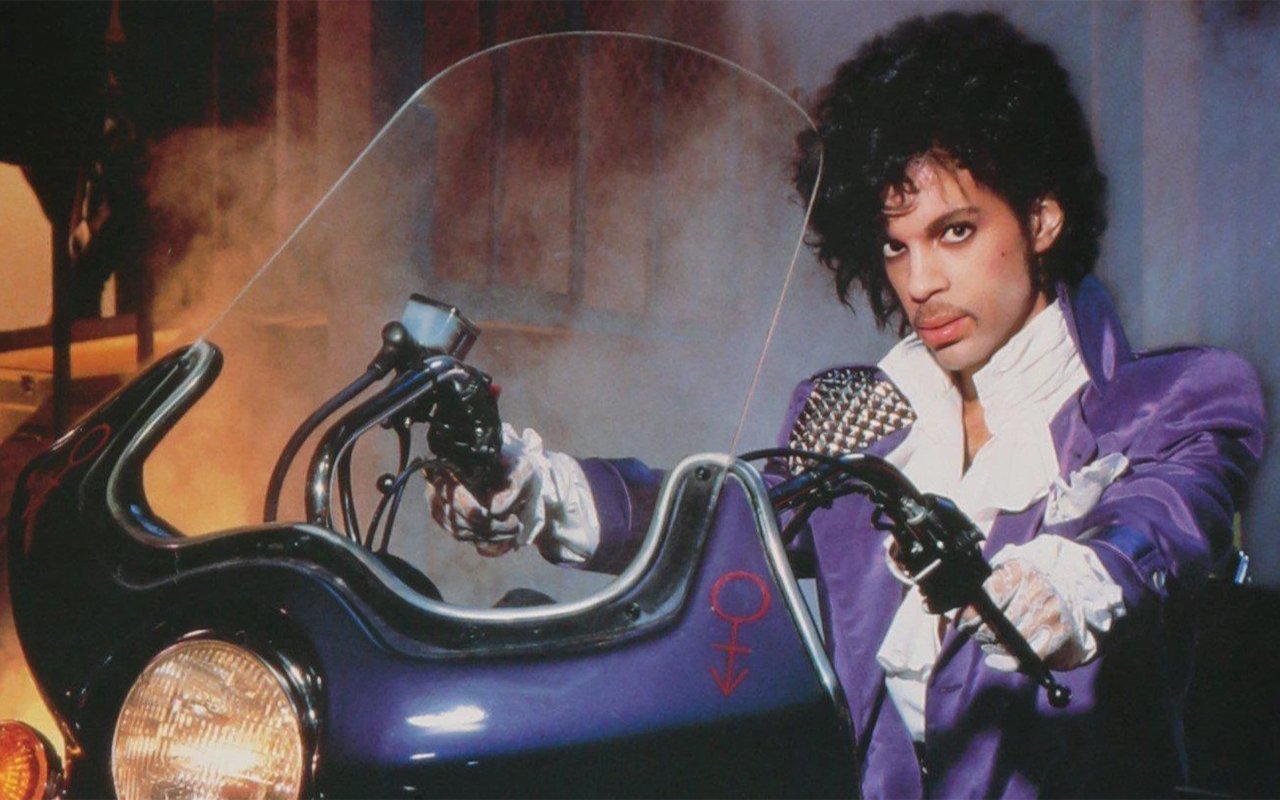
Prince’s “Purple Rain” meaning centres on redemption at the end of the world. The simplest answer to what does “Purple Rain” mean is this: it describes the moment the world ends and love is the only thing left.
Prince explained that the phrase describes a sky turning purple when blood mixes with rain, red and blue combining into the colour he made his own, and that the song is about holding onto love and faith as everything else falls apart.
In his own words: “When there’s blood in the sky, red and blue = purple… purple rain pertains to the end of the world and being with the one you love and letting your faith/god guide you through the purple rain.”
The meaning of “Purple Rain” is Prince’s vision of love and faith surviving the end of the world, symbolised by a sky turning purple when blood mixes with rain.
Released June 25, 1984, as the title track and closing song on the Purple Rain soundtrack, the Prince “Purple Rain” meaning has been debated since the day it arrived.
Written by Prince and The Revolution, recorded live at First Avenue in Minneapolis, and produced by Prince, the song reached number 2 on the US Billboard Hot 100, held back by Wham!’s “Wake Me Up Before You Go-Go” during its two-week peak.
It spent 16 weeks in the Top 40 and 24 weeks on the chart in total. In the UK it reached number 8. The Purple Rain album is certified 13x Platinum in the US with over 25 million copies sold worldwide. The song won Prince the Academy Award for Best Original Song Score for the Purple Rain film soundtrack.
For anyone still asking what the meaning of “Purple Rain” by Prince is, the rest of this article works through every layer.
Its live presence outlasted its chart run by decades. Prince performed it at almost every show after 1984 and used it as the closing number on both his Purple Rain and Musicology tours.
At Super Bowl XLI in 2007 he played it during the halftime show in actual rain, the stadium lit in purple, his silhouette alone at the mic stand.
Many people who were not Prince fans became Prince fans during those eight minutes. He performed it at the Grammy Awards in February 2004 alongside Beyoncé, his first Grammy appearance since 1985, and used it to re-announce himself after years of catalog disputes and name changes.
The song’s final public appearance was also its most permanent. It was the last song Prince performed live, closing his April 14, 2016 concert at the Fox Theatre in Atlanta.
He died eight days later. After his death on April 21, 2016, the song re-entered the Billboard Hot 100 at number 4 and climbed to number 6 on the UK chart, two places above its original peak. Buildings across the world turned purple.
Bruce Springsteen opened his Brooklyn show two days later with an unannounced performance of it. The song had become the thing people reached for when nothing else would do, at funerals, at memorials, in arenas going dark.
The Origin of Purple Rain: How Prince Wrote the Song
Prince originally conceived the track as a country song. He sent Stevie Nicks a ten-minute instrumental and asked her to write the lyrics. She turned it down. “I listened to it and I just got scared,” Nicks said. “I called him back and said, ‘I can’t do it. I wish I could. It’s too much for me.'”
What happened after that matters more. At a rehearsal with The Revolution, Prince told the band, “I want to try something before we go home. It’s mellow.”
Guitarist Wendy Melvoin, 19 years old and making her live debut with the band, began playing a chord voicing that shifted the song’s direction entirely.
Keyboardist Lisa Coleman recalled: “He was excited to hear it voiced differently. It took it out of that country feeling. Then we all started playing it a bit harder and taking it more seriously. We played it for six hours straight and by the end of that day we had it mostly written and arranged.”
Prince recorded the song live on August 3, 1983, at First Avenue during a benefit concert for the Minnesota Dance Theatre.
The performance was captured by David Rivkin, also known as David Z, Bobby Z’s brother, using a mobile recording unit.
“With Prince, you never knew. I thought we were recording a concert, but I wasn’t sure if it was going to be a record, too,” Rivkin said.
The album version runs eight and a half minutes. Prince later trimmed the track, cutting a verse reportedly about money, and performed overdubs at Sunset Sound in Los Angeles between August and September 1983.
He also added strings and backing vocals. The shortened single version exists but the full-length live recording is the one most associated with the song.
The track is written in Bb major and opens with a clean electric guitar figure, joined by drums and piano within the first few bars.
Wendy Melvoin reportedly changed several chord voicings from suspended seconds to add 9ths, giving the progression a more open, less grounded quality than Prince originally wrote. That shift is audible across the entire song.
Purple Rain Meaning: Prince’s Faith, Apocalypse and Love
Prince was raised as a Jehovah’s Witness and his faith runs throughout his catalog. Purple Rain is not the first time he used apocalyptic colour to frame a spiritual idea.
On 1999, released two years earlier, he wrote about a sky going purple on Judgment Day. The imagery was not decorative. It was doctrinal.
For a devout Jehovah’s Witness in the early 1980s, the end of the world was not a metaphor. It was an anticipated event.
The song sits inside that belief system without advertising it. Purple becomes the colour of a sky in crisis: red from blood, blue from rain, combined into something neither fully one nor the other.
Lisa Coleman offered a quieter reading of the same phrase: “Purple rain means a new beginning. Purple, the sky at dawn; rain, the cleansing factor.”
Her version and Prince’s are not contradictory. Apocalypse and dawn share the same sky depending on where you stand in the story. The song holds both without forcing a conclusion.
The B-side of the single was a track called “God,” an overtly religious piece drawing on the Book of Genesis. Prince placed that alongside “Purple Rain” deliberately. The pairing makes the faith subtext of the title track harder to ignore.
At the relationship level, the lyrics address a lost friendship and a love that could not be made whole.
Prince sings about never wanting to cause sorrow or pain, about failing to be more than a weekend presence in someone’s life, about a friendship ending before it should have.
The third verse shifts register. He addresses something larger than one person, reaching out for something new, questioning an absent leader, then offering to guide whoever is listening toward the purple rain himself.
Whether that leader is a person, a god, or Prince himself stepping up at the mic is not clarified. The song allows all three.
The spiritual and romantic readings reinforce each other. Being guided through the purple rain, through the chaos of the sky turning that colour, requires both faith and the presence of someone to hold onto.
Prince did not separate those things. His most erotic songs carry religious imagery. His most devotional songs carry erotic weight. “Purple Rain” sits at that intersection more than most.
Purple Rain in the Film: The Song’s Emotional Climax
Prince was explicit in interviews that the Purple Rain film was fictional, not autobiographical. He told MTV in 1985: “I didn’t write Purple Rain. Someone else did. And it was a story, a fictional story, and should be perceived that way.” That disclaimer matters.
The film’s narrative, written by William Blinn and director Albert Magnoli, was shaped by stories Prince told them about his father, a musician who felt his family had held him back, but the screenplay was their construction, not Prince’s memoir.
Within that fictional frame, the song functions as the film’s emotional turning point. The Kid, Prince’s character, has spent the entire film ignoring songs written by his bandmates Wendy and Lisa, replicating the emotional withdrawal of his father, and watching his relationships fracture as a result.
In the final scene at First Avenue, he introduces “Purple Rain” by crediting Wendy and Lisa. He dedicates the performance to his father.
That act of acknowledgment, crediting collaborators, addressing the parent who failed him, is the reconciliation the film has been building toward. The song carries the weight of everything the character could not say directly.
It is also the moment where the audience in the film and the audience watching the film collapse into each other.
The concert scenes were shot at First Avenue with real crowds. The cheering is not staged. People in the room were genuinely responding to what they were witnessing.
That crossover between fictional performance and real event gives the scene an instability that most film climaxes do not have.
Purple Rain Lyrics and Structure Explained
The full album version contains only eight lines of lyric, the majority of which repeat the title refrain. Prince edited out a verse and chorus that diluted what remained.
What was left is a framework: the guitar and the repeated phrase carry everything.
The pre-chorus lines shift slightly across verses. I only wanted to see you laughing in the purple rain becomes bathing in the purple rain, then underneath the purple rain.
The image turns without moving far. It stays in the same register and returns to the same place.
The third verse broadens the address. Prince pivots from a specific person to something that sounds like a crowd, reaching for something new, questioning an absent leader, then offering to guide whoever is listening toward the purple rain himself.
Whether this lands as a love lyric, a sermon, or a stage appeal is not settled. Prince rarely settled it.
Prince’s Vocal Performance and the Purple Rain Guitar Solo
Prince’s vocal operates differently here than across most of his catalog. The falsetto is present but used sparingly. His lower mid-register carries the verses.
Delivery is slow-paced, with gaps allowed between phrases. He does not press the lyric. By the time the song reaches the extended instrumental section, his voice has stepped aside and does not return for several minutes.
The guitar solo was reportedly performed on a Hohner MADCAT, a Fender Telecaster copy Prince bought for $200 at a Minneapolis shop called Knut-Koupee.
Fender later sued over the design and produced a reissue. The solo stays in a narrow range. Pressure comes from note repetition and sustained bends, not speed. It does not spike. It accumulates.
The arrangement holds a consistent tempo across the full eight and a half minutes. There is no breakdown, no contrasting bridge, no modulation into the final chorus.
The track does not build by adding instrumentation. It builds by staying put and letting the guitar do the work the structure refuses to do.
The song ends on the same chord it opened on. It asks how you hold onto love when the sky itself looks like it is ending, and it does not answer. That question was always the point.
You might also like:
- How Prince Songs Shaped the Music Landscape: A Guide for New Fans
- Edge of Seventeen Lyrics: How Stevie Nicks Turned Grief into a Rock Anthem
- The Hidden Messages and Symbolism in Billie Jean Lyrics
- Everybody Wants to Rule the World: Unveiling the Meaning and Nostalgia Behind the Iconic Song
- Fleetwood Mac’s Everywhere: How a 1980s Hit Became a 21st Century Phenomenon
- The Euphoric Escape of DeBarge’s Rhythm of the Night