The rules stopped working sometime around autumn 2025. Platforms that built empires on infinite content libraries started deleting millions of tracks.
Record labels that spent decades chasing radio play watched 84% of songs that entered the Billboard Global 200 go viral on TikTok before they chart, it’s hard to pretend TikTok is just a promotional tool.
Artists who’d never touched an instrument racked up streams using text prompts.
By January 2026, the infrastructure of pop culture had fundamentally restructured itself, and most people were still scrolling as if nothing had changed.
This isn’t another year-in-review roundup. The shifts happening right now cut deeper than viral moments or breakout artists.
Streaming platforms are abandoning the content-quantity playbook that defined the past decade. Discovery has migrated almost entirely to platforms that weren’t built for music.
Creation itself has split into two parallel industries: one human, one algorithmic. And the money that used to flow predictably from listener to artist now moves through channels that didn’t exist three years ago.
These changes matter because they’re quietly rewriting the contract between culture and commerce.
The old bargains are expiring. New ones are being negotiated in real time — mostly without asking permission.
Streaming Declared War on Its Own Model
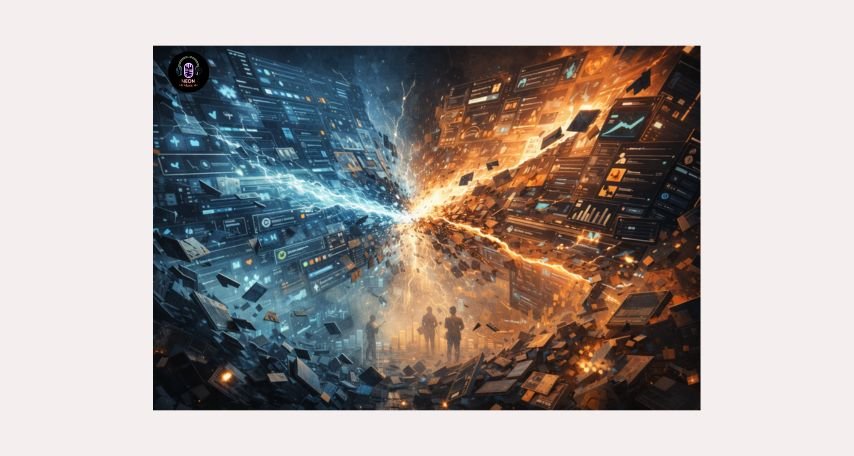
Netflix’s greatest trick was convincing everyone that success meant more: more shows, more seasons, more content to scroll past. Music streaming adopted the same philosophy.
Upload everything, let algorithms sort it out, measure success in catalogue size. That strategy effectively died in 2026.
The retention pivot arrived quietly. Platforms stopped chasing subscriber spikes and started obsessing over who stays. Weekly releases replaced album dumps.
Cross-title funnelling became standard practice. Algorithmic scheduling now predicts when you’ll cancel and surfaces content designed to keep you locked in – sometimes a little too accurately.
As streaming industry analysts noted: streaming stopped asking “How many shows do we have?” and started asking “How many viewers can we hold?”
This shift murders certain types of content on arrival. One-off cultural moments that exploded on social media but couldn’t sustain engagement? Dead.
Expensive originals that generated buzz but not binge behaviour? Liability. The era of “Peak TV” abundance is closing, whether executives admit it or not. What’s replacing it looks more like engineered addiction.
Vertical video is forcing this evolution faster. According to recent industry data, 90% of consumers now accept vertical video on publisher sites. Platforms aren’t just adding short-form feeds as a feature anymore.
They’re rebuilding entire interfaces around swipe-first discovery, treating vertical clips as the front door to everything else.
Disney’s partnership with AI video tool Sora to create licensed user-generated content within Disney+ shows where this leads: the platform becomes the sandbox, and you become both viewer and creator.
The economics are brutal. Sub-3-second latency technology is enabling real-time betting and premium multi-view sports packages, but only for content that justifies the infrastructure investment.
Everything else gets cost-optimised into oblivion. Hybrid cloud models are replacing full-cloud architecture because hyperscalers proved too expensive and unreliable.
The 2026 FIFA World Cup will test whether streaming infrastructure can handle simultaneous global demand without collapsing.
After recent high-profile outages, disaster recovery moved from afterthought to board-level priority.
TikTok Stopped Being a Platform and Became the Game
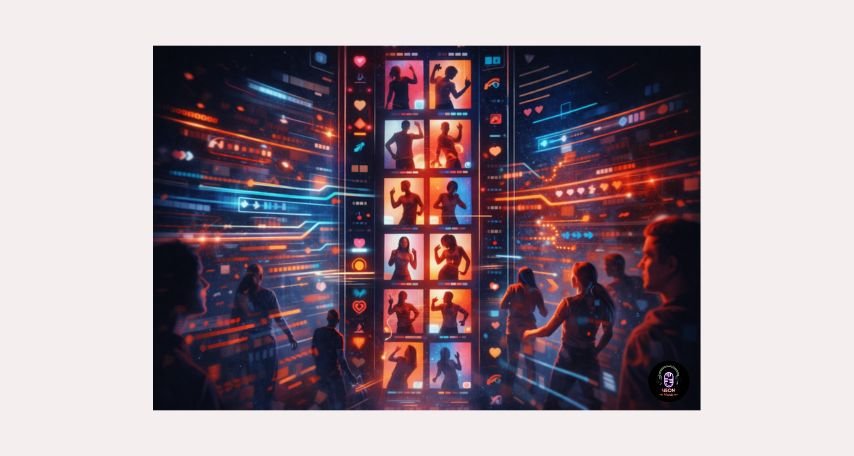
When 84% of songs entering the Billboard Global 200 go viral on TikTok before they chart, you’re no longer looking at a promotional tool.
You’re looking at the entire discovery apparatus of modern music. American users are 74% more likely to discover and share music on TikTok than any other platform.
The “Add to Music App” feature converted over one billion tracks from TikTok to streaming services since launch. One. Billion.
YouTube owns the other half of this equation. According to Nielsen’s Gauge report, the platform accounts for 12.9% of all US television-screen viewing, reaching 2.7 billion monthly users who collectively watch one billion hours daily.
More than 150 million people watch YouTube on TV screens each month.
Netflix’s biggest title, Squid Game, generated roughly 1.65 billion hours viewed in its first month. YouTube generates two-thirds of that watch time every single day.
But here’s what the raw numbers miss: TikTok and YouTube don’t just distribute music anymore. They dictate what music gets made.
Artists are reverse-engineering tracks around 15-second hooks designed for vertical video.
Chord progressions, lyrical phrasing, even song length is being optimised for algorithm-friendly moments that translate to user-generated content.
The catalogue is eating itself and regenerating as something new – faster than most labels can react.
The real shift isn’t technological. It’s cultural. Release dates mean nothing on TikTok.
A song from 1962 or 2024 has the same shot at virality if it hits the right emotional note at the right moment.
When Jess Glynne’s 2015 single “Hold My Hand” dominated summer 2025 after resurfacing via holiday montages, it proved the platform cares more about emotional connection than commercial strategy. Time collapsed. Context dissolved. Only the feeling matters.
Neon Music has been tracking this phenomenon closely – from viral nursery rhyme remixes to unexpected decade-old breakouts, the pattern is consistent: authenticity and emotional resonance matter more than polish or marketing budget.
AI Split Music Creation Into Two Parallel Industries
Ten per cent of music creators now use generative AI tools, according to industry research on music creation trends.
That number doubled between 2024 and 2025. Traditional music software sales fell two consecutive years.
Native Instruments entered preliminary insolvency, maker of professional-grade production tools that appeal to established creators. The consumerisation of music creation isn’t coming. It arrived.
This isn’t really about AI “replacing” musicians. That framing misses what’s actually breaking.
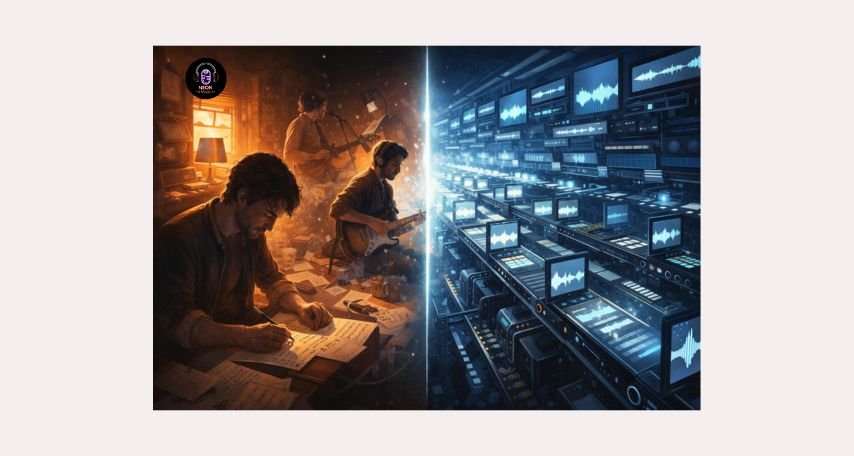
What’s happening is bifurcation: two separate music industries operating under completely different rules.
One requires years of skill development, instrument proficiency, technical knowledge. The other requires a text prompt.
The quality debate is mostly a distraction. AI-generated artists like Sienna Rose command millions of Spotify listeners.
In January, ‘Jag vet, du är inte min’ hit number one on Swedish charts before being banned for being AI-generated.
Tracks on platforms like Suno sound convincing enough to average listeners. The sophistication improves weekly.
Fraudsters are industrialising fake streams using AI-generated tracks, diverting over one billion dollars annually from legitimate artists – by most credible estimates.
In a pro-rata royalty model, every fraudulent stream steals money from real musicians.
But AI is also solving the metadata crisis that’s plagued streaming for years.
Operational AI and LLM-driven automation are transforming backend workflows: automatic translation, smarter tagging, improved recommendations, predictive issue detection.
The unsexy infrastructure improvements matter more than the shiny creative tools.
Platforms that can analyse behavioural patterns in real time detect fraud, personalise experiences, protect artist revenue, and justify content inclusion decisions.
Data became the common denominator across almost every music industry function.
The licensing battles will drag on for years. Multiple lawsuits will determine how copyright applies to AI-generated work.
Warner Music settled with one AI platform; others are fighting in court. Until legal precedent establishes clear boundaries, the grey zone expands.
Artists using AI tools face unclear ownership rights, potential copyright claims with no protection, and terms of service that make users responsible for defending platforms in litigation.
For now, two philosophies coexist uneasily. Some creators view AI as instrument, not composer: generate ideas, re-record with human performance, release the authentic version.
Others release AI-generated tracks directly to streaming, gambling that statistical obscurity protects them from legal consequences.
The gap between viral moment and sustainable career has never been wider.
Superfans Became Investors, Co-Creators, and the Only Revenue Stream That Matters
Pro-rata streaming payouts were always broken. If you listen to one artist exclusively all month and five dollars of your subscription goes to royalties, that money should go to your chosen artist.
Instead, it’s pooled across the entire platform, disproportionately benefiting whoever commands the most total streams.
This system mathematically disadvantages independent artists and niche genres.
User-centric payment models fix this. They’re also spreading. If someone listens only to your music, you receive their full royalty share.
The resistance comes from major labels who profit from the current model and platforms that don’t want to rebuild their entire payment infrastructure. But the pressure is building.
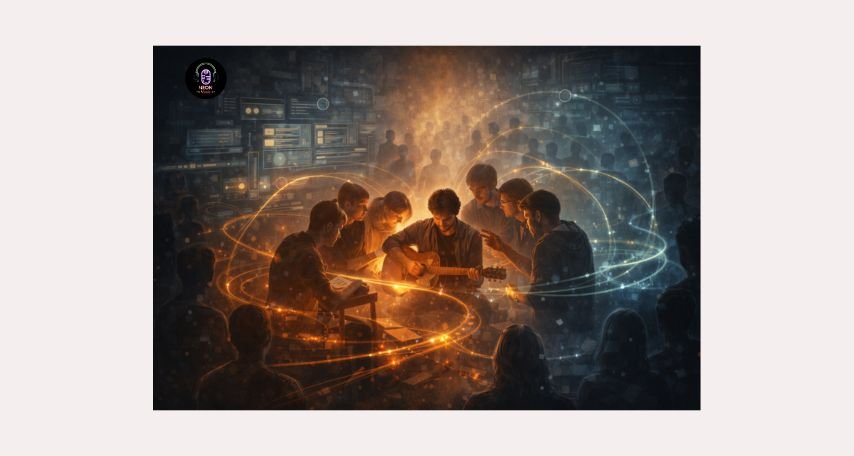
The real shift isn’t happening in backend accounting systems. It’s happening in fan behaviour. Superfans don’t want passive consumption anymore. They want participation.
Social radio features, tipping models, direct artist support mechanisms are proliferating.
Fans in markets like Japan demonstrate this instinct through repeated purchases and deep engagement with the same artists. That psychology is spreading globally.
Platforms are testing the limits. Token-gated content, virtual goods, micro-transactions, creator-led channels, interactive overlays during streams. Music is borrowing monetisation mechanics from gaming: spend money to unlock experiences, show status, gain access.
The post-subscription era is quietly arriving. Superfans spending 50 dollars directly on one artist now generate more value than 50 casual listeners paying ten dollars monthly for unlimited access.
This creates two problems. First, it accelerates inequality. Artists with passionate fanbases win.
Everyone else drowns. Second, it requires artists to be community managers, content creators, and engagement specialists, not just musicians.
The job description expanded beyond what most people signed up for.
Genre Collapsed Into Feeling
PluggnB is a nanogenre combining plugg (laid-back trap) with ’90s R&B. Afrofuturism fuses traditional African instrumentation with electronic production.
Nu-metal is having its biggest moment since 1999. Rock music is commanding festival headliner slots again after a decade in commercial wilderness.
Organic sounds and minimalism are gaining traction as counterweights to ultra-processed pop.
What ties these movements together isn’t sound. It’s rejection of algorithmic blandness. Streaming platforms optimised music for passive background listening. AI tools threaten to automate the creative process entirely.
Certain audiences are pulling away from both, seeking music that sounds irreducibly human: mistakes intact, rough edges preserved, real instruments played by actual people.
But the bigger shift is post-genre fluidity. Collabs, remixes, streaming, AI: all of it led to bleeding borders and softening factions.
Genre isn’t dead, but it’s no longer the primary organising principle the industry relies on.
Playlists built around mood, activity, or vibe matter more than whether something is “rock” or “electronic.”
Artists are free to combine whatever influences they want because the distribution system stopped caring about radio formats.
This opens creative space but murders cultural cohesion. When everything is available everywhere simultaneously, local scenes struggle to build identity.
The algorithmic monoculture problem is real: platforms surface similar-sounding content to keep you engaged, creating a flattening effect on musical diversity.
The weird stuff gets buried unless it accidentally goes viral, as we saw with pre-teen artists creating the ironic “Sigma Boy” phenomenon or the unexpected Dominican bodega anthem “Bacon, Egg and Cheese”.
The Fraud Problem Went Industrial
Streaming fraud started with individual bad actors using bots to inflate play counts. By 2026, it’s organised crime.
Sophisticated networks generate fake tracks using AI, funnel them through fraudulent accounts, and collect royalties.
Experts estimate over one billion dollars annually is stolen from legitimate artists this way.
Eighty per cent of streaming fraud is executed by coordinated professional operations, not amateurs, according to music fraud specialists.
Voice cloning and unlicensed content impersonation make detection harder.
Behavioural pattern analysis using AI is the only viable counter-strategy. Platforms are deleting tens of millions of suspicious tracks, but the scale is overwhelming.
This ties directly to content moderation challenges. With 500,000 to 700,000 hours of new video uploaded to YouTube daily, and similar ratios across audio platforms, manual review is impossible.
Automated systems catch obvious violations but miss sophisticated fraud. The war is infrastructure-versus-infrastructure: fraudsters using AI to generate content and slip past detection, platforms using AI to identify abnormal activity and block it.
Digital service providers are becoming far more selective about what enters their catalogues.
The era of “upload anything” is ending. Quality thresholds, editorial justification, data-backed relevance checks: these are becoming gatekeeping requirements again.
Spotify reportedly removed tens of millions of low-quality or spam-like tracks in 2025. That trend is accelerating industry-wide.
The debate around what deserves shelf space is exposing uncomfortable truths about abundance.
Infinite choice was supposed to liberate culture. Instead, it created noise that drowns out the signal.
Instead, it created noise that drowns signal. Curation is becoming the scarcest, most valuable skill. Platforms that can separate meaningful content from algorithmic slop will win.
Sustainability Stopped Being Optional
Climate change is too big to ignore, even for touring musicians. Solar-powered stages, carbon-offset shows, biodegradable merchandise, regional touring to reduce travel: these aren’t fringe experiments anymore.
Coldplay has pioneered sustainable touring practices for years. Smaller acts are catching up.
Younger audiences increasingly align purchasing decisions with environmental ethics. Sustainability is becoming a differentiator.
The music industry’s carbon footprint comes primarily from touring: flights, buses, trucks, venue power consumption, single-use materials.
Streaming’s environmental impact is less visible but substantial: data centres require massive energy to store and deliver content. As platforms optimise for scale, their infrastructure demands grow.
This creates tension. Artists need touring income to survive because streaming pays terribly. But touring contradicts sustainability goals.
Younger fans want artists to reduce environmental impact but also expect global accessibility. The contradictions are unresolved.
What Happens Next Depends on Who You Believe
Linear television is hitting a point of no return. Global linear TV ad spend is down more than a quarter in nominal terms over the past decade, more than half when adjusted for inflation.
This shift is structural, not cyclical. High-reach digital video and connected TV are projected to surpass linear TV ad revenue globally. Out-of-home advertising is emerging as one of the few channels that can still deliver large-scale dependable reach.
Retail media and performance-driven environments continue attracting investment thanks to strong measurement and proximity to conversion.
The consolidation wave everyone predicted is happening, but slower than expected. Warner Bros. Discovery is exploring strategic alternatives.
Disney is cost-cutting and licensing rather than building. The streaming wars didn’t produce a winner. They produced exhaustion.
Attention is the only currency that matters now. Platforms compete not just with each other, but with everything: TikTok, gaming, podcasts, short-form video, whatever distracts you next.
Xbox’s head of game studios said it plainly: “Our biggest competition isn’t another console. We are competing more and more with everything from TikTok to movies.”
The question isn’t whether AI will change music. It already has. The question is whether the music industry can create sustainable economic models that reward human creativity in an era when algorithmic creation is free, instant, and improving daily. The gap between creating content and creating value is widening.
For artists, this means proof of work. YouTube-first creator Mary Spender uses her channel as proof that her music is made by a real human.
That’s the defensive strategy: demonstrate humanness so convincingly that audiences care. It’s a depressing framework, but it’s the one emerging across creative industries.
For platforms, this means retention engineering. The subscription era is maturing into a churn-management era. Every decision optimises for stickiness, not growth. That shift changes what content gets made, who gets paid, and what survives.
For fans, this means choosing between convenience and connection. Algorithmic recommendations are undeniably effective. They’re also flattening taste, reducing exposure to challenging work, and rewarding the safest, most engagement-optimised content. Opting out requires effort. Most people won’t bother.
The Only Constant Is That Nothing Stays Constant
Predictions are snapshots, not prophecies. The trends shaping 2026 will look quaint by 2027.
Technology moves faster than culture, which moves faster than regulation, which moves faster than our ability to meaningfully process what’s changed.
But some truths are holding: The platforms that win won’t be the ones with the most content. They’ll be the ones that make you stay.
The artists who survive won’t be the ones chasing virality. They’ll be the ones who build something that virality can’t replace.
The fans who shape culture won’t be the ones with the most followers. They’ll be the ones spending money directly on what they care about.
Pop culture broke its own rules because the old ones stopped generating growth, and nobody had a better replacement ready.
What’s replacing them isn’t better or worse. It’s just different, and we’re all learning the mechanics in real time.
Neon Music will keep tracking these shifts, dissecting the forces that matter, and refusing to treat culture as content. Subscribe to stay ahead of what’s next because the next set of rules is being written right now.
You might also like:
- How TikTok Viral Songs Dominated Charts in 2025
- Top 30 TikTok Trends & Viral Songs of 2025
- Do You Own Suno AI Music? Terms of Service Explained
- 15 Old Songs That TikTok Resurrected Into Modern-Day Hits
- Chrystal “The Days”: TikTok Viral Hit After 10 Years in the Vault
- The Rise of Tommy Richman’s Viral Hit Million Dollar Baby