
When Haim released “Hallelujah” in November 2019, the title alone invited confusion. This wasn’t a Leonard Cohen cover. It wasn’t a hymn.
It was something quieter and more personal: a song about the people who catch you when everything else falls away.
The track arrived as the third single from what would become Women in Music Pt. III, following “Summer Girl” and “Now I’m in It”.
Where those songs orbited around Danielle Haim’s experiences with anxiety and romantic turbulence, “Hallelujah” widened the lens.
This wasn’t about one person’s breaking point. It was about three sisters acknowledging the weight each carries, and the relief of not carrying it alone.
Alana Haim wrote her verse after waking up on an October morning when she was 20 to learn that her best friend, Sammi Kane Kraft, had died in a car accident.
The loss rewired her understanding of permanence. She started thinking about all the milestones Sammi wouldn’t see: turning 21 together in Vegas, travelling to festivals around the world, standing beside her at a wedding.
The verse doesn’t dwell on the grief itself. It focuses on what remains after someone is gone, and who you turn to when language fails.
Este’s verse came from a different kind of rupture. Diagnosed with Type 1 diabetes at 14, she had spent years managing the condition with the kind of discipline that makes it invisible to everyone else.
But around the time she wrote her part of the song, she received difficult news from her endocrinologist.
She’d been ignoring warning signs, letting the constant vigilance slip. She described the feeling as “diabetic burnout”, when the 24-hour responsibility of managing a chronic illness becomes too exhausting to sustain.
Her verse doesn’t name the illness. It speaks instead to the fragility of trying to hold everything together, and the need for people who understand without needing to be told.
Danielle opens the song with a line about meeting “two angels in disguise”. The reference points toward her sisters, but it also sets the tone for what the song is really about.
This isn’t a love song in the traditional sense. It’s about recognising the people who stay close when everything else becomes unstable.
The chorus repeats the same question: “Why me? How’d I get this hallelujah?” The word doesn’t carry religious weight here. It’s closer to disbelief, or quiet astonishment at surviving something you weren’t sure you would.
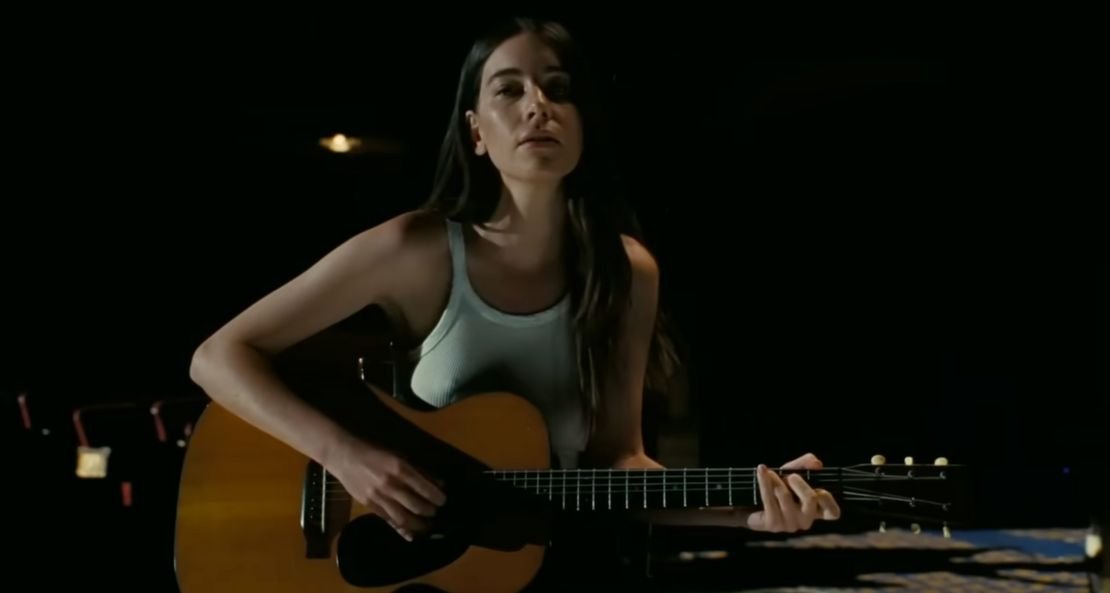
The production reflects that restraint. There are no drums. Just acoustic guitar, voices layered in harmony, and space around every line.
Co-written with Tobias Jesso Jr. and produced by Ariel Rechtshaid, Rostam, and Danielle herself, the arrangement refuses to dramatise the emotion. It lets the words sit plainly, without embellishment.
Each sister takes a verse, and the structure makes the meaning collective rather than confessional.
When Danielle sings about old fears easing and new tears drying in time, she’s not offering reassurance to the listener.
She’s describing what it feels like to lean on someone who already knows the shape of your worst days.
When Este sings about leaning her back against someone else’s, or travelling like her feet don’t touch the floor, the imagery is physical but not literal.
It’s about the sensation of being held up when standing alone feels impossible.
Alana’s verse shifts the tense. “I had a best friend but she has come to pass,” she sings, before addressing Sammi directly. “You always remind me that memories will last.”
The verse doesn’t attempt closure. It holds the past and present in the same breath, acknowledging that grief doesn’t resolve but integrates.
The final lines return to childhood imagery: long hair, running through fields, the feeling of being protected. The simplicity makes it more affecting, not less.
The Paul Thomas Anderson-directed video mirrors that approach. Shot on a single dark stage, each sister takes her turn alone under a spotlight before they come together for the chorus.
There’s no narrative arc, no symbolic imagery. Just three people passing something fragile between them.
You might also like:
- HAIM’s Top 10 Iconic Moments in Music: From Viral Hits to Genre-Defining Tracks
- Haim’s Relationships Meaning and Review: The Bitter-Sweet Chaos of Love Unwrapped
- HAIM Down to Be Wrong Lyrics & Meaning: A Bruised Heartboard to Freedom
- Lenn Captures Emotional Depth in Her Latest Track Older Sister
- The Crane Wives The Well Is An Evocative Folk Ballad
- We Hug Now Song Meaning & Review: Sydney Rose’s Emotional Reflection
Listeners connected to “Hallelujah” in ways that surprised even the band. The song became a reference point for people dealing with chronic illness, grief, or the slower, less visible kinds of survival that don’t fit neatly into public conversation.
It offered permission to feel relief without needing a reason, to be grateful for small continuities rather than grand resolutions.
What makes the song work is what it refuses to do. It doesn’t explain. It doesn’t resolve. It doesn’t offer comfort in the form of answers.
Instead, it acknowledges that some of the most important relationships in our lives are the ones that ask the least of us, the ones that exist without needing to be named or defended.
The word “hallelujah” becomes a way of marking that presence, not celebrating it.
In the context of Haim’s catalogue, “Hallelujah” stands apart. It doesn’t reach for the propulsion of “The Wire” or the grit of “My Song 5”.
It doesn’t play with the textural density of their earlier work. It sits still, and in sitting still, it reveals something the louder songs couldn’t.
Five years after its release, the song remains one of the band’s most quietly necessary. Not because it offers catharsis, but because it doesn’t pretend to. It simply holds space for the feeling of being held.