
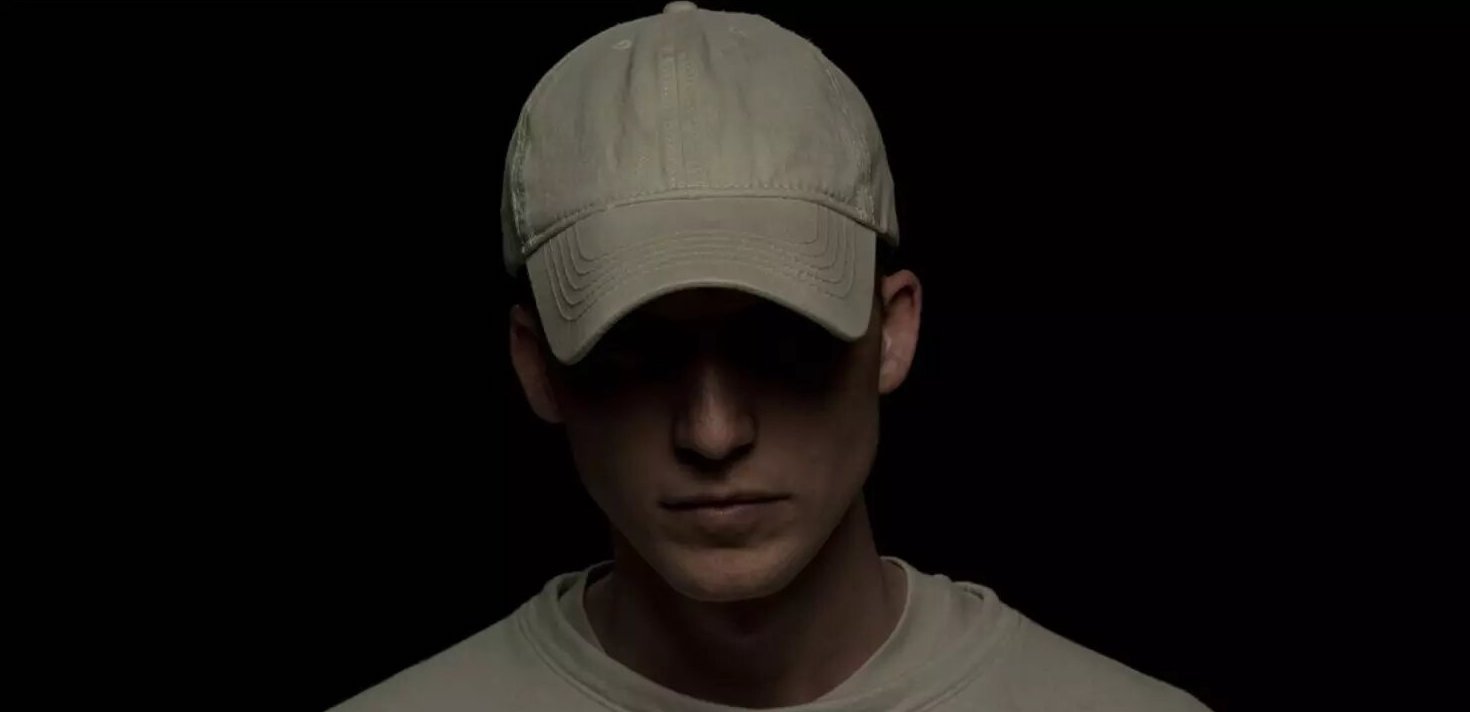
The title is rather deceiving. NF’s “Happy,” released in March 2023 as the third track on his fifth album HOPE, is a song about the psychology of having become addicted to one’s own depression, where the idea of getting better feels more alien and threatening than the agony itself. Nathan Feuerstein opens the track with a prayer, apologetic and distant, the kind of address you make to someone you’ve been avoiding.
By the chorus, the pretence disintegrates: livin’ in my agony / watchin’ my self-esteem / go up in flames. The word “livin'” is doing most of the work. Not suffering. Not drowning. Living.
Sound enforces it. The intro strings are tense and pacey, building anxiety rather than atmosphere, before a spare piano enters to soften nothing. Underneath it all runs what sounds, structurally, like a dance track. Elevated percussion, rhythmic momentum, the architecture of movement, pressed against lyrics that cannot move at all. That dissonance is the argument: depression, at its most entrenched, has its own groove. You adapt to it. It becomes legible. Built to sound like a life that functions, from the outside.
Feuerstein drops the ambiguity in verse two. I got some issues that I won’t address. Not can’t. Won’t. That single word is the hinge the entire song is built on. Earlier he admits he is too proud to open up, too trapped to ask to be pulled out. But “won’t” removes the helplessness. It names the choice. This is where NF breaks from the tradition of mental health music that frames the sufferer as purely victim and admits something uglier: the suffering is also, on some level, a decision. The baggage hasn’t been opened. The phone calls haven’t been returned. The bridges haven’t been rebuilt. Not because he can’t, but because doing so would require confronting who he is without all of it. I can’t imagine who I’d be if I was happy. His identity is the illness. Getting well means getting gone.

Generational trauma is where the video takes it. A child and an adult woman run in parallel timelines, the same household chaos, the same arguments, the same empty bottles on the floor, before the reveal that they are the same person at different ages. The child absorbs everything as precedent: the fighting, the emotional debris of the rooms. The adult woman is simply honouring what she learned. Her coping mechanisms aren’t departures from her upbringing but a meticulous continuation of it. She drinks the same, isolates the same, argues the same. None of this is judged. It watches the way you watch someone perform a ritual they don’t remember learning.
There is one structural break. At the bridge, a single word: but. Everything drops out at that moment. The percussion, the strings, the momentum. The song breathes for the first time. What comes after is not resolution, nothing in Feuerstein’s catalogue is that generous, but it is a pivot. The narrative shifts from passive immersion to something closer to acknowledgement. Up to that point the song has no exits. The single word cracks one open, barely. The music video synchronises the adult woman reaching a moment of internal recognition with this same beat, finally processing her past rather than repeating it. It is the smallest possible gesture toward healing, and the song treats it as monumental, because for someone who has lived inside pain long enough to call it home, recognising it at all is the entire war.
HOPE is Feuerstein’s most commercially minded album, the title an explicit corrective to the bleaker registers of earlier records. The album debuted at number two on the Billboard 200. “Happy” was among its most-streamed tracks in its opening weeks, demonstrating that there is a large audience for music that anatomises depression without offering platitudes about it. That audience is not looking for comfort. They are looking for accuracy.
The song never answers its own question. It never decides whether happiness is genuinely unimaginable or simply unfamiliar. Whether the “won’t” is a character flaw or a survival mechanism. Whether the woman in the video, older and still circling the same patterns, has actually started to break the cycle or only recognised it. Feuerstein leaves it unresolved. The question isn’t rhetorical, it’s just unanswered.
If you or someone you know is struggling with mental health, please reach out to a trusted professional or helpline for support. You are not alone.
You might also like: