

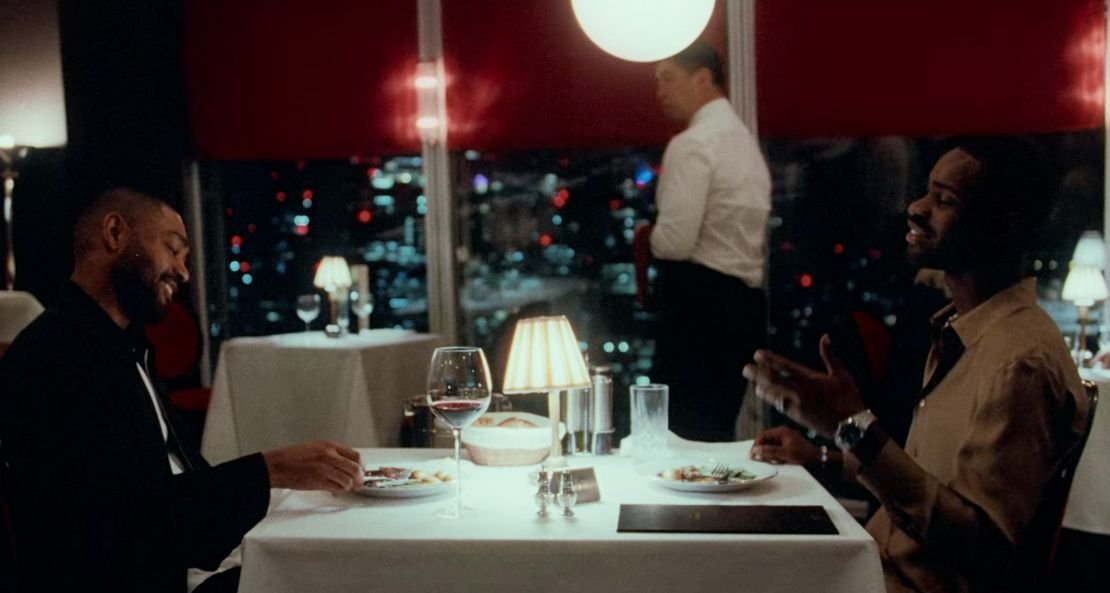
Listen. When Dave and Kano finally got in the studio together, they could’ve done the obvious thing. Big beat, flexing bars, maybe a hook about being the best in the game. Standard collaboration fare.
Instead, they sat down over dinner and just talked.
“Chapter 16” plays out like someone secretly recorded a conversation between two generations of UK rap royalty and turned it into a six-minute track. You can hear cutlery clinking in the background.
There’s actual restaurant noise mixed into the production. They’re interrupting each other, laughing at inside jokes, debating whether it’s “plantain” or “plantin” (Dave’s Nigerian roots versus Kano’s Jamaican heritage), and at one point Kano just flat-out calls Dave out about his dating habits.
James Blake’s production gives them space to breathe. Minimalist piano, some harp from Eleanor Turner that nods to the album’s biblical theme, and enough air in the mix that you catch every bar.
Blake’s always been brilliant at creating atmosphere without crowding the artist, and here he’s practically invisible whilst somehow making the whole thing feel cinematic.
The chemistry is immediate. These two acted opposite each other on Top Boy, Dave playing the volatile Modie whilst Kano embodied Sully, the Summerhouse legend.
That screen dynamic translates directly into their flow here. Dave’s got that smooth, almost conversational delivery that makes complex bars feel effortless.
Kano brings that sharp grime cadence that defined 2000s UK rap, the kind of flow that makes you rewind to catch everything he just packed into eight bars.
What gets me is how comfortable they are with silence between verses. There are actual pauses. Moments where one finishes and you can almost see the other nodding, processing, before coming back with their response.
That’s not how most collabs work. Usually everyone’s fighting for space, trying to outshine the other person. Here? It’s more like watching two chess players who respect each other enough to actually think about their next move.
Dave opens with that wagyu line. Fifty-second floor of The Shard, expensive steak, “just to take the piss.” Then immediately flips it: somehow we’ve dealt with higher stakes than this. Stakes. Steaks.
It’s the kind of wordplay that seems almost too simple until you realise he’s setting up the entire theme. Luxury versus survival. Success versus where they came from.
The biblical weight sits heavy throughout but never feels forced. Dave literally names the track after the Book of Samuel chapter where young David gets anointed as the future king.
Kano becomes Samuel in this scenario, the OG passing knowledge to the next generation. When Dave suggests they “base it on the Book of Samuel, call it ‘Chapter 16′” near the end, you realise they’ve just documented the torch being passed in real time.
Kano’s verse about the five senses is genuinely masterful. “Can you ever see when you’re just someone’s wallet?” Sight. “Have you ever smelt when a cousinship turns rotten?” Smell. “Do you ever hear from your brother and start sobbing?” Hearing. He runs through all five before adding his “sixth sense” for knowing who’s really from the streets. It’s technically brilliant but also cuts deep because you can hear the experience behind it.
These aren’t hypothetical questions. Kano’s lived through watching family relationships disintegrate over money, watching the industry chew people up.
The bit about kings being “checkable” hits particularly hard. Everyone wants the throne but nobody talks about how exposed you become sitting there.
Kano’s warning Dave about the target on his back, about envy turning into “jealous juice” that people sip until they’re addicted to hating your success.
It’s wisdom from someone who’s navigated this industry for two decades whilst Dave’s still relatively early in his journey, despite his massive success.
Dave’s vulnerability comes through in unexpected moments. The whole section about relationships and buying Chanel tortoiseshell glasses for girls whilst his “heart’s cold like Courchevel” (skiing reference, showing how he’s learnt to match Kano’s layered wordplay).
Then that line: “God loves a trier, David loves a liar.” Trier. Liar. But he flips “liar” into lyre, the harp-like instrument biblical David played. Even when he’s being playful there are three levels of meaning stacked on top of each other.
The conversation structure means they can pivot naturally. One minute they’re discussing serious industry politics, the next Kano’s teasing Dave about his latest romantic interest. “So what’s her name?” It’s real friendship captured on record. The outro especially feels like the track ends because the waiter came back, not because they ran out of things to say.
What makes “Chapter 16” stand out in 2025’s UK rap landscape is how uninterested it is in flexing for flex’s sake. Dave asks Kano: “How’d you do it? Do you have regrets? What’s your life like?”
Those aren’t rhetorical questions. He genuinely wants to know. And Kano responds with actual advice, not platitudes. “Some years’ll worsen you and some will better you.” That’s just truth from someone who’s lived through the ups and downs.
The track runs six minutes and twenty seconds. That’s long for a single. But nothing feels padded. Every bar serves the conversation.
When Kano talks about “38 years, that’s an evil sentence,” he’s simultaneously referencing prison sentences, the biblical story of the man healed after 38 years by the pool of Bethesda, and just the general cruelty of time passing. Three meanings in four words.
There’s a moment where Dave mentions needing “some water I can give to my seed” and it connects to everything.
Water representing knowledge, life, heritage, culture. Passing it forward to the next generation. He’s already thinking about legacy whilst Kano’s actively building his by having this exact conversation. The track is the water being passed.
The production never overpowers but it supports perfectly. Blake knows when to pull back and when to add texture.
The harp isn’t constantly present but when it appears it reinforces the David connection without being heavy-handed.
The background restaurant ambience makes you feel like you’re at the next table, awkwardly eavesdropping on a conversation that’s clearly important to both participants.
UK rap has always thrived on collaboration but it’s usually competitive. Fire in the booth clashes. Grime sets where everyone’s trying to murder the beat harder than the last person. This isn’t that.
This is two artists comfortable enough in their own positions that they can have an actual dialogue about what it means to do this at the highest level.
The meta-textual element adds another layer. They’re discussing whether to make a track about their dinner whilst simultaneously making that exact track. It’s clever without being too clever.
The kind of concept that could’ve collapsed into self-indulgence but instead feels natural because their chemistry is genuine.
By the time Kano’s telling Dave not to overthink his relationship situation, “day at a time, man,” you’ve forgotten you’re listening to a carefully constructed piece of music.
It just feels like two mates having a chat over food. That they’ve managed to make it this technically accomplished, this layered with meaning, this sonically interesting, whilst maintaining that natural feel? That’s the achievement.
“Chapter 16” isn’t trying to be the hardest track of the year or the most experimental or the catchiest. It’s just two exceptionally gifted lyricists documenting a conversation that matters to them, trusting that it’ll matter to us too. That confidence in the material, in themselves, in the audience, comes through in every bar.
You might also like:
- Love Pain: DA REAL3ST Crafts Street-Smart Anthem On Summer Walker Sample
- Deca OTA x Hunnid2Hebron Drop Hallelujah Redemption
- Dave The Boy Who Played the Harp Lyrics Meaning
- oakland x Stacy N.K.R ‘goodnight’ Review: 90s Neo-Soul Haze, Modern UK Rap Calm
- JBEE Returns with Deja Vu: A Sharp Turn in North London’s Rap Scene
- Krillz Drops A Summer Anthem With Boujee


