
Updated February 25, 2026
Vodka Cranberry is the second single and third track from Conan Gray’s fourth album Wishbone, released July 11, 2025.
It follows This Song in both sequence and narrative. That earlier single captured reconciliation. This one documents the point where reconciliation starts to thin out.
This is not a breakup song. It is a pre-emptive one.
On Capital Buzz’s Making The Album podcast, Gray described the track as reflecting his “irrational fear of people leaving.”
In the chorus he sings, “If you won’t end things, then I will.” The line positions him as the one initiating the end, but the phrasing reads less like power and more like containment.
Dan Nigro rebuilt the production twice before settling on the final version. The original sat an octave lower. An anti-chorus structure was attempted and removed. The finished track shifts the key upward, placing Gray in a brighter register during the bridge.
The guitars remain clean and lightly layered. The percussion keeps a steady mid-tempo pattern. The song does not build toward a large instrumental release before it ends.
The arrangement holds back. So does the narrator.
What is Conan Gray’s “Vodka Cranberry” about?
Vodka Cranberry is about initiating a breakup out of fear rather than certainty. In interviews, Conan Gray described it as reflecting his “irrational fear of people leaving,” which aligns with the chorus line, “If you won’t end things, then I will.”
Why Is It Called Vodka Cranberry?
The title does not reference The Cranberries. In an August 2025 interview with GRAMMY.com, Gray said it came from a drink his friend Olivia Rodrigo orders.
“Vodka Cranberry is a drink my best friend Olivia drinks every once in a while,” he said. “I ended up writing the song a week later.”
The title comes from that night. Nothing more ornate than that.
Gray and Rodrigo have known each other since 2020, when he messaged her about her High School Musical: The Musical: The Series song “All I Want.” The connection predates their current visibility.
The Lyrical Evidence
“You say we’re fine, but your brown eyes / Are green this time, so you’ve been crying.”
He claims to recognise the difference in their eyes after crying. Whether literal or exaggerated, the emphasis is on attention. He is looking closely.
“It’s in the way you say my name / So quick, so straight, it sounds the same.”
The issue is tone, not wording. The name is pronounced correctly. The warmth is missing.
“As the time we took a break / February fourth through the sixteenth of May.”
He does not summarise the earlier separation as “a few months.” He gives dates. February 4th through May 16th. The break still occupies space in his head.
“Got way too drunk off a vodka cranberry / Called you up in the middle of the night / Wailing like an imbecile.”
He calls himself “an imbecile.” The call is framed as embarrassing rather than romantic.
“If you won’t end things, then I will.”
The sentence lands as something decided in advance.
“You casually steal back your T-shirt / And your Polo cap, yeah, I noticed that.”
Retrieving belongings often precedes an ending. He notes both items separately. The repetition of “I noticed” suggests someone scanning for confirmation.
In the bridge, two lines cycle:
“Don’t make me do this to you.”
“I will.”
As the instrumentation reduces, the repetition becomes more exposed. The song narrows around the choice instead of expanding beyond it.
The Music Video and the Wishbone Continuum
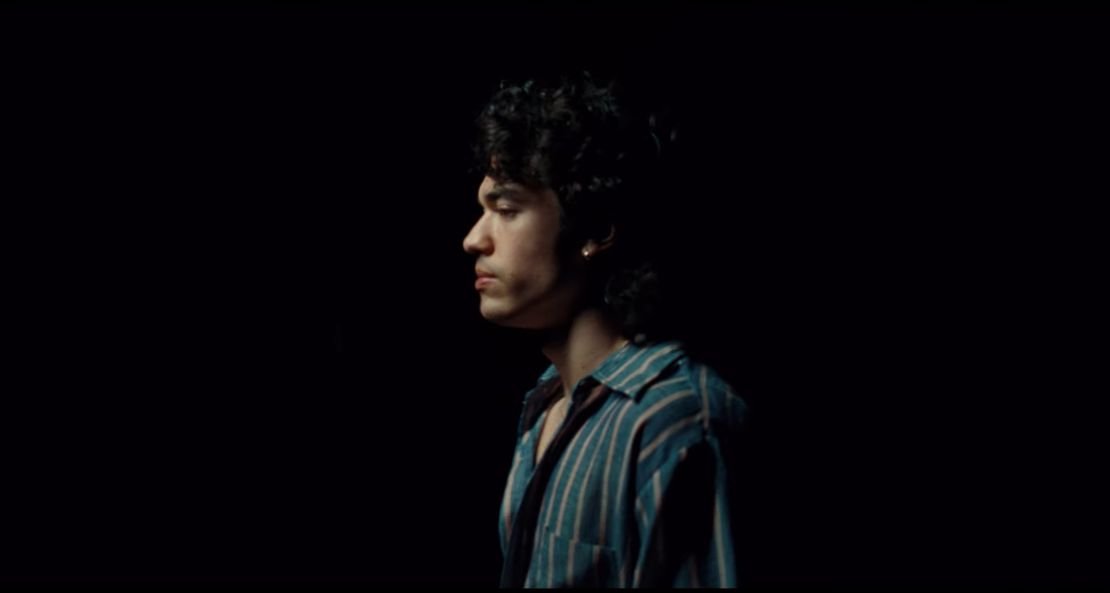
Directed by Danica Kleinknecht and shot on Kodak 35mm film in Texas, the video forms the second instalment in the Wishbone trilogy: This Song, Vodka Cranberry, and Caramel.
Corey Fogelmanis reprises his role opposite Gray. The road trip setting keeps the characters moving while emotional distance grows.
In one scene, Fogelmanis pushes Gray into a lake. In another, he leaves before dawn while Gray remains asleep. The gestures alternate between closeness and withdrawal.
Gray said the shoot required sustained crying across multiple days.
Near the end, a semi-truck passes as Gray stands near a road. Earlier songs referenced crossing roads without looking. Here, he pauses.
The video presents a male love interest directly, without ambiguity.
Where It Sits in His Catalogue
Attachment instability runs through Gray’s catalogue, from “Heather” to “Astronomy” to “Alley Rose” and “This Song.” In “Heather,” he waits. In “Vodka Cranberry,” he moves first.
Earlier songs lingered. This one ends something.
The track was performed at the 2025 MTV Video Music Awards, on The Today Show in August 2025, and throughout the Wishbone Pajama Show tour.
It was submitted for Grammy consideration in Record of the Year, Song of the Year, and Pop Solo Performance at the 2026 ceremony. It became one of his highest-charting singles.
He counts the days of a previous break. He monitors the shift in tone when his name is spoken. He notices the return of a T-shirt and a cap. None of these moments are dramatic in isolation.
By the time he repeats, “I will,” the line does not escalate. It settles.
The production never widens to support the choice. The ending arrives without spectacle.
The decision comes slightly before it has to.
You might also like:
- David Kushner Darkerside: A Gritty Reflection on Faith, Temptation, and Sonic Mastery in The Dichotomy
- Benson Boone’s Mr Electric Blue Lyrics Meaning: Supercharged Swagger with a Glint of Satire
- Breaking Down Sombr’s Back to Friends Lyrics: When Casual Leaves a Scar
- Sleep Token’s Infinite Baths Lyrics Meaning: A Cleansing Spiral Into Chaos, Memory, and Salvation