
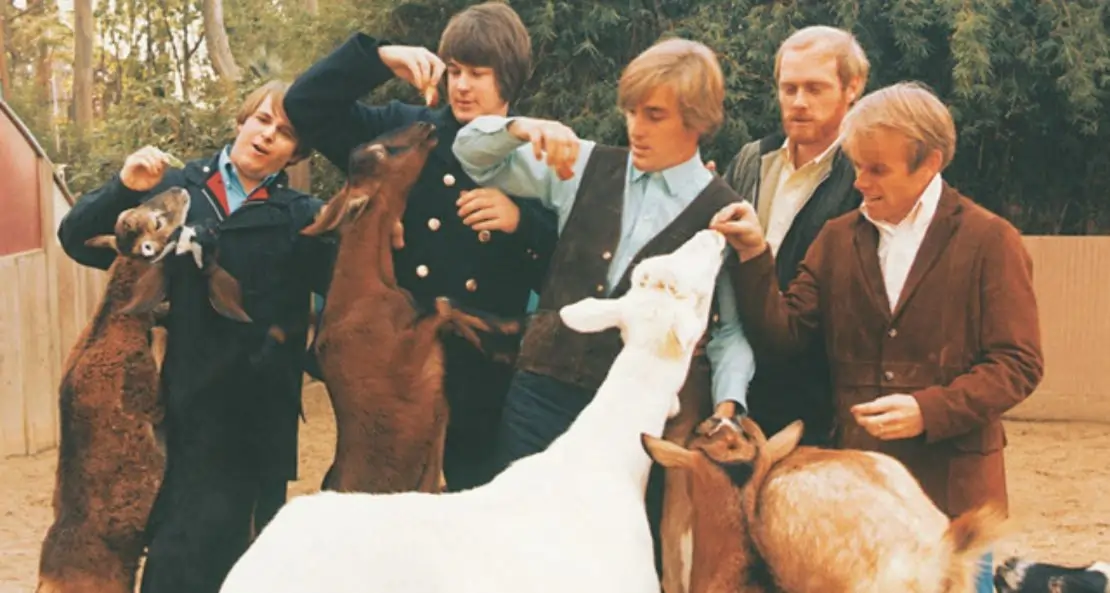
Brian Wilson wrote “God Only Knows” in 45 minutes. When someone later told him it was the greatest pop song ever written, his response was not pride. It was dread. If that was the best he had, he said, he would never write anything as good and was therefore finished. That is the human centre the song has always had underneath its reputation: a piece of music so complete it frightened its own creator.
When Wilson died on June 11, 2025, aged 82, the song re-entered the charts within hours. Not because of a sync or a campaign. Just people going to put it on.
“God Only Knows” is a love song built on an uncomfortable admission. The singer cannot promise he will always love the person he is addressing. What he can say is that his life without them would be so hollow, the question of what he would become sits beyond human understanding. Only God could know. The devotion is real, but so is the need underneath it, and the song does not try to hide which one came first.
What does “God Only Knows” mean?
“God Only Knows” is a love song about emotional dependence rather than certainty. Instead of promising forever, the singer admits his love might not last but cannot imagine life without the other person. The song’s power comes from that contradiction, vulnerability over devotion, which is why it’s often considered one of the greatest songs ever written.
The opening line makes that contradiction unavoidable: “I may not always love you.” It’s a sentence most love songs refuse to say out loud. The rest of the track spends its time trying to live with what that admission means.
Where It Came From
By January 1966, Wilson had stopped touring. He had a phobia of flying and sent Glen Campbell out in his place while the Beach Boys worked through their Japan and Hawaii dates.
The time at home gave him access to his piano and to a new collaborator. He had met Tony Asher, an advertising copywriter who had written jingles for Mattel and Max Factor, at a Hollywood party in late 1965. They started talking, clicked, and set to work on what would become Pet Sounds.
Wilson had just listened to Rubber Soul and, as he later told The Guardian, went straight to his piano and started writing. He has also cited the 1944 standard “Stella by Starlight” and a John Sebastian melody he had been listening to as part of the song’s genetic material. That mixture of sources is telling. Wilson was not writing a surf song. He was writing something closer to a standard, something with the kind of emotional precision that George Gershwin or Burt Bacharach would have recognised.
The lyric argument that produced the song’s most famous line is well documented. Asher had written the opening as a hook that defied the conventions of the love song genre. Wilson objected.
He thought it was too downbeat, too risky as an opener. Asher stood his ground. What survived is a first line that does something almost no pop song had attempted at that point: it opens with doubt.
The singer freely admits his feelings might not last. Instead of promising everlasting love, he offers something celestial and fixed, the stars. He is leaning on the universe to make his case because he cannot quite make it himself.
The second verse pulls the same trick from the other direction. “If you should ever leave me / Though life would still go on, believe me…” sounds like acceptance at first. Then it gives way: “The world could show nothing to me / So what good would living do me?” The song keeps setting up an exit and then blocking it.
The title caused a separate argument entirely. In mid-1960s America, using “God” in a pop song title was treated as borderline blasphemy. Radio stations were expected to reject it. Asher recalled that unless you were singing “God Bless America,” nobody believed you could get away with it. Wilson and Asher chose to go ahead.
When the single was released in July 1966, Capitol flipped it to the B-side of “Wouldn’t It Be Nice,” exactly as they had feared. In the US it peaked at number 39. In the UK, where it was issued as the A-side, it reached number two, kept off the top by The Beatles’ “Yellow Submarine.” The American market’s wariness about the title remains one of the stranger chart footnotes of the decade.
The Session
The instrumental tracking session started at 12:30 in the morning on March 10, 1966, at Studio 3 of Western Studios on Sunset Boulevard. It ran until 4:30 am. Twenty takes, four hours, and the result was one of the most layered pop recordings of the era.
Around 20 musicians were crammed into a studio not really built for that number. Most were from the Wrecking Crew, the LA session pool that played on hundreds of Top 40 records through the 1960s and 70s.
Hal Blaine was on drums and also played sleigh bells. Jim Gordon played percussion using the bottoms of two plastic orange juice bottles, creating the echo-laden clip-clop that runs under the track.
Larry Knechtel handled harpsichord. Carl Fortina and Frank Marocco played accordion. Jim Horn and Bill Green were on flutes. A string quartet provided the low viola and cello lines. There was also a tack piano, its strings muted with masking tape to produce a duller, more percussive tone. The French horn part was played by Alan Robinson, a member of the 20th Century Fox studio orchestra who had played on The Sound of Music soundtrack the previous year.
Carl Wilson was the only Beach Boy to play an instrument on the track, adding 12-string electric guitar alongside Carol Kaye, who was on 12-string rather than her usual bass. The bass section used three players: Lyle Ritz on upright, Ray Pohlman on electric.
The stumbling block during the session was the instrumental break. Pianist Don Randi solved it by suggesting the musicians shorten their notes to a staccato approach, which immediately gave the section a different character and pulled the whole arrangement into shape. Wilson accepted it on the spot.
Danny Hutton, the Three Dog Night singer who was present that night, later recalled sitting in complete silence for most of the session, unable to think of a single thing to add.
Brian had recorded his own lead vocal first. He later gave the song to Carl. His reasoning was precise: he wanted tenderness and sweetness, and he knew Carl carried those qualities in his voice and in his character. The instruction Carl received from his brother was minimal. Sing it straight. No effort. Take a breath. Let it go easy.
What Carl did with those instructions is the reason the song hits the way it does. He was 19 years old. He does not push the melody anywhere. He does not add vibrato for effect or reach for the emotional moments the way a more experienced singer might.
He just follows the line exactly where Brian placed it, and because the melody itself does so much work, that restraint becomes devastating. There is no performance in it. It sounds like someone actually saying this to someone, not singing it at them.
The particular sound Carl and Brian reach at the song’s climax does not seem to belong to anything that came before it. Wilson drew from the Four Freshmen, the Everly Brothers, doo-wop, show tunes, but what the two of them produce in that coda is hard to trace back to any of it. The same goes for Carl’s lead. It does not sound like any other vocal on any other record.
The harmonies in the fade were recorded after Carl had left the building, exhausted. Brian and Bruce Johnston stayed behind. Brian sang the top and bottom parts; Johnston took the middle. The three-part counterpoint that closes the song was built by two people, one of them doing twice the work.
What the Melody Does
Wilson described the song as being in no definite key, and that is not a vague claim. The track opens on an alternating A major and E major vamp. Both chords sit comfortably in either the key of A or the key of E, so the opening gives you no anchor. A third chord would settle it. Wilson withholds that information. The melody enters pointing toward A major, then the harmony shifts toward E, and then lands on a note belonging to neither. By the time the verse is done, the song has visited both keys and confirmed neither.
That harmonic uncertainty does not feel unsettling when you are listening. It feels like longing. The song sounds like someone who cannot quite put their finger on what they feel, which is exactly what the lyric is describing. The structure and the words are doing the same thing.
The melody also contains no repeated phrases. Every line is new territory. This is difficult to sustain without sounding aimless. Wilson avoids that by giving each phrase a similar opening movement, a small oscillation followed by a melodic leap, but changing the specifics each time.
The melody also systematically introduces notes that the previous phrases had not used, quietly expanding its range through the verse without the listener noticing it is happening. Each line earns its place by adding something the song did not already have.
The ending uses vocal rounds, the same principle as “Row, Row, Row Your Boat” or “Frère Jacques.” Multiple voice parts entering at staggered intervals on the same phrase. Wilson used it because, as he wrote in his 2016 memoir, rounds make a song feel eternal. The fade-out is deliberate. The song does not end. It becomes inaudible.
Hanif Abdurraqib has written about the way songs like this fade out, suggesting something that feels like it is still going on somewhere, even after it ends.
What Happened After
The song peaked at number 39 in America in 1966 and was largely overlooked as a commercial release. Its reputation was built across the following decades through covers, critical reassessment, and the consistent view of musicians who named it as a benchmark. Rolling Stone placed it at number 11 on its 500 Greatest Songs of All Time list.
Paul McCartney cited it repeatedly over fifty years. When he was invited to perform the song with Wilson at a 2002 benefit concert in Los Angeles, he said afterwards that during the soundcheck, he broke down.
Standing there singing it with Brian was, he said, simply too much. He held it together for the performance. Telling BBC Radio 1 in 2007, he put it plainly: it reduces him to tears every time. It is, he said, just a love song, but brilliantly done. It shows the genius of Brian.
Following Wilson’s death in June 2025, “God Only Knows” debuted at number 7 on the Billboard Digital Song Sales chart, its first top 10 entry on that tally. Elton John performed it at the Rock and Roll Hall of Fame ceremony in November 2025 as a direct tribute, describing Wilson as the biggest influence on his own songwriting.
Sting and Dave Matthews both played it at concerts in the days after Wilson died. No campaign organised any of this. People just reached for the same song.
George Martin said that without Pet Sounds, Sgt. Pepper would not have happened. That mutual influence, Pet Sounds spurred by Rubber Soul, Sgt. Pepper then reaching back toward Pet Sounds, is the most productive creative conversation in the history of pop music, and “God Only Knows” sits at its centre.
The recording lasts two minutes and fifty-five seconds. Carl Wilson, who sang the lead that makes it work, died in 1998 at 51. Brian Wilson, who wrote it, built the session, gave it away, and stayed up to finish the harmonies, died in June 2025.
Both of them gone now, and the song still running. It opens the same way every time: a key you cannot name, a singer admitting he might not always love you, a French horn sliding into place. Then it fades out rather than stopping, the chorus circling back, the same question asked again. Still no answer. Still going somewhere we just cannot hear anymore.
You might also like:
- Radiohead’s Karma Police Meaning: The Petty Grievance Behind One of OK Computer’s Biggest Songs
- What “Losing My Religion” Really Means: R.E.M.’s Song About Obsession Explained
- Running Up That Hill Meaning: The Story Behind Kate Bush’s “Deal With God”
- What Does Welcome to the Black Parade Mean? My Chemical Romance’s Anthem Explained