

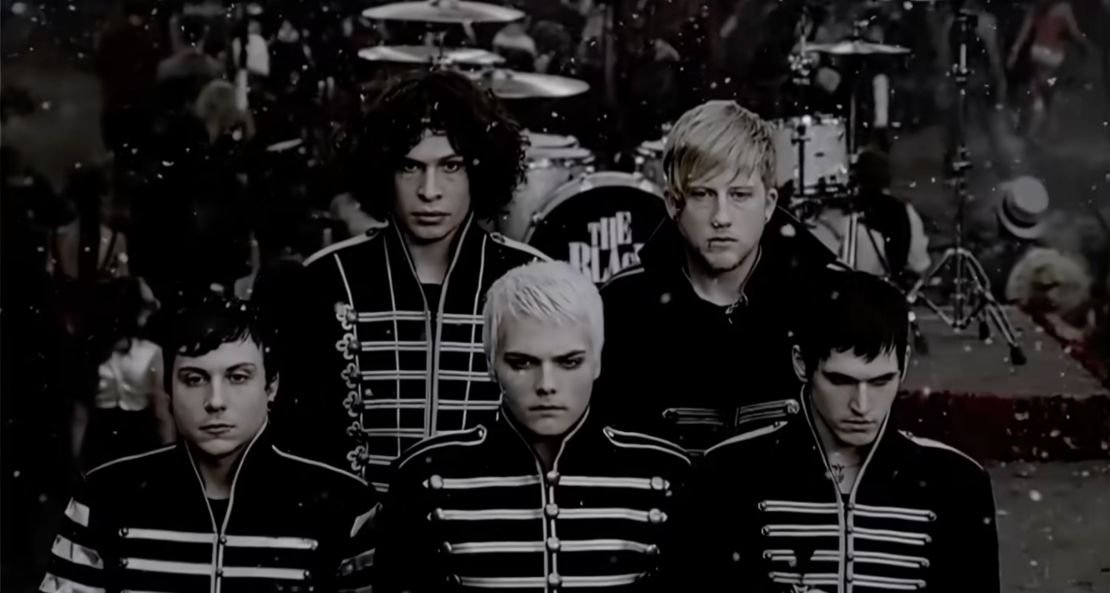
“Welcome to the Black Parade” is a 2006 rock opera anthem by My Chemical Romance in which a dying man known as The Patient is escorted to the afterlife by a spectral marching band summoned from his most powerful memory: his father taking him to see a parade as a child.
It sits at the centre of the album The Black Parade, a full concept record built around The Patient’s death from cancer and the life he recalls as he fades.
What does “Welcome to the Black Parade” mean? It is a song about mortality, parental legacy, and the question of whether a broken person can still become something worth remembering.
In simple terms, the meaning of “Welcome to the Black Parade” centres on how a person faces death and what remains after them. The Patient’s memory of the parade becomes the way his mind gives shape to the end of his life.
His father’s challenge, asking whether he will become “the savior of the broken, the beaten and the damned,” lingers unanswered as he dies.
The song suggests that legacy is not measured by whether someone fulfils that promise, but by whether the question stays with them until the end.
Released on 23 October 2006 as the lead single from The Black Parade, the track was written by Gerard Way, Ray Toro, Frank Iero, Mikey Way, and Bob Bryar, and produced by Rob Cavallo.
It peaked at number one in the UK and number nine on the US Billboard Hot 100, eventually earning platinum certification in multiple territories.
Way explained the song’s premise to MTV at the time of release: the album’s concept is built around a character who dies of cancer at a young age, and death arrives not as a figure or a void, but as his most powerful memory.
For The Patient, that memory is a parade. The Black Parade is not metaphor. It is a literal mythology, a dead man’s childhood becoming the vehicle that carries him out.
On the meaning behind the track more broadly, Way told Steve Baltin’s podcast My Turning Point: “The triumph of the human spirit over darkness was something that was kind of built into the DNA of the band from the beginning. The self-actualisation, the triumph of the spirit and things like that, getting through really hard things.” He added: “There’s darkness in the world. And I think overcoming that darkness, that darkness externally and internally, is a beautiful thing.”
The song was written at the Paramour Mansion in Los Angeles, a reportedly haunted estate where the band secluded themselves during the album’s creation.
The isolation fed directly into the work. “We were just in this haunted house together, kind of becoming slowly depressed, and withdrawn, and isolated from the world outside,” Way recalled. “It became a dark place, and just being in there and kind of jamming this idea together, and playing it together, and getting the original bones of the song, that was really collaborative.”
The track was originally titled “The Five of Us Are Dying.” Way struggled to connect to it and nearly cut it from the record.
The rename came first, then a complete structural overhaul. “Once we re-approached it from the perspective of starting with a completely new introduction,” he said, “it helped us fix the rest of it.”
That new introduction was the piano melody Way wrote, one of the most immediately recognisable openings in twenty-first century rock.
The piano sequence is one of the most recognisable openings in modern rock. Four notes in and the listener already knows exactly where they are, and what kind of record is coming. It does not set a mood so much as announce a world: cinematic, grieving, and oddly ceremonial.
What follows is precisely that. The song’s arrangement builds in clear stages, each adding weight without cluttering. Rhythm guitar enters and locks the track into forward motion. Drums carry the march. Layered vocals stack across the chorus. At no point does the song overextend.
There is no gratuitous breakdown, no wasted section. Each section arrives exactly when it should.
The opening verse, set against sparse piano, establishes the memory: a father and his young son at a parade.
The video makes this concrete, a boy absorbing his father’s words, a man recalling it as he dies. The music video extends the idea literally, showing The Patient leaving a hospital bed as the Black Parade marches around him, death rendered as procession rather than void.
The father’s instruction becomes the lyrical tension that runs through the entire song: “Son, will you be the savior of the broken, the beaten and the damned?”
The command is enormous and the son’s ability to answer it is uncertain. He is, after all, dying.
Whether this is a real inheritance or a dying man’s final delusion is left unresolved. That ambiguity is not decorative. It holds the song together.
Way’s vocal delivery tracks the song’s emotional arc without overreaching at any point.
The opening verses are stripped back, almost spoken in places, a quality that keeps the lyric intelligible and the listener close.
As the arrangement fills in, the delivery gains texture and force. By the time the track reaches its final build, the voice is raw but controlled, powerful without abandoning the melody. Pronunciation stays clean throughout. Every word lands.
This matters in a song where the lyrical content is doing substantial narrative work.
Small production choices reinforce the concept without announcement. Snare drums enter during the sections explicitly about marching. The connection is direct rather than symbolic, the arrangement demonstrating its own subject matter. The military rhythm is not added for dramatic contrast; it belongs to the logic of the world the song is building.
The song charted, sold, and became generational. For My Chemical Romance, it also became the defining moment of their career.
That reach is partly explained by how completely it holds together, but it also landed at a moment when rock radio needed something with scale.
“Welcome to the Black Parade” arrived wearing the emo label, a tag that had calcified around guitar-driven melodrama by 2006, and promptly complicated it.
The song is too wide for that category: the Queen influence is audible in the layered vocals and the theatrical build, the Pink Floyd comparison holds in the cinematic pacing, and the military pageantry belongs to neither.
MCR got filed under emo because that was the available drawer, not because it fit.
That said, the song is not without its tensions. The chorus is so dominant that the verses sometimes feel like loading screens rather than scenes carrying weight of their own.
The final build resolves cleanly, but it resolves toward anthem rather than ambiguity.
That flatters the song’s most accessible quality at the slight expense of the more interesting one: the question of whether The Patient was ever truly capable of answering his father’s call. The arrangement closes the case before the lyric does.
The piano intro remains the song’s most durable achievement. Everything else was reconstructed once.
The intro was written once and has never needed revision. And the father’s question still has no answer.
The Patient dies carrying the words rather than fulfilling them, which may be the closest thing to fulfilment the song allows.
You might also like:
- The Drag Path: How a Song That Doesn’t Exist Became the Most Honest Thing Tyler Joseph Has Ever Written
- The Killers’ Timeless Hit: Unravelling the Mr. Brightside Lyrics and Its Enduring Impact on Pop Culture
- You Get What You Give meaning: Why New Radicals anthem still hits harder than you think
- Iris Lyrics: The Story and Meaning Behind the Goo Goo Dolls’ Hit Song
- Exploring The Meaning Behind The Lyrics of The Calling Wherever You Will Go
- Smells Like Teen Spirit by Nirvana: Meaning, History, Lyrics and Legacy