

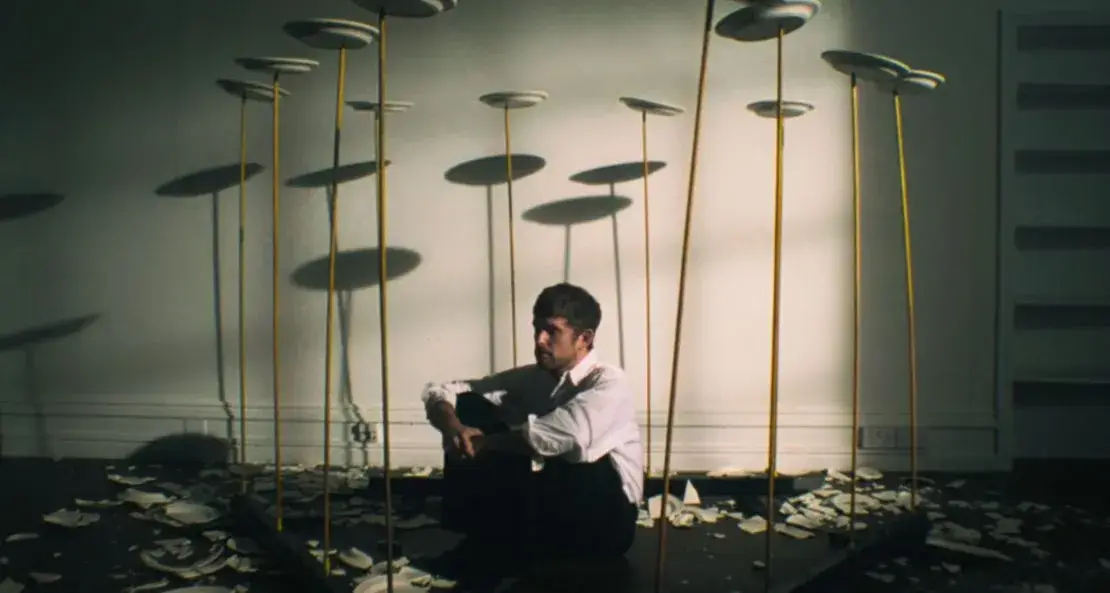
James Blake’s latest album, Trying Times, finds him existing in a dual state: the quiet piano and synth ballads that made him famous, and the electronic experimentation that pushes his music forward.
His seventh solo record, and the first he has self-released after departing a major label, put out on his own Good Boy imprint, it represents one of his most captivating collections of songs to date, arriving as a successful synthesis of the singer-songwriter vulnerability explored on Friends That Break Your Heart and the left-field electronic textures of Playing Robots into Heaven.
The opening track, “Walk Out Music,” is immaculate. Lyrically brief but captivating across its three-minute runtime, it establishes a mechanical pulse, steady but incapable of warmth, a rhythm that keeps time without ever becoming a heartbeat. Its few elements, the drums, the repetition, that deadened vocal, hold each other at a distance. The song feels like it’s for someone suspended between the desire to move forward and the paralysis of knowing you’re no good to anyone. It is all hinge and no door.
The album speaks to the current cultural moment, not through overt political messaging, but by addressing the despondency many feel and advocating for maintaining humanity and connection amid darkness.
“The Death of Love” establishes this tone immediately. Blake’s falsetto anchors you in a loneliness so complete it feels physical. A choir hums in the background. The instrumentation is stunning, content to let you get caught in the emotions he’s communicating. “Sometimes we come back empty handed, like bees from plastic flowers,” a line that hits like a verdict on everything hollow the internet has made of us. By the time the Leonard Cohen sample drifts through, you realise he’s not just mourning a relationship. He’s mourning the capacity itself.
“I Had a Dream, She Took My Hand” serves as the album’s heart, a love-struck track that reimagines doo-wop through Blake’s singular lens, drawing on classic American vocal group traditions including Hollywood oddities the Lewis Sisters. The harmonies ache, the prophet synth blooms small then swells until it fills every corner, and the whole thing moves like a memory you’re afraid to wake from. “I felt higher than storms, lighter than sand,” he sings, and later, “I heard my call to the Titanic band playing them out, miles from land,” a poet’s way of saying love is both the ship and the sinking. By the outro, when he’s just repeating “come back,” the dream has dissolved and taken him with it. The production doesn’t just support the lyric.
The title track lands with English understatement so dry it barely feels like irony anymore. “You know I’m shredded by the time I’m home,” Blake sings, “like polystyrene foam,” a detail so specific and unglamorous it could only be true. The song moves slow and spacey, acoustic guitars stretched into something almost indie rock, but the paranoia creeps in through the cracks: “the anxious end up alone / ’cause there are far too many things we can’t control.” By the time the pre-chorus reaches ‘I would die for, stay alive for,’ it’s not a vow. He’s just telling you what it costs.
Blake has described the track as a space-rock love song at the end of the world. The title itself is a piece of English sarcasm, the understatement of a nation that greets catastrophe with a shrug.
“Didn’t Come to Argue” featuring Monica Martin stands as some of the most beautiful music Blake has ever released. The way he blends original vocals with pitched and stretched samples creates a seamless, spacious, and elegant sound that feels vintage and forward-looking. The strings, the bouncy beat switch, and Martin’s presence on the back end combine for something transcendent.
The Dave collaboration breaks the album’s momentum. That sense of drift shows up in the writing as much as the music, where sharp insights, from the Dave collaboration’s disruption to the Kanye lineage, arrive without quite being absorbed into the album’s wider shape.
Lyrical moments like “the end of the tunnel is a therapy couch like Tony Soprano” are crisp amid the distorted, cello-like production.
The album showcases range. “Make Something Up” brings energy reminiscent of certain Radiohead moments, with a drum build that pays off satisfyingly.
Later tracks venture into dance-influenced territory, nodding to Blake’s electronic roots. “Days Go By” is the most audacious of these moves, flipping Dizzee Rascal’s “I Luv U” into something lovestruck and almost giddy, the sentiment landing as the groove lifts.
“Rest of Your Life,” with its cathedral-like atmosphere and spinning house sensibilities, builds on a hauntological Dusty Springfield sample before blooming into dancefloor euphoria. It is beautiful music even as its stylistic shift arrives unexpectedly.
However, the album is not without flaws. The sequencing grows disjointed in the second half, and it feels bloated with a few weaker songs compared to the undeniable peaks of the first leg.
“Obsession” functions as a brief interlude that fits the album’s energy but leaves minimal impression.
“Through the Highwire” maintains beauty, yet the fragmented progressions and glitchy embellishments feel unnecessary on a track that might have benefited from more traditional instrumentation, notably, the song is believed to rejig material from Blake’s 2022 sessions with Kanye West, a lineage that lends an uneasy subtext to its themes of reputation and fallen glory. “Feel It Again,” though showcasing Blake’s remarkable tone, is too brief to leave a lasting mark.
The album closes with “Just A Little Higher,” the record’s most explicitly political statement, Blake cataloguing fractured information and civic helplessness with the resigned clarity of someone who has stopped waiting for answers. It ties everything together, rewarding patience with space to breathe and reflect.
This isn’t an album about falling in love. It’s about keeping something alive after the feeling has already started to erode.
The production throughout balances beauty with experimentation, and Blake’s vocal performances remain stunning across every track. Nobody else sounds quite like him or operates with this particular blend of vulnerability and technical ambition.
Ultimately, the highs of Trying Times make it thoroughly worthwhile. The lyrical focus, creative use of samples and features, and consistent thematic through-lines make it one of Blake’s most focused records. It is an album that reveals new dimensions with each pass. For all its inconsistencies, it finds an artist pushing his boundaries while remaining unmistakably himself.
You might also like:
- Jon Bellion’s Father Figure Album: A Mature Return to Form
- Mitski – Nothings About to Happen to Me Review: Her Darkest, Most Honest Record Yet
- Harry Styles’ Kiss All the Time. Disco, Occasionally Review: The Disco Album That Barely Wants to Dance
- BLACKPINK – DEADLINE Review: The Four Who Write Their Own Rules