

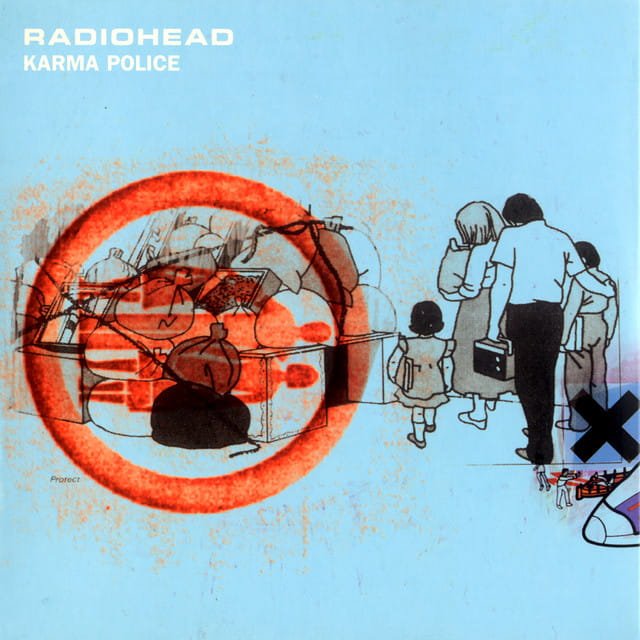
Karma Police is Radiohead’s 1997 song about a person who calls on an imaginary force of cosmic justice to deal with people who irritate them, before quietly realising in the final line that they might be the problem themselves.
That reading is easy to miss. Karma Police is often treated like a protest song. It is closer to a character study and one of the clearest examples of how song lyrics can hide their real message beneath an inviting melody.
The meaning of Karma Police becomes clearer once you realise the song is really about self-righteous irritation dressed up as cosmic justice.
Where It Came From
The phrase “karma police” started as a running joke on the OK Computer tour bus. Jonny Greenwood explained it became a band catchphrase whenever someone behaved badly, a shrug that cosmic justice would catch up eventually.
Thom Yorke turned that into a song and described the finished result as dedicated to everyone working for a large company, a song against bosses, against middle management.
Ed O’Brien is credited with first suggesting the concept. Yorke later said it makes him laugh. That matters when you get into the lyrics, because most listeners hear something far more serious than the band apparently intended.
The song was recorded at St Catherine’s Court, a 15th century Tudor mansion near Bath, where Radiohead had installed a mobile studio in the library, used the ballroom as the main live room, and turned hallways into vocal booths.
The second half of the track, from the middle section through to the outro, was built entirely differently from the first.
Producer Nigel Godrich noted it was constructed from samples and loops rather than the band playing together. It was the first time they had worked that way, and a method that shaped a lot of what came after, during the period when Radiohead were pushing toward the experimental sound that defined their late-90s work.
What the Lyrics Actually Mean
Three verses, three targets. The speaker summons an imagined authority to deal with a man who talks in mathematical abstractions and drones like a broken appliance, a girl whose haircut offends them enough to warrant confrontation, and then, in the third verse, themselves: out of ammunition, still on the payroll, running on empty.
Yorke recorded an actual fridge buzzing for the original demo, partly as a way of capturing how some people talk without really saying anything. He associated that feeling with American rock radio during the touring cycle.
What makes the song unsettling on closer inspection is that the targets are barely crimes. Someone talks in maths. Someone has a haircut you dislike. These are the irritations of a person who has decided the universe owes them more than it is delivering. The chorus, this is what you get when you mess with us, sounds like a threat from someone who has never actually confronted anyone directly in their life.
The outro flips everything. “For a minute there, I lost myself” is either the speaker stepping back and recognising how ridiculous the whole situation is, or it is the relief of someone who almost woke up but chose not to. Yorke has said the song is not entirely serious and that he hoped people would pick that up. A lot of people did not.
The song works best as a study in how ordinary grievance wraps itself in the language of justice. The speaker genuinely believes they are on the right side. The lyrics do not tell you they are wrong. They just show you the evidence and let the “phew” do the work, similar to how obsession quietly drives the story in R.E.M.’s Losing My Religion.
How Karma Police Sounds
The song moves like something you almost recognise from another record. That is not an accident. Many listeners hear a clear line back to The Beatles’ Sexy Sadie, the White Album track Lennon wrote as a barely disguised attack on the Maharishi, though the comparison has never been officially confirmed.
Both songs treat accusation like melody, keeping the surface calm while something more acidic runs underneath.
There is a specific moment in the verses worth listening for. The first time through, a particular chord arrives in a softened form, present but held back. The second time, it hits full weight. Nothing else changes. The melody is the same.
But that chord landing harder the second time changes how the whole verse feels, the way a tone of voice can shift the meaning of a sentence without altering a single word.
Listen to how Yorke phrases different lines. “Arrest this man” comes out in short, clipped syllables, each word landing separately, like a formal charge being read. “He buzzes like a fridge” flows in a single descending line, conversational, almost bored. The contrast is deliberate and completely audible once you hear it. The melody sits slightly off the beat throughout the verses, creating a low-level friction, as if the song is just slightly out of step with itself.
The middle section sounds like it is heading somewhere familiar and then does not arrive there. The piano line climbs, you wait for the obvious resolution, and instead lands somewhere unexpected. The melody has to follow it, and together they produce something that does not feel wrong exactly, just genuinely surprising on every listen.
Yorke plays a Gibson Hummingbird acoustic, Greenwood takes the piano, and O’Brien handles the Rickenbacker guitar, the scribbles and embellishments across the top of the arrangement. The ending, where everything dissolves into distortion and noise, belongs entirely to O’Brien.
Why the Karma Police Video Still Works
Directed by Jonathan Glazer, who would later make Under the Skin and The Zone of Interest, the Karma Police video is one of the best-constructed music clips of the 1990s and still stands among the most memorable music videos ever produced.
The concept grew out of a half-conscious memory of the opening credits of David Lynch’s Lost Highway, which Glazer had fallen asleep watching during a late-night private screening arranged for Marilyn Manson. The idea was originally pitched to Manson for a different song. Radiohead got it instead.
The clip debuted on MTV’s 120 Minutes on September 21, 1997, with a production budget of around $200,000. That money mostly went on the car, the logistics of the fire sequence, and flying in the actor who plays the running man from Hungary.
Most of the video is shot from the driver’s perspective. You are inside the car. You are doing the chasing. When the man lights the match, you are now the one being chased.
Where It Sits on OK Computer
The album deals with alienation, corporate logic, and the slow erosion of individual identity under systems of work and consumption. Paranoid Android screams. Fitter Happier recites. No Surprises goes numb. Karma Police does something slightly different.
It shows what happens when a person absorbs those systems and turns them outward, appointing themselves as an agent of moral correction while the actual machinery grinds on around them.
Yorke observed that most of the music on OK Computer is extremely uplifting and that you would only think otherwise once you engaged with the words. Karma Police is probably the clearest example of that gap. It became a singalong at concerts, thousands of people cheerfully belting out a song about someone whose sense of justice is largely self-serving.
It became a singalong at concerts, thousands of people cheerfully belting out a song about someone whose sense of justice is largely self-serving. Whether the band finds that funny or grim probably depends on the night.
You might also like:
- Smells Like Teen Spirit by Nirvana: Meaning, History, Lyrics and Legacy
- What Does Welcome to the Black Parade Mean? My Chemical Romance Anthem Explained
- The Gorillaz Paradox: How a Fake Band Became Real
- Iris Lyrics: The Story and Meaning Behind the Goo Goo Dolls’ Hit Song
- All Star by Smash Mouth: A Deep Dive into a Late 90s Anthem
- The Story Behind Scar Tissue by Red Hot Chili Peppers: A Song of Pain, Hope, and Healing