

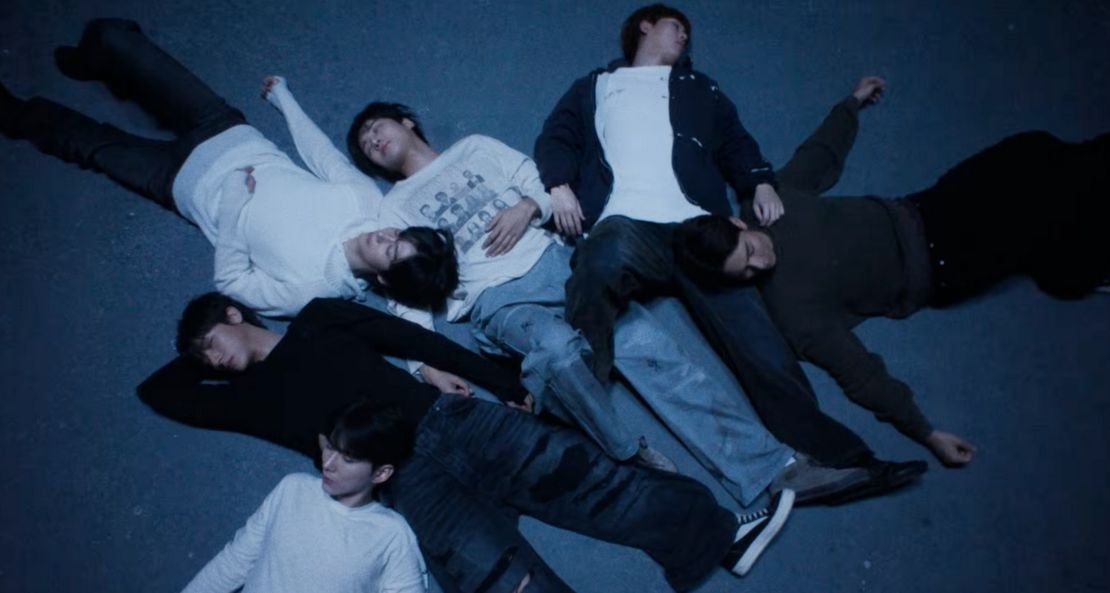
K-pop powerhouse MONSTA X has returned with their latest English-language offering, and it’s a far cry from their signature hard-hitting sound.
“Baby Blue,” released November 14th, finds the six-member group trading their usual intensity for something quietly heartbreaking: a stripped-back meditation on love’s gradual dissolution.
The track arrives as MONSTA X’s first release under Intertwine Records, marking a significant new chapter for the group.
This label partnership represents a fresh direction whilst proving their remarkable versatility across genres and markets.
The single also holds special significance as the group’s first full-member English release since all six completed their mandatory military service, reuniting Shownu, Minhyuk, Kihyun, Hyungwon, Joohoney, and I.M for this emotionally charged ballad.
Written by Lionel Crasta, Lita, and Nate Cyphert, with arrangement handled by Crasta, “Baby Blue” captures that specific ache of watching a relationship slip away despite both people desperately clinging to what once was.
Unlike previous English singles that leaned into their energetic performance style, this release showcases a different side entirely.
Where tracks like “Whispers in the Dark“ from their 2021 album “The Dreaming” balanced atmospheric production with the group’s characteristic edge, “Baby Blue” operates in a more vulnerable space.
It’s a deliberate artistic choice that speaks to the group’s maturity as they approach their tenth anniversary in 2025.
The opening lines set the melancholic tone immediately, acknowledging how things have shifted in a relationship.
It’s that uncomfortable space where couples pretend nothing’s changed whilst knowing everything has.
The pre-chorus builds this tension beautifully, with the members questioning whether living in denial counts as survival or self-deception.
The lyrical exploration of whether the couple is clinging to the past captures the paralysis that comes with fading relationships.
What makes “Baby Blue” particularly gutting is its central metaphor. That colour, specifically how it looks on someone you’ve loved, becomes shorthand for all the small, cherished details you can’t forget.
The chorus hits with effective simplicity: familiar movements, unchanging beauty, and the impossibility of walking away from comfort masquerading as connection.
The repeated imagery of dancing “like I remember” reinforces how relationships become frozen in memory even as they deteriorate in real time.
Vocally, the group delivers something special here. Shownu’s warmth anchors the emotional weight, providing a steady foundation for the song’s more delicate moments.
His tone suits this material perfectly, confirming suspicions that he excels in this ballad territory.
Minhyuk surprises with a tonal quality that cuts straight through. His delivery carries genuine vulnerability, showcasing a facet of his voice that often gets overlooked in the group’s more aggressive material.
What he brings to this track feels revelatory, a rawness that makes the heartbreak tangible.
Kihyun’s technical prowess shines without overshadowing the song’s intimacy. His control and emotional delivery remain impeccable, as expected from one of K-pop’s most respected vocalists.
All six members handle the English lyrics with impressive fluency and emotional intelligence, drawing on their years of experience crafting English-language content for international audiences.
The accompanying music video, directed with soft lighting and nostalgic colour grading, reinforces the song’s bittersweet mood.
There’s no theatrical storyline or high-concept narrative, just the members conveying the painful reality of recognising a relationship’s expiration date whilst lacking the courage to act on it.
The visual treatment feels intentionally understated, matching the song’s subdued production.
The bridge section hits hardest with its repeated phrase about a love one has simply “gotten used to.”
It’s not about passion dying; it’s about love calcifying into habit, affection becoming muscle memory rather than genuine feeling.
That’s somehow more painful than a dramatic ending. The repetition creates a hypnotic effect, drilling down into that specific emotional territory where comfort and genuine connection become impossible to distinguish.
This sonic direction represents a calculated risk for MONSTA X. The group built their reputation on powerful performances and hard-hitting tracks like “Jealousy,” “Shoot Out,“ and “Gambler.”
Their discography typically leans towards aggressive, percussion-heavy production that showcases their performance prowess.
“Baby Blue” asks listeners to engage with them differently, stripping away the armour to reveal something more fragile.
The timing of this release within the broader K-pop landscape is worth noting. As the industry continues its global expansion, groups increasingly experiment with English-language material aimed at Western markets.
MONSTA X has consistently been at the forefront of this trend, but “Baby Blue” distinguishes itself by refusing to chase radio-friendly pop formulas. Instead, it commits fully to its melancholic vision.
For a group known for commanding stages with aggressive charisma, this measured approach demonstrates serious artistic maturity and confidence in their artistic identity.
As they move through their tenth year together, their willingness to explore these softer, more vulnerable spaces strengthens their case as one of K-pop’s most artistically ambitious acts.
You might also like:
- Two Years – ROSÉ: A haunting ballad of lingering love
- Something in the Heavens – Lewis Capaldi: A heartfelt ballad about loss and hope
- Too Sweet – Hozier: A nocturnal ballad exploring indulgence and compromise
- How Does It Feel to Be Forgotten – Selena Gomez & Benny Blanco: A ballad about humiliation, nostalgia and closure
- On My Mind – Alex Warren & ROSÉ: A nostalgic spiral of obsession disguised as reminiscence
- Damocles – Sleep Token: A ballad of pressure, fame and losing oneself beneath success