
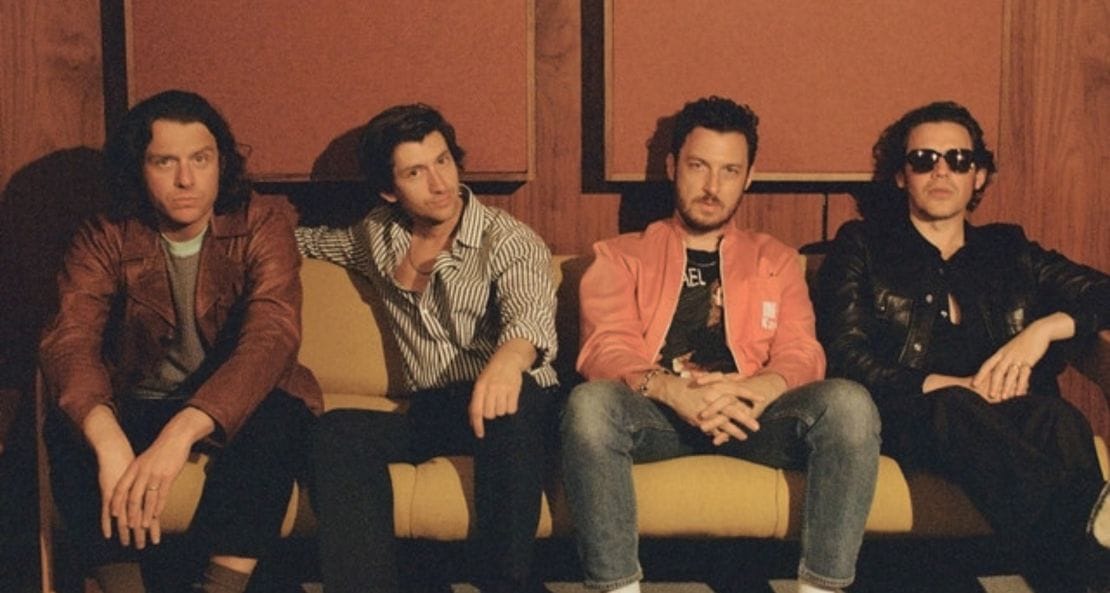
“505” by Arctic Monkeys is about Alex Turner’s longing to get back to a hotel room, number 505, where his then-girlfriend Johanna Bennett was waiting while he was on tour. The song is about the space between departures, written by someone who keeps saying goodbye.
For years people have wondered what the title actually refers to. A hotel room? An area code? Something Turner invented to keep fans guessing? The answer is simpler and more specific than the mythology suggests.
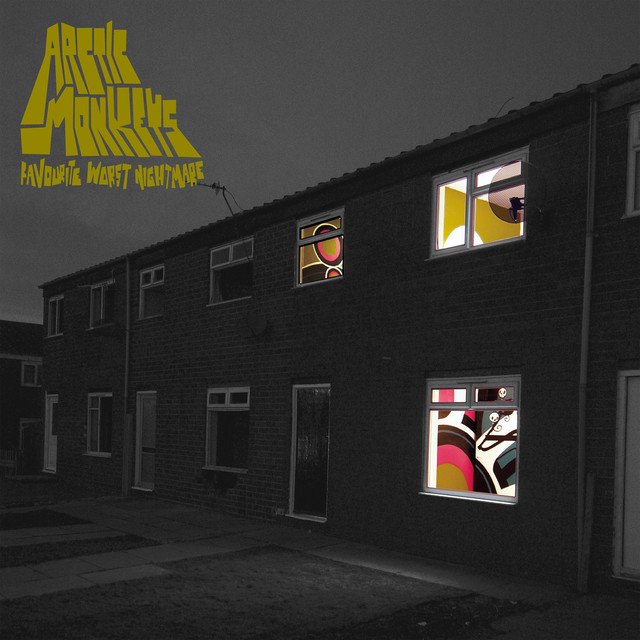
When Arctic Monkeys closed Favourite Worst Nightmare with “505” in April 2007, they buried their most emotionally exposed song at the end of an album that otherwise moved at sprint pace. “Brianstorm” opened it. “Teddy Picker” and “D Is for Dangerous” followed.
“505” was the quiet thing at the end, album-closer territory, not radio territory, with no single release and no music video. It peaked at number 74 on the UK Singles Chart and stayed there.
Turner told NME around the time of release that it was “the first proper love song we’ve done… as in like, ‘Oh, it’s that one person.'” That person was Johanna Bennett, his girlfriend at the time, a musician who had fronted the band Totalizer. Most write-ups treat her as background detail. Her connection to the album runs deeper: she co-wrote “Fluorescent Adolescent” with Turner on a quiet holiday the two took together, the same holiday Turner has referenced in interviews about this period of their relationship.
She described it to The Observer in 2007 as a word game they played to stop themselves going mad in an isolated hotel, no TV, no music, just the two of them briefly cut off from everything. Whether the room they stayed in was numbered 505 has never been confirmed.
The context is the same either way: a couple briefly alone, aware the time was borrowed, because it always was. Turner was at the centre of the biggest guitar-band story in Britain. He was always about to leave.
“505” is not a reunion song. It’s a song about the space between departures. Turner is always somewhere mid-journey, going back to 505 but not yet there, running the reunion in his head rather than living it. That distinction matters for every line that follows.
The Lyrics
The opening chorus sets the terms immediately. A seven-hour flight and a forty-five-minute drive are wildly different propositions. The narrator treats them as equivalent. He’s going regardless.
Some fans have suggested 505 is an area code (central New Mexico) or a Sheffield bus route, but Turner’s NME confirmation and the biographical context make the hotel room interpretation the one that holds. The other theories are more interesting as proof of how hard people reach to make sense of a number that Turner kept deliberately bare.
The second line of the chorus is where the song reveals its real subject. “In my imagination, you’re waitin’ lyin’ on your side / With your hands between your thighs.”
The phrase “in my imagination” is doing the heavy lifting. He’s not describing arrival. He’s describing the rehearsal: what he replays on the plane, in the greenroom, on the tour bus. The image is domestic and intimate, her waiting, unhurried.
Whether what he finds when he gets there matches what he’s been rehearsing is left completely open, and that gap, between the imagined version and the actual one, is where the song lives.
The verse sharpens that anxiety into something more uncomfortable. “I’d probably still adore you with your hands around my neck / Or I did last time I checked.”
This line gets more debate than almost anything else in the Arctic Monkeys catalogue. Some people read physical violence into it. Some read erotic intensity. Both make the mistake of putting the force in her hands.
The word “probably” is the tell. He doesn’t say he still adores her. He says he probably would, present tense conditional, like he’s running the calculation mid-sentence and it’s coming back uncertain. “Or I did last time I checked” is the same move again: not a joke, not charm, but genuine doubt about whether the feeling is still intact.
Turner is describing a man whose attachment has started to feel indistinguishable from being held in place, and who can’t entirely tell whether he minds.
“The knife twists at the thought that I should fall short of the mark” follows directly from that uncertainty.
Turner was writing about the specific fear of inadequacy in a private relationship, the knife metaphor precise in a way his earlier lyrics weren’t, not a general ache but a sudden, sharp thought arriving uninvited.
The bridge is where the composure breaks entirely. The narrator has been running through imagined reunions and the song has been building around that tension, and then suddenly there’s no image, no metaphor: “I crumble completely when you cry.” One plain sentence.
And the line after it pins the whole situation: she keeps having to say goodbye. He keeps making her do it. The song doesn’t offer any way out of this. “I’m always just about to go and spoil the surprise / Take my hands off of your eyes too soon.” He knows he’s going to ruin it. He goes anyway.
The music was built to match that emotional logic. The organ riff that opens the track comes from Ennio Morricone’s score for the 1966 Sergio Leone western The Good, the Bad and the Ugly, the standoff cue at the film’s climax. Tense, cyclical, going nowhere until it goes everywhere at once.
Producers James Ford and Mike Crossey built the track around the same patience. The two chords repeat. The drums don’t arrive for nearly two minutes.
Structurally, “505” is a song that refuses to give you what you want until it’s ready, which is exactly what the lyrics are about: the standoff inside one person’s head, waiting to see who blinks first.
As the track builds, Turner’s vocal rises in pitch and intensity, and what starts as a spare, almost whispered thing eventually fills the room.
Miles Kane, then of The Rascals and later co-founder of The Last Shadow Puppets with Turner, plays guitar on the recorded version, his contribution thickening the sound in the back half when the restraint finally gives.
The Guardian’s Alexis Petridis, reviewing the album on release, wrote that the track “discusses how touring plays havoc with one’s love life,” calling it “so heartfelt and riven with insecurity that it transcends the dreary genre to which it should by rights belong, that of songs in which rock stars complain about being rock stars.”
In a later ranking of every Arctic Monkeys song, he placed it third. Pitchfork’s Marc Hogan described it as “one of Turner’s first proper love songs,” noting the way it “poignantly describes Turner’s longing to get back to a hotel room where his lover awaits.”
The critical consensus, when it eventually came, was that the track was pointing somewhere the rest of Favourite Worst Nightmare wasn’t: stylistically it sits closer to 2013’s AM than to “Brianstorm,” the cinematic restraint and the lyrics preoccupied with desire and inadequacy rather than nightlife. Whether Turner had any sense of that in 2007 is another question.
One factual point worth clarifying: several articles on “505” list “Fluorescent Adolescent” among the emotional highlights of Favourite Worst Nightmare. It isn’t on that album. It appeared on Suck It and See in 2011, four years later. The confusion is understandable because both songs connect to the same relationship and the same holiday with Bennett. Same person, same era, different record entirely.
Live, the song became something else again. Since 2008 it has closed almost every Arctic Monkeys set, and over the years it developed a specific weight around the bridge.
The BBC’s recording from Reading Festival 2022 captures what that looks like: Turner reaches “I crumble completely when you cry,” the band drops to almost nothing, and the crowd, tens of thousands of them, already knows every word of what comes next.
The pause before the final chorus, documented consistently across recordings and reviews, is the moment the audience has been waiting for all night.
Kane has rejoined the band for the song on several occasions, including at TRNSMT in 2018 and the final night of Arctic Monkeys’ three-night Emirates Stadium residency in June 2023.
The two also performed it as The Last Shadow Puppets during their 2016 Rockwave Festival headline set. A live version recorded at the Royal Albert Hall on 7 June 2018 was released in November 2020 as a promotional single for Live at the Royal Albert Hall, with all proceeds going to War Child.
In August 2022, the song went viral on TikTok, where users set clips to its crescendo and the streams surged past a billion.
By early 2026 it had accumulated around 2.6 billion Spotify plays, making it Arctic Monkeys’ third most-streamed track behind “Do I Wanna Know?” and “I Wanna Be Yours.” A track that was never a single is now one of their defining songs. The song did that. TikTok was just the room it walked into.
Part of what made it work online is the same thing that made it work in 2007: the narrator never arrives. He’s always on the way, running the reunion in his head, anticipating the ruination of it. Bennett described the holiday she took with Turner as a deliberate cut-off from everything, just the two of them in a quiet hotel.
That version of the relationship, brief and borrowed, is what the song keeps trying to return to. People pour themselves into it because Turner left the door open, and because the number in the title means nothing until it means everything.
The complete meaning of “505” belongs to Alex Turner, Matt Helders, Jamie Cook, Nick O’Malley, and to Johanna Bennett. Outside of what Turner told NME, everything else is interpretation. Bennett is now married to Kings of Leon guitarist Matthew Followill and has three children. She and Turner haven’t been together for nearly two decades.
Somewhere there’s a hotel with a room numbered 505 where some of this happened. Nobody has confirmed exactly where. That’s the point.
Quick Facts: Arctic Monkeys’ “505”
- Album: Favourite Worst Nightmare (2007), closing track
- Written by: Alex Turner
- Johanna Bennett: co-wrote “Fluorescent Adolescent” with Turner; widely connected to this era and the relationship the song describes
- Produced by: James Ford and Mike Crossey
- Additional guitar: Miles Kane (The Rascals / The Last Shadow Puppets)
- Original UK chart peak: No. 74 (2007)
- Post-TikTok peak: No. 2 on Billboard Bubbling Under Hot 100 (2022)
- Spotify streams: Approximately 2.6 billion (early 2026)
- Live version: Released 19 November 2020, Live at the Royal Albert Hall (proceeds to War Child)
Key musical reference: Ennio Morricone, The Good, the Bad and the Ugly (1966)
You might also like:
- Iris Lyrics: The Story and Meaning Behind the Goo Goo Dolls’ Hit Song
- The Killers’ Timeless Hit: Unravelling the Mr. Brightside Lyrics and Its Enduring Impact on Pop Culture
- Heart-Shaped Box by Nirvana: A Deep Dive Into The Lyrics And Their Meaning
- Oasis’ Wonderwall: The Meaning, The Story, and The Legacy of a Britpop Classic