
Little Foot Big Foot is a song about a boy whose father goes to prison and who fills the gap his father left. That’s the whole engine. Every line about drugs, guns, money and paranoia runs directly from that starting point. The rest is consequence.
It doesn’t stop at showing you the cycle from the inside. The music video, directed by Hiro Murai, the same collaborator behind This Is America, shows you the cycle from the outside too. Those two views point at the same thing.
“Little Foot Big Foot” first appeared under the title “35.21” on 3.15.20, Childish Gambino’s pandemic-era 2020 release in which every track was tagged by timestamp rather than name.
In May 2024, Gambino released Atavista, a revised version of the album with proper track titles and refreshed arrangements. “Atavista” refers to atavism, the re-emergence of an ancestral trait after generations of absence.
For an album centred on a son stepping into a role his imprisoned father vacated, that title is doing real work. The song was written by Gambino alongside Lil Jino and DJ Mars. Production credits go to Gambino, DJ Dahi and Curti$ $hmo. It features Atlanta rapper Young Nudy.
“I was seven years old, daddy thrown in the clink / Said ‘Life ain’t fair, everybody gon’ cheat’.” That’s where the song begins and, structurally, where it ends too. The lesson passed down at seven shapes everything that follows. Gambino isn’t building a character, he’s narrating a situation.
The first verse catalogs what that situation produces: drugs, weapons, lookouts, money, violence. None of it is glorified, none condemned. It’s presented as sequence.
The sharpest moment in the song isn’t about the narrator at all. “He was only sixteen, he was lookin’ at three / Now he lookin’ at nine, pray to God he don’t speak.” The camera briefly cuts to someone nearby, a sixteen-year-old whose sentence tripled, and keeps moving. That person is absorbed into the background. The environment processes people this way.
The second verse is where the song states its meaning outright: “They was in school, I was stirrin’ that pot / Daddy couldn’t come home, I was takin’ that spot.” The absent father isn’t only a psychological wound, he’s a vacancy. The son fills it. The cycle doesn’t require moral collapse; it requires an opening.
“Crime don’t pay, I ain’t heard what they say.” It’s not bravado. The choice is there. The song shows why it doesn’t land the way people think it should.
The hook, infectious, swaggering, operates as a surface. You could hear it as pure confidence rap. That’s the trap. The chorus is the performance. The verses are what the performance is actually about.
Young Nudy’s contribution doesn’t extend the narrative, it sits outside it. His verse operates on pure assertion: status, money, aggression. “Ego’s too slow, mind too big / Check out my life, I need big / Check out my ice, yes, they dig.” Gambino maps formation; Nudy inhabits arrival. Together they bracket the system without the connective tissue.
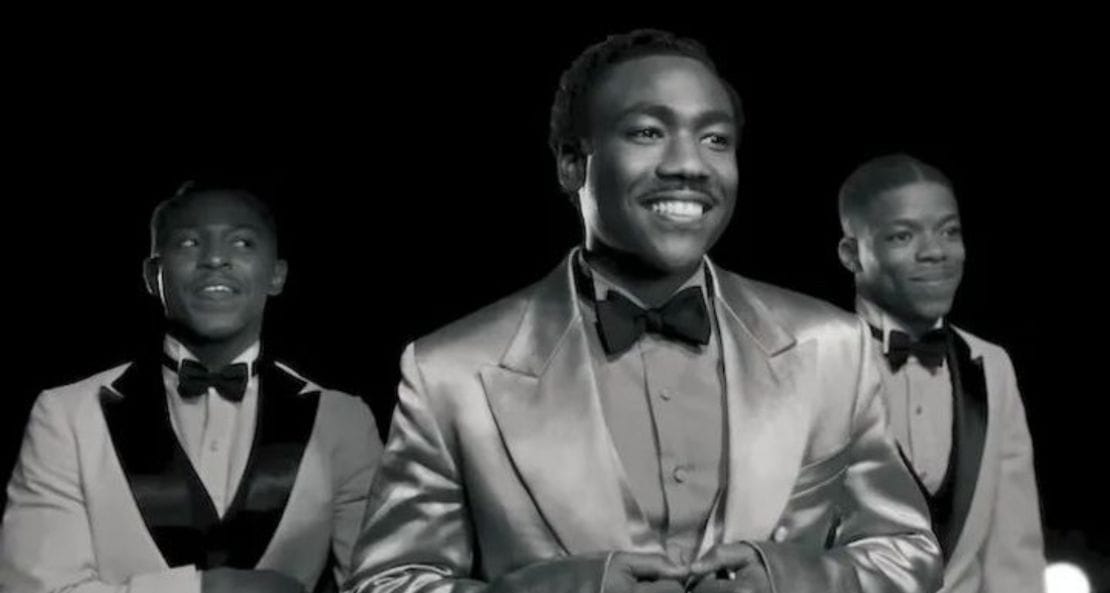
Hiro Murai directs the six-minute black-and-white video, their first major collaboration since This Is America in 2018, a promo that accumulated over 900 million YouTube views and remains one of the most discussed music videos of the past decade. The new video does something different.
The setting is a Jim Crow-era jazz nightclub. Gambino appears as part of a fictional doo-wop trio called Johnny and the Pipes. Quinta Brunson, known for Abbott Elementary, plays the venue manager. The choreography, handled by Shay Latukolan, traces a lineage from Cab Calloway through to Beyoncé. It’s accomplished, historically literate, physically committed. The room gives it nothing.
Then: Gambino takes a drag from an elderly audience member’s cigarette. The man confronts him, produces a gun, charges at him. The man dies. After a beat of uncomfortable silence broken by someone else’s laughter, the crowd finally engages. The performance becomes memorable, not because the music changed or the dancing improved, but because a man died in the room.
The artistry was always there. It took a death to make anyone lean in.
This Is America put violence behind the performance, asking the viewer to notice what they’d been distracted from. Little Foot Big Foot puts violence in front of the performance and shows that it’s the violence that produces the engagement. The crowd doesn’t need to be distracted from the show. They need the violence to find the show worth watching at all.
One cycle runs inside the story, the other runs around it. The audience in the nightclub and the audience watching the video are in the same position. It isn’t imposed from outside. It’s what people respond to. The demand is visible in real time. What gets engagement continues to appear. The same way the character’s path is shaped by circumstance, the stories that persist are shaped by what holds attention.
The loop closes here. The environment produces the story. The attention the story receives determines what repeats.
Gambino and Murai understood this when they made This Is America. They understood it differently here. There, the camera caught the audience looking away. Here, it catches the audience looking, finally, hungrily, at exactly the wrong moment.
Moving from the timestamp “35.21” to “Little Foot Big Foot” wasn’t cosmetic. The original naming system on 3.15.20 deliberately obscured entry points, resisting the song-as-product idea. Atavista names things, owns them, and asks you to look at the content directly rather than through an experimental wrapper. It also arrived with a proper music video, the visual that 3.15.20 never had, which changed how the song circulates entirely.
Gambino spoke about the gap between the two releases: “I had just lost my father, I had just had a kid, and I was going through a lot. I was having a lot of different new experiences, and that’s what I expressed.” The album sitting dormant for four years, then returning with its full name, is its own kind of atavism, something that disappeared and came back carrying what it always carried.
“Little Foot Big Foot” doesn’t ask for sympathy for its narrator. It doesn’t offer a verdict. A boy loses his father at seven. The lesson he learns is that life is unfair and everyone cheats. He fills the vacancy. A sixteen-year-old nearby gets nine years instead of three. The hook plays over all of it.
What does it say about the room that it needed the gun to start paying attention?
You might also like: