
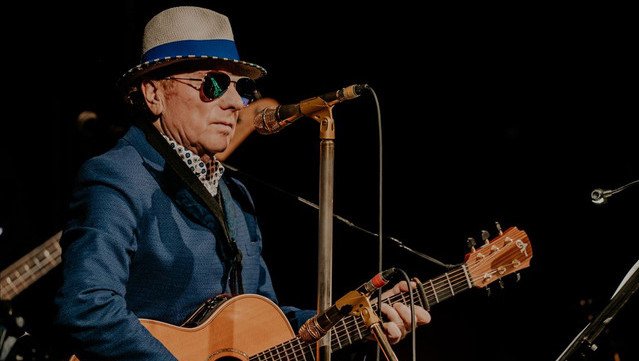
Van Morrison songs don’t age. They accumulate weight. The Belfast-born singer-songwriter has spent six decades moving between garage R&B, jazz-folk mysticism, and gospel-inflected soul with no visible concern for trend or commercial expectation, and the best of his work carries that indifference like a quality.
So what are the best Van Morrison songs, ranked?
This list prioritises musical craftsmanship and cultural reach over streaming metrics, working through twelve tracks and pulling apart what actually happens in each one rather than what it’s supposed to represent.
The ordering reflects impact, not personal sentiment. This list necessarily excludes masterpieces from Veedon Fleece and Common One that deserve their own consideration; “Streets of Arklow” stands in for both here.
1. “Brown Eyed Girl” (1967)
The most-streamed Van Morrison song on Spotify, and the one that effectively owns his public identity regardless of his feelings about it.
In an era when streaming has reshuffled legacy catalogues dramatically, pushing deep cuts into playlists and burying catalogue-fillers, “Brown Eyed Girl” has only tightened its grip.
Released in June 1967 on Blowin’ Your Mind! (Bang Records), written by Morrison, produced by Bert Berns. Peaked at number 10 on the Billboard Hot 100. Inducted into the Grammy Hall of Fame. Never received an official UK single release.
The song was originally titled Brown Skinned Girl; the title change was a label decision, not Morrison’s. He told Time magazine in 2009: “‘Brown Eyed Girl’ I didn’t perform for a long time because for me it was like a throwaway song. I’ve got about 300 other songs I think are better than that.”
The song sits at number one here not because it’s his finest composition but because no other track in his catalogue has achieved this level of cultural penetration across generations.
The streaming numbers are evidence of that presence, not the cause of it; the song was being passed between generations long before algorithms existed to measure the fact.
Structurally, it is built around a recurring calypso-inflected guitar figure and a chorus designed for mass singalong.
The Sweet Inspirations handle backing vocals. Eric Gale and Hugh McCracken play guitar. The arrangement never shifts: no breakdown, no modulation, no dramatic pause. Morrison’s vocal sits high and loose, almost boyish against the locked rhythm.
The lyrical tension lands quietly in the bridge: “Whatever happened to Tuesday and so slow.” It is the one moment the song stops moving forward. The arrangement doesn’t acknowledge it.
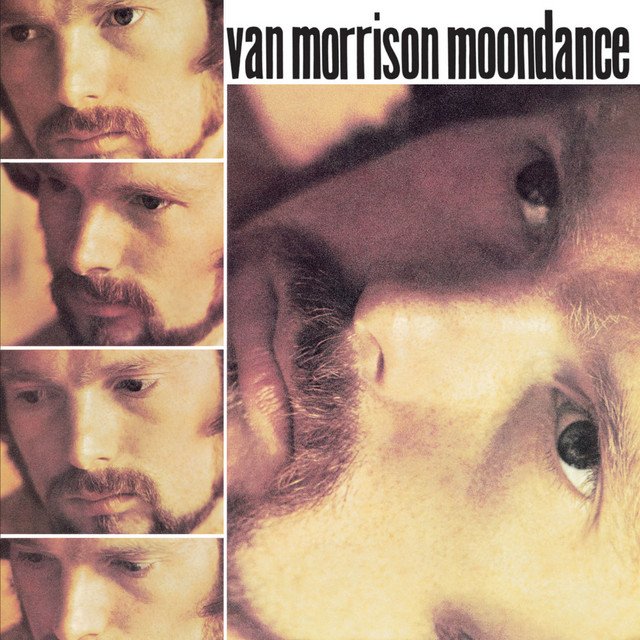
2. “Moondance” (1970)
From Moondance (Warner Bros.), written and produced by Van Morrison. Released as a single in 1977, seven years after the album: number 92 on the Billboard Hot 100, number 71 in the UK.
A sleeper hit by any measure, and one whose streaming profile has grown steadily with each wave of jazz-adjacent playlisting.
Morrison has said: “With ‘Moondance’ I wrote the melody first. I played the melody on a soprano sax and I knew I had a song.” Pianist Jeff Labes, who played on the recording, recalled Morrison singing live alongside the track because “Sinatra did that. He loved having a first-take vocal. He was looking for the magic.” (Labes, interviewed by Gold Radio, 2024.)
The track is jazz-pop in construction: walking bass from John Klingberg, restrained horns, rhythm guitar on the two and four. Morrison’s vocal is conversational for most of the song, briefly pushing into full voice on the chorus before pulling back.
The saxophone countermelody runs parallel to the vocal without fighting it. The song started as an instrumental and that lineage is audible. The arrangement has the patience of a piece written for musicians first, words second.
3. “Into the Mystic” (1970)
From Moondance (Warner Bros.), written by Van Morrison, produced by Morrison and Lewis Merenstein. Not released as a single. Genre: soul, Celtic folk.
Morrison told biographer Johnny Rogan (Van Morrison: No Surrender, 2005) that the song existed in two lyrical versions and was briefly titled Into the Misty.
The foghorn in the arrangement was recorded and placed deliberately; it is not a production choice made after the fact.
The track is built around a steady mid-tempo pulse, Morrison’s acoustic rhythm guitar, and Klingberg’s bass anchoring the low end.
The vocal sits mid-register for most of the track, rising only in the closing section. The flute and strings enter late.
The lyrical tension sits in a single image: a foghorn that usually signals danger being reframed as homecoming.
The song holds that inversion without comment. What Morrison’s voice does across eras is resist resolution; it locates the feeling before the meaning arrives, and on “Into the Mystic” that quality is as close to uncut as it gets on record.
4. “Madame George” (1968)
From Astral Weeks (Warner Bros.), written by Van Morrison, produced by Lewis Merenstein. Not released as a single. Nine minutes and twelve seconds. Genre: folk rock, jazz.
The title track of Astral Weeks could occupy this slot equally well; “Madame George” wins here for its structural audacity, particularly how Morrison sustains intensity across nine minutes without a conventional chorus or dynamic break.
The session musicians were given no charts. Bassist Richard Davis, guitarist Jay Berliner, and drummer Connie Kay were played the song on acoustic guitar and told to respond.
Berliner later recalled: “We were used to playing to charts, but Van just played us the songs on his guitar and then told us to go ahead and play exactly what we felt.”
(Berliner, quoted in Graeme Thomson, Van Morrison: No Guru, No Method, No Teacher, 2020.) Davis’s double bass is the structural anchor. The flute and violin move freely above it.
Morrison later described the central character as “an amalgam of six or seven different people.” The song ends on a sustained farewell that keeps unravelling after the words run out.
5. “Gloria” (1964)
Recorded with Them. Written by Van Morrison, released as a B-side to Baby Please Don’t Go (Decca, 1964). Genre: garage rock, R&B. Did not chart on original US release; the Shadows of Knight’s 1966 cover reached number 10 on the Billboard Hot 100. Covered by The Doors, Patti Smith, and Bruce Springsteen, among others.
Three chords: G, F, C. Morrison’s vocal is raw and barely controlled, which is the architecture. The structure is call-and-response stripped to its minimum: verse, stop, chorus, repeat. There is no bridge.
The lyrical content is almost entirely phonetic: “She come around here, just about midnight.” It is widely cited as a precursor to punk rock. The song has required no development to remain useful.
6. “Have I Told You Lately” (1989)
From Avalon Sunset (Polydor), written by Van Morrison, produced by Morrison and Mick Glossop. Peaked at number 12 on the Billboard Hot 100 and number 74 on the UK Singles Chart on original release.
Rod Stewart’s 1993 MTV Unplugged cover reached number 5 in both the US and UK. The Chieftains’ version with Morrison won a Grammy in 1995.
Morrison has confirmed the song was written as a prayer before it became a love song. The arrangement is piano-led, steady tempo, with no dramatic structural shift.
The verse and chorus share the same melodic contour. Morrison’s vocal is controlled throughout, warmer than much of his catalogue but not unguarded.
The gospel undertone is in the chord movement, not the delivery. Rod Stewart’s version pushed it further into sentiment.
Morrison’s original sits closer to devotion than romance, which is why both readings hold without cancelling each other out.
7. “Crazy Love” (1970)
From Moondance (Warner Bros.), written by Van Morrison. Not released as a US single. Features Janet Planet on harmony vocal and the Sweet Inspirations on backing vocals.
The arrangement is deliberately spare: acoustic guitar, light percussion, bass, piano. Morrison keeps the vocal quiet throughout. The Sweet Inspirations provide the only moment of full-voiced gospel push, and it lasts eight bars.
The track runs two minutes forty-seven seconds. Nothing is extended past its initial statement. Covered by Ray Charles, Aaron Neville, Robbie Robertson, and Michael Bublé. The restraint is the structure.
8. “Domino” (1970)
From His Band and the Street Choir (Warner Bros.), written by Van Morrison, produced by Morrison and Ted Templeman. Number 9 on the Billboard Hot 100, his highest-charting US single. Morrison held the track for two years to avoid a publishing deal that would have cost him half the royalties.
The arrangement is horn-driven, loose, rhythmically insistent: the closest thing to straight R&B in his peak catalogue.
Morrison’s vocal is unguarded in a way most of his studio work is not. He confirmed he didn’t want the lyric analysed and that there was no coded meaning to locate. The bridge drops briefly into a spoken section before the horns push the song back out. The momentum never breaks.
9. “Bright Side of the Road” (1979)
From Into the Music (Mercury), written by Van Morrison, produced by Morrison and Mark Isham. Peaked at number 27 on the UK Singles Chart, number 63 on the Billboard Hot 100. Features backing vocals from Katie Kissoon, a piano solo, and a full horn section.
The track opens with piano and a horn figure and stays in that configuration. The tempo is brisk for Morrison, closer to uptempo pop than the meditative pace of his Astral Weeks or Moondance material.
The lyric is direct: sunlight, forward movement, uncomplicated pleasure. It was written as a response to James Carr’s The Dark End of the Street, composed by Dan Penn and Chips Moman.
Where Carr’s original sits in guilt and secrecy, Morrison’s answer is daylit and declarative. The contrast is structural, not accidental.
10. “Tupelo Honey” (1971)
Title track from Tupelo Honey (Warner Bros.), written by Van Morrison, produced by Morrison and Ted Templeman. Did not chart as a single. Features slide guitar, a string section, and backing vocals from Ellen Schroer.
Morrison wrote the song for Janet Planet during a period of domestic stability in Northern California, an unusual compositional context. The arrangement is country-inflected and unhurried. The slide guitar sits above the rhythm section without overplaying.
The title metaphor, honey produced by bees in Tupelo, Mississippi and prized for its rarity and flavour, is stated directly in the lyric and not developed further. The song trusts the image. Covered by Dusty Springfield and Cassandra Wilson, among others.
11. “Streets of Arklow” (1974)
From Veedon Fleece (Warner Bros.), written by Van Morrison, produced by Morrison. Not released as a single. Genre: Celtic folk, acoustic rock.
Veedon Fleece is routinely listed among Morrison’s greatest records and routinely overlooked in streaming-era roundups, which is what makes it the most useful album to pull from when the goal is to represent his actual range rather than his radio presence.
“Summertime in England” from Common One belongs in the same conversation; this entry stands in for both. “Streets of Arklow” was written after Morrison returned to Ireland in 1973 for the first time since emigrating in 1967.
James Rothermel’s recorder part soars over the arrangement, which is acoustic and slow-moving until the strings enter in the third verse. The lyric describes a walk through the Wicklow town with Morrison’s “head full of poetry.” He doesn’t elaborate on what that means. The music does enough.
Among the best Van Morrison songs ranked here, this is the one most likely to be unfamiliar, and the one most likely to send a reader back to the full album.
12. “Caravan” (1970)
From Moondance (Warner Bros.), written by Van Morrison, produced by Morrison and Lewis Merenstein. Not released as a charting US single. Known widely from Morrison’s performance with The Band in The Last Waltz (1976) and from the live album It’s Too Late to Stop Now (1974), recorded with the Caledonia Soul Orchestra.
In the studio version, the structure is tightly held: a repeated melodic hook, horn punctuation, a vocal that rises in controlled increments. The “turn up your radio” instruction is delivered without irony.
The Caledonia Soul Orchestra version extends the song’s architecture until the strings and horns move independently of the verse structure. It earns its length. The studio version keeps the expansion brief and deliberate.
Across these twelve best Van Morrison songs, the ranking follows a single logic: cultural weight first, compositional integrity second, and the honest acknowledgement that the two don’t always land on the same track.
What holds the list together is not genre or era but a consistency of approach: Morrison treats the song as a container for something that can’t be fully named, and the arrangements, whether jazz, folk, gospel or garage rock, are built to hold that pressure without releasing it too early. The songs that last are the ones where he doesn’t explain himself. Most of the best ones are in that category.
You might also like: