
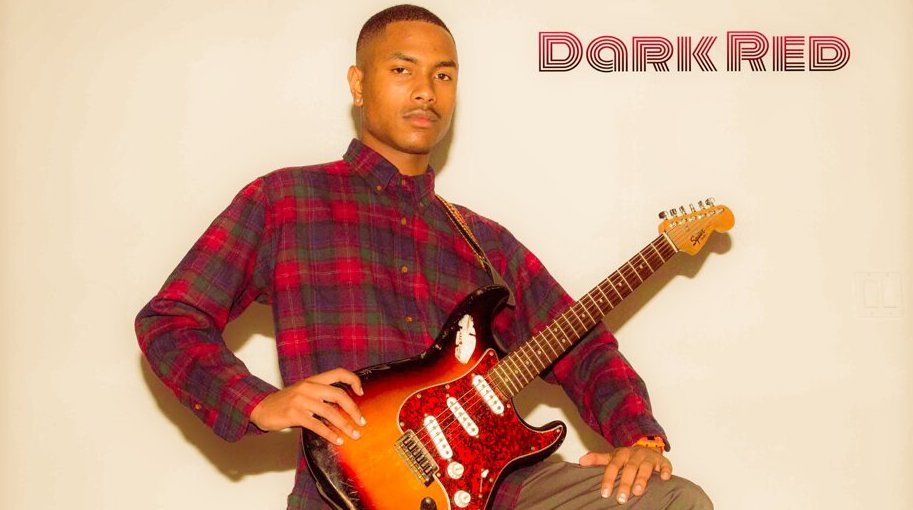
“Dark Red” is a song about the fear of losing someone before they’ve actually left, a 17-year-old’s paranoia about a relationship slipping away, set to a bassline that sounds like it’s trying not to panic.
Steve Lacy wrote it on an iPhone in his bedroom in Compton, sang the vocals directly into the built-in microphone, programmed the drums in Ableton, and released it in February 2017 as part of a six-track project he called a “song series” rather than an album.
The lo-fi production wasn’t a stylistic gesture. He just hadn’t access to a studio. What came out sounded like the inside of someone’s head at 2am, which is exactly why, four years later, it went viral on TikTok and accumulated over 680 million streams on Spotify.
Professional engineering wouldn’t have helped much.
The song holds to a single emotional premise: something bad is coming, I don’t know what, and I don’t want her to leave. Lacy doesn’t dramatise it or make it cinematic. One anxious loop, a premonition he can feel but can’t name, a woman he’s terrified of losing, a chorus where he just begs her to stay.
In the second verse he admits he thinks of her so much it drives him crazy. In the bridge he turns on himself: what if she’s fine? What if it’s my mind that’s wrong? The song ends before you find out whether the paranoia was justified. Lacy told Genius he was “just really paranoid because I really liked this girl at this time. I don’t know if she liked me back or not because she was just doing some weird stuff that made me think she didn’t like me back.”
The title never appears anywhere in the lyrics. Whatever shade Lacy was working from, danger, desire, something shifting, he kept it offstage. The colour does what the words won’t.
Lacy produced and played every instrument himself, guitar, bass, keyboard, drums last, then layered his own vocals into harmonies, singing directly into the iPhone mic. He described the whole Demo process plainly: “I did everything myself. I played everything myself. I recorded everything myself.”
Somewhere between Southern California funk and bedroom R&B, with a twangy guitar line and strings that feel slightly overripe, carrying more emotion than the surface admits.
Lacy has described his own sound as “plaid” because there’s so much going on but it doesn’t clash. On “Dark Red” that holds harder than anywhere else on the Demo. The drum pattern clicks along with just enough space for the vocal anxiety to fill it. The bassline is funky, almost danceable. You want to move to a song about dreading loss. His iRig guitar plugin fed into GarageBand, the vocals carrying the slight proximity distortion of a phone recording, a breath of room noise, the edges of the bedroom audible in the mix.

The first verse opens on a premonition: something bad is about to happen, he can feel it, he doesn’t know what. He says it twice because he genuinely doesn’t know how else to say it. No metaphor, no reaching for poetry. The closest he gets to imagery is “might leave my nose running,” a physical detail that lands harder than any abstract description of sadness could.
By the chorus it’s a direct plea not to be abandoned. He belongs with her, and only her. “Only you” repeated across six consecutive lines sounds desperate written down and sounds right when you hear it. How lyrics are interpreted on paper versus how they sit in a body is what this song feels like.
In the second verse he thinks of her so much it drives him crazy. He doesn’t know why he feels this way, and in the space where an explanation should be, he puts a “maybe.” That’s the whole verse, really.
The bridge is where the song breaks its own logic. Suddenly Lacy considers that maybe she’s fine, maybe it’s his mind that’s wrong. He says it twice, and then the chorus comes back with the same desperation as before, as if the self-questioning changed nothing.
“Dark Red” went viral on TikTok in August 2021, four and a half years after release. By then Lacy was already a recognised figure in R&B, with credits on Kendrick Lamar’s “PRIDE” from the Grammy-winning DAMN., J. Cole’s “Foldin Clothes,” Mac Miller’s Swimming, Solange’s When I Get Home, and a Grammy nomination for The Internet’s Ego Death. He wasn’t unknown. But “Dark Red” hit the algorithm in a way none of those associations could explain.
The song is 2 minutes 53 seconds long, built around one emotional state. No key change, no redemption arc. It fits perfectly inside a short-form loop. TikTok users latched onto the paranoia specifically, the feeling of watching something end before it’s officially ended, and the song’s refusal to resolve it. It charted worldwide by 2022, in markets that had ignored the Demo entirely in 2017.
The Smithsonian National Museum of American History acquired the actual iPhone Lacy made the Demo on. Teenagers reportedly bowed in front of it when the exhibit opened, which happened to coincide with “Bad Habit” sitting at number one on the Billboard Hot 100.
Before the Demo, Lacy had built his reputation as a guitarist and producer for hire, joining The Internet at 17 as part of an Odd Future-adjacent neo-soul collective. The Demo was described as “song sketches.” Thirteen minutes. Six tracks. Released independently through AWAL with no commercial infrastructure behind it.
“Dark Red” was track three.
It remained Lacy’s most-streamed song for years, until “Bad Habit” took that position. “Bad Habit” had co-writers including Fousheé and Diana Gordon, was mixed by Neal Pogue, backed by RCA Records, and reached number one on the Billboard Hot 100 after going viral on TikTok. It replaced Harry Styles after his fourteen-week run with “As It Was.” An official sped-up version followed after fan edits outpaced the original. Lacy described being initially disgusted by it before agreeing for commercial reasons.
“Dark Red” had none of that machinery. Nobody requested a sped-up version because the original already runs on the emotional tempo of someone who can’t slow their thoughts down. “Bad Habit” is the more carefully constructed song. What “Dark Red” is, is something harder to manufacture, and both ended up at approximately the same cultural coordinates via completely different roads.
Dark red sits further along the spectrum than plain red, deeper, past the point where the colour still reads as passion. It might be the lipstick Songfacts speculated about, a signal of someone preparing to move on. Or the colour of what anxiety looks like at seventeen before you have a word for it.
This isn’t a song about heartbreak. It’s about the anticipation of it. Most songs about losing someone require the loss to have already happened. Lacy makes the waiting the subject and the paranoia into the bassline.
The bridge’s self-questioning, “What if she’s fine? / It’s my mind that’s wrong,” doesn’t undercut anything. Someone in that much anxiety doesn’t calm down when they briefly consider the alternative. The chorus comes back exactly as desperate as before. And then the song just stops.
What being 17 and scared of losing someone actually sounds like, recorded in real time, on a phone, in a bedroom, left there without cleaning it up.
The Smithsonian has the phone now, preserved under glass. A song about helplessness, archived as a cultural artefact. Make of that what you will.
Steve Lacy’s Demo (2017) is available on all streaming platforms. “Dark Red” is track 3.
You might also like:
- Unravelling Call Out My Name by The Weeknd: A Lyrical Journey Through Heartbreak
- Willis I Think I Like When It Rains: A Deep Dive into the Lyrics and Meaning
- Miguel’s Sure Thing: A Deep Dive into the Lyrics, Inspiration, and Impact of a Timeless Love Anthem
- The Enduring Resonance of Keyshia Cole’s Love: A Deep Dive into Its Lyrics, Meaning, and Impact