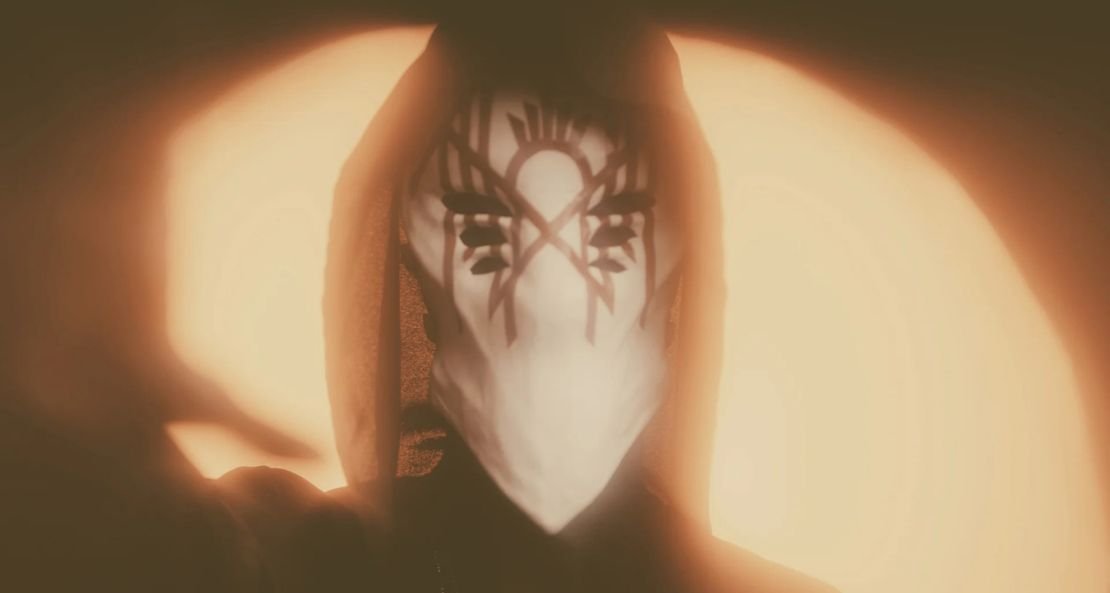
Ascensionism is a song about staying. Not because you don’t see what’s happening, but because you do, and you stay anyway. That’s the argument Sleep Token’s Vessel makes across seven minutes and eight seconds of the sixth track on Take Me Back to Eden, and it’s the argument the song never lets you argue against.
It starts with recognition. Soft piano, Vessel’s voice barely above breath, and a first line that arrives already certain: I know what you want from me. No searching. No arrival at understanding. The understanding was there before the song began. What’s being asked for isn’t love or closeness. It’s a mirror. Your bitter deception setting you free. The deception isn’t accidental. It’s perpetrated knowingly. It gives the other person something they need, something that holds them together, and absorbs the cost of that without complaint. So you take what you want and leave. No shock in it. Just repetition. A pattern that’s been run enough times to feel like weather.
Written and produced by Vessel alongside Carl Brown, who shaped much of Take Me Back to Eden‘s sonic architecture, Ascensionism was the first track on the album not to receive a single release before the record dropped on 19 May 2023. That matters. The singles, Chokehold, The Summoning, Aqua Regia, Vore, built the world. Ascensionism is where the narrator stops describing the world and admits he chose to live inside it.
Then it folds inward. Who made you like this? It sounds like confrontation, but it’s really the beginning of justification. The moment you start asking how someone became the way they are, you’ve already leaned toward staying. Curiosity softens the exit. Then the language shifts register. Who encrypted your dark gospel in body language? The word encrypted pulls from digital code, something deliberately locked, designed to require effort to decipher. A gospel is sacred, but this one is dark, and it’s communicated through gesture and presence, not words. There’s no sermon, it’s just the physical liturgy of someone who learned to communicate in contradictions. And instead of walking away from something that can’t be read, starts to adapt his nervous system to it. Synapses snap back in blissful anguish. The brain rewires around the experience. Pain becomes familiar. Familiar becomes manageable. Manageable becomes something you return to.
Vessel and Carl Brown build the production around that thought process. The ballad opening doesn’t disappear so much as it gets swallowed, incrementally, by something colder and more synthetic. The tempo shifts. The rap-adjacent cadences in the middle section turn Vessel’s voice into something closer to a drummer’s tool, staccato and percussive, words arriving in clusters that hit before you’ve finished processing the previous line. Then the structure collapses entirely into distorted guitars and drums that border on chaos. The sound doesn’t illustrate the emotional state. It is the emotional state.
Tell me you met me in past lives, past life. Some transcriptions render that second clause as past lie, and both readings hold. The past life reading is the familiar one: intensity reframed as destiny, the idea that something consuming must have roots older than this incarnation. The past lie reading is harder. It sits next to past life like its shadow. You’re not sure which one is the truth. That ambiguity is deliberate in a way that most songwriting doesn’t manage. Half algorithm, half deity. One part mechanical and predictable, one part elevated, almost sacred. They don’t cancel each other out. When the algorithm glitches, something real shows through. When the deity fades, you’re left wondering if you imagined it. Tell me you guessed my future and it mapped onto your fantasy. Now control has a direction. Not just emotional manipulation but something structural. Identity shaped around someone else’s projection. Turn me into your mannequin and I’ll turn you into my puppet queen. That’s not just influence. That’s erasure. And the response isn’t resistance. It mirrors.
This is where the song stops hiding what it’s doing. Won’t you come and dance in the dark with me? Show me what you are, I am desperate to know. Nobody better than the perfect enemy. That line is where the whole thing locks. There’s no misunderstanding left. The harm is visible, the dynamic is understood, and it’s chosen anyway. Not out of confusion. Out of something more honest and harder to excuse. Digital demons make the night feel heavenly. Even something artificial. Even something mediated and cold. Even that is enough to fill space. Anything’s better than the way I feel right now. That’s the engine. Not passion. Not even desire, really. Avoidance. The willingness to accept something damaging because it interrupts something worse.
I can offer you a blacklit paradise. Diamonds in the trees, pentagrams in the night sky. Diamonds carry allure. Pentagrams carry invocation. Both exist in the same image, neither cancelling the other. A blacklit paradise looks vivid and alive. It also only shows up under a specific light. Step out of it and it disappears. The imagery in the third verse accelerates without explaining itself. Lipstick, chemtrails, red flags, pink nails. Signals layered on top of signals. Some obvious, some disguised as something prettier. One eye on the door, other eye on a rail. The awareness is there. The exit is visible. But something else keeps the attention fixed forward, moving along a trajectory he knows isn’t going anywhere good. Bloodstains on the collar, just don’t ask. The damage isn’t hidden. It just isn’t something he wants named anymore. Naming it means confronting it. Confronting it means ending it. Let’s choke on the past. Take to the broken skies at last.
That word ascension does something uncomfortable here. Across Sleep Token’s lore, Vessel’s relationship with the entity he serves, Sleep, carries a current of cycles and inevitability, past ties repeating across lifetimes, destructive patterns inherited and re-enacted. Ascensionism sits at the structural midpoint of Take Me Back to Eden, track six of eleven, and it functions as the album’s turn: the moment Vessel stops circling and arrives at a clear-eyed admission that the love, however real, will destroy both of them. What follows on the album, Are You Really Okay?, is almost unbearable to listen to after this. The acoustic gentleness of that track lands like a bruise because Ascensionism has already shown you what was underneath.
But the ascension in the song’s title isn’t healing. You’re gonna watch me ascend. That line doesn’t sound like peace. It sounds like performance. Rising out of something without fixing it. Carrying the damage up rather than putting it down.
When the song circles back to its opening, the words are almost identical. I know what you want from me. You want the same as me. The dynamic that defined the other person has been absorbed. The reflection runs both ways now. My redemption, eternal ascension, setting me free. So I’ll take what I want then leave. The pattern repeats. Only the subject has changed. What looked, for a moment, like clarity turns out to be the same behaviour in a new body.
And then the whole thing falls into a single line.
You make me wish I could disappear.
Not leave. Not win. Not ascend. Disappear. It’s the only moment in the song that doesn’t try to become something else. Every other line has an argument inside it, a justification, a reframe, a negotiation. This one just sits there. Which is what makes it the most honest thing Vessel sings across the entire seven minutes.
The song doesn’t tell you what to do with that. It doesn’t offer a way out or a lesson folded into the back half. It just leaves you with the image of someone who has seen everything clearly, understood everything completely, and still doesn’t know how to stop.
Ascensionism is on Take Me Back to Eden, Sleep Token’s third studio album, released 19 May 2023 via Spinefarm Records.
You might also like:
- Sword by Wisp Lyrics & Meaning: A Shrouded Cry for Visibility Disguised in Dream Pop Armour
- Sleep Token’s Caramel: Lyrics Meaning and Metaphor Explained
- Sleep Token’s Emergence Lyrics Explained: A Lurking Transformation Wrapped in Devotion and Dread
- Linkin Park’s Up From The Bottom Lyrics and Meaning: A Defiant Roar From the Wreckage
Ascensionism Lyrics by Sleep Token
Intro
Well, I know what you want from me
You want someone to be
Your reflection, your bitter deception
Setting you free
So you take what you want and leave
Verse 1
Who made you like this?
Who encrypted your dark gospel in body language?
Synapses snap back in blissful anguish
Tell me you met me in past lives, past life
Past what might be eating me from the inside, darling
Half algorithm, half deity
Glitches in the code or gaps in a strange dream
Tell me you guessed my future and it mapped onto your fantasy
Turn me into your mannequin and I’ll turn you into my puppet queen
Verse 2
Won’t you come and dance in the dark with me?
Show me what you are, I am desperate to know
Nobody better than the perfect enemy
Digital demons make the night feel heavenly
Make it real
‘Cause anything’s better than the way I feel right now
I can offer you a blacklit paradise
Diamonds in the trees, pentagrams in the night sky
Verse 3
Lipstick, chemtrails, red flags, pink nails, with
One eye on the door, other eye on a rail
Other other eye following a scarlet trail
And the last few drops from the Holy Grail, now
Rose gold chains, ripped lace, cut glass
Blood stains on the collar means just don’t ask
Be the first to the feast
Let’s choke on the past and
Take to the broken skies at last
Bridge
(Diamonds in the trees, pentagrams in the night sky)
(Diamonds in the trees, pentagrams in the night sky)
(Diamonds in the trees, pentagrams in the night sky)
(Diamonds in the trees, pentagrams in the night sky)
(Diamonds in the trees, pentagrams in the night sky)
(Diamonds in the trees, pentagrams in the night sky)
(Diamonds in the trees, pentagrams in the night sky)
Diamonds in the trees, pentagrams in the night sky
Breakdown
You’re gonna watch me ascend
Verse 4
And I know what you want from me
You want the same as me
My redemption, eternal ascension
Setting me free
So I’ll take what I want then leave
Outro
You make me wish I could disappear, no
You make me wish I could disappear