
“What It Is (Block Boy)” is a 2023 song by Doechii, released March 17 via Top Dawg Entertainment and Capitol Records, in which she takes the blunt, male-coded call-and-response of hip-hop’s street vernacular and turns it back on itself, centering her own desire in a genre that has rarely let women hold that position without cost.
The hook lands before your defences are up. “What it is, hoe? What’s up?” came from Trillville’s 2004 single “Some Cut,” originally a man’s line, blunt and sexually direct, aimed at women. Doechii lifts it and doesn’t soften it. The aggression stays, and she’s doing it over production that lands sharp enough to bruise. That’s where the song actually lives, in what it refuses to smooth over. She isn’t interested in being palatable, and she’s saying so in the language men built for themselves.
Produced by J. White Did It and Brian Kennedy, the track runs at 88 to 92 BPM in C-sharp minor. The tempo has room for choreography but nothing drifts. Trap hi-hats flicker over piano hits that land with real precision and leave space around them. Nothing crowds the hook. It loops clean, sits exactly where a TikTok clip needs it to sit, and the architecture doesn’t ask you to have heard what came before.
The song was originally written for Normani by a team locked in the studio for three days: songwriter Bianca “Blush” Atterberry, J. White Did It, Verse Simmonds, and Fresh. They knew immediately they had something. Normani passed on it, reportedly feeling it didn’t fit her vision at the time, and the track sat on a shelf for two years with other artists looking at it without picking it up. What Doechii brought was the refusal to play nice with what the song was asking. Normani’s sound then was cinematic, velvet-edged. This song needed hunger in a different register, Tampa heat rather than polished R&B theatre, and Doechii had it.
The TLC “No Scrubs” sample arriving under the verses is the emotional anchor. A 1999 No. 1 that the entire streaming generation already has in its body memory, it gives “What It Is” warmth without the song having to earn it from scratch. You’re already inside it before anything settles. The Trillville interpolation pulls harder. It takes a lyric written about women, hands it back to a woman, and the whole thing tips. “Every good girl needs a little thug / Every block boy needs a little love” isn’t an apology for the men she’s drawn to. It’s a terms-and-conditions notice. She gets to name them.
Vocally, Doechii knew this was new territory. She described “What It Is” as showing “a side of my vocal range my fans haven’t really seen yet.” Her earlier TDE singles moved between rapping and singing in the same breath, shape-shifting the way she always has. Here she mostly sings, harmonies and ad-libs piling on top of each other rather than pulling in different directions. The call-and-response, “What it is?” bouncing against its own echo, gives it a live communal charge, like the recording is halfway between a studio session and something happening in real time, in front of people.
Everything around the hook backs it up. Doechii’s first verse, “Bedroom bully in the bando / He gon’ make it flip, do it with no handles,” is explicit without being graphic, which is harder to pull off than it sounds. The language sits in a Tampa-tinged hip-hop vernacular and doesn’t translate itself for the uninitiated. Then: “I don’t care if you run the streets / Long as you comin’ home to me.” She isn’t softening. She’s setting different terms. Loyalty over explanations. The tenderness sits alongside the desire rather than apologising for it. She knows what she’s choosing and she’s choosing it eyes open.
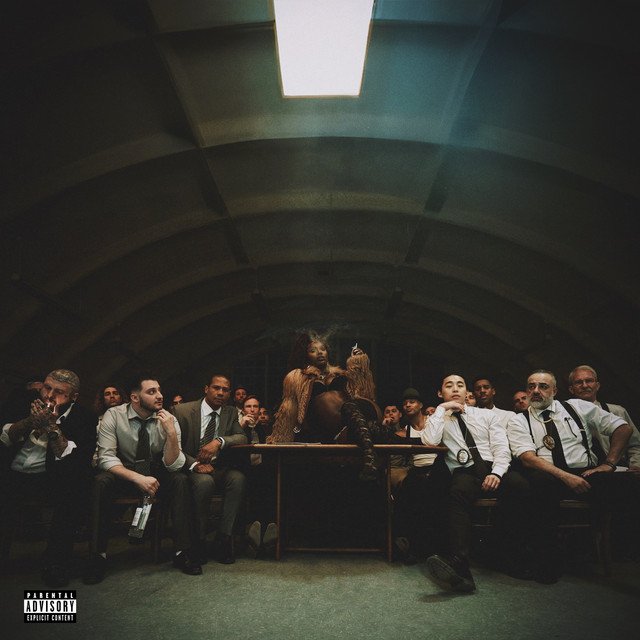
Then Kodak Black arrived on the original release and a song that was entirely hers became something else. His verse, from the perspective of the block boy she’s describing, technically fits the structure. But as SoulBounce noted at the time, his arrival causes the energy to slump. He doesn’t ride the beat. He occupies it. Kodak was already radioactive in conversations about his public comments on dark-skinned Black women, and Doechii’s fanbase, drawn to her precisely because of how openly and fiercely she moved through the world as a dark-skinned Black woman, didn’t receive the collaboration quietly. The backlash was immediate. Without making a public statement, Doechii made the solo version the dominant one. Her official YouTube channel carries only the solo cut. Both versions exist across streaming, but the solo is what TikTok ran with, what radio picked up, what became the actual cultural event.
By June 24, 2023, on the Billboard Rhythmic Airplay chart, Doechii hit No. 1. Her first chart-topper on any Billboard listing. The solo version had already been used in over 138,000 TikTok clips by the time it entered the Hot 100. Six versions were made available across streaming: standard, sped-up and slowed-down cuts both with and without Kodak. The sped-up edition, which compresses the hook further and pitches Doechii’s voice up into something close to a glass-sharp squeal, held up in its own right because the construction doesn’t fall apart under that kind of pressure.
It wasn’t a clean origin story. Written by committee, shelved for two years, passed on by the first artist it was made for, then picked up by someone who wasn’t the intended recipient. It became the biggest commercial moment of Doechii’s career to that point, and almost immediately she found herself frustrated by TDE encouraging her to make more like it. Her 2024 song “Boom Bap” was reportedly a direct response to that pressure. For Doechii, whose real catalogue is dense and shape-shifting in ways “What It Is” was never built to match, the hit sat a little wrong. It was the song that introduced her to the widest audience she’d ever had, and it wasn’t entirely hers in the way that mattered to her.
What she did with it was hers, though. Releasing the solo version quietly, letting that be the one that travels, removing Kodak from the dominant version without a press release or any statement at all. The song is about desire and who gets to name it. What happened around it pushed that same argument into the real world, and Doechii didn’t have to say a word.
She won the Grammy for Best Rap Album in February 2025 for Alligator Bites Never Heal. Billboard named her Woman of the Year the same year. “What It Is” was the door she walked through to get there, but it was never the whole house. The hook lands the same way it always did because the construction is airtight. Whether it tells you much about who Doechii actually is as an artist is a question the song was never trying to answer.
You might also like:
- The Genius and Conflict of J. Cole’s Searing 7 Minute Drill
- Future & Metro Boomin Drop Like That, Featuring Kendrick Lamar: A Nostalgic Brawl with Bangers and Bars
- Big Sean Shoots to Kill with Blistering New Single Precision
- Drake ft. J. Cole’s First-Person Shooter: An In-Depth Analysis and Exploration