There’s a voice climbing the streaming charts right now. It’s technically perfect, emotionally controlled, and designed to fit whatever mood TikTok decides to amplify this week.
The catch? It doesn’t belong to anyone. No lungs produced it. No throat shaped it. No human lived the experiences it seems to express.
Welcome to 2025, where AI singers aren’t just novelty experiments anymore. They’re building fanbases, accumulating monthly listeners in the millions, and soundtracking millions of TikTok edits. And nobody’s quite sure how to feel about it.
The shift happened quietly. A few years ago, AI-generated songs went viral as curiosities. People shared them, laughed at them, forgot about them. But something changed.
The technology improved. The voices became harder to distinguish from real ones. More importantly, the culture shifted.
Younger listeners, already comfortable forming emotional connections with anime characters and VTubers, didn’t need the person behind the voice to be physically real. They just needed the voice to work.
Now we’re watching synthetic singers transition from viral moments to actual artists. They’ve got Spotify profiles. Release schedules. Fanbases that defend them in comment sections.
The strangest part? Many listeners don’t even care that there’s no human behind the microphone.
@beatsbyaiofficial Asking Ai To Make A Hit Country Song Day 273 #aimusic #country #aisong #countrysong #countrymusic #lovesong #funnysong #discover #newmusic #comedy #lyrics #suno #southern #beatsbyai ♬ original sound – Beats By Ai
TikTok accelerated this in ways the music industry didn’t see coming. The platform thrives on perfect loops, aesthetic precision, and characters that can be whatever the viewer needs them to be. AI singers slot into this ecosystem like they were designed for it. Because, well, they were.
Creators use these synthetic voices for POV edits, transformation videos, nostalgia filters, character roleplay.
The voices adapt instantly to whatever micro-trend emerges. Need a dreamy voice for a melancholic edit about doomed romance? There’s an AI model for that. Want something upbeat for a before-and-after gym transformation? Done. The flexibility is the point.
Traditional artists need time to write, record, release. AI singers can theoretically release new material daily, responding to trends before they’ve even peaked. For a platform where relevance expires within 72 hours, that speed matters.
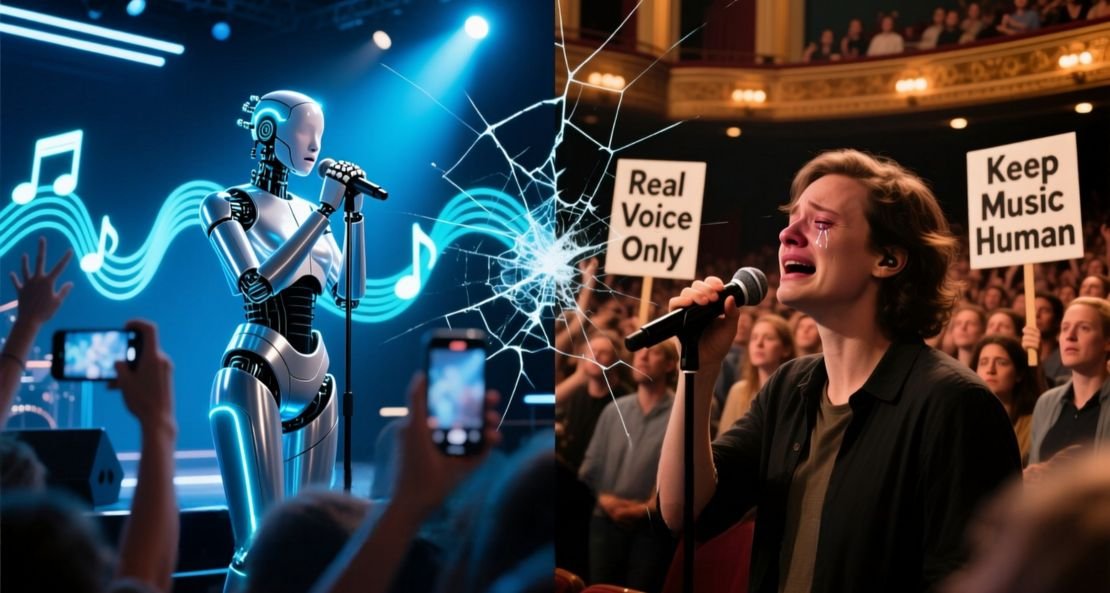
But here’s where it gets complicated. Fans aren’t unified in their enthusiasm. Scroll through any comment section under an AI singer’s track and you’ll find camps forming.
Some listeners treat synthetic artists like digital characters, no different from falling for a well-written protagonist in a game or forming attachments to virtual idols.
For them, the lack of a physical body doesn’t matter. What matters is the aesthetic, the mood, the way the voice makes them feel.
Then there are the listeners who find the whole thing deeply unsettling. Not because the technology is bad, but because it’s too good. They hear something almost human and feel manipulated.
They crave the imperfections that signal vulnerability, the vocal cracks that reveal emotion under pressure, the lived experience that gives weight to a lyric.
The split often breaks down generationally. Younger listeners, particularly Gen Alpha and younger Gen Z, have grown up in a world where digital and physical blur constantly.
They’ve formed parasocial relationships with streamers, fallen for fictional characters, built identities in games.
An AI singer with a compelling aesthetic and consistent output feels natural to them. It’s just another form of creative expression.
Older listeners struggle more. They’re used to music as a form of human storytelling, where the power comes from knowing someone actually felt the pain they’re singing about, actually experienced the joy, actually lived through the loss.
The question they keep asking is: how can something that’s never been heartbroken sing convincingly about heartbreak?
The appeal of AI singers taps into something specific about how we listen now. We’ve been primed for this.
Think about how many people consume music through sped-up versions, slowed + reverb edits, pitched vocals, heavily processed tracks. We’ve already accepted synthetic manipulation as part of the listening experience. AI voices just take that manipulation one step further.
There’s also a perfectionism angle. AI singers don’t have bad days. They don’t go off-key, don’t miss notes, don’t struggle with range.
For listeners who want flawless execution, that’s appealing. It’s music as product, optimised for consumption, stripped of human unpredictability.
But that’s exactly what makes other listeners reject them. They want the imperfection. They want the vulnerability that comes from a voice pushing its limits, the rawness of someone actually trying.
They argue that music without lived experience is just sound design. Pretty, maybe. Moving, occasionally. But fundamentally hollow.
The parallel to VTubers and virtual idols is obvious. Japanese virtual idol Hatsune Miku has had a massive fanbase for over a decade. K-pop groups already use heavy vocal processing and AI-assisted production.
The line between human and synthetic has been blurring in pop music for years. AI singers just make it explicit.
What’s fascinating is how these synthetic artists function as emotional blank canvases. Listeners project onto them whatever they need to feel.
There’s no messy personal life to contradict the fantasy. No interviews where the artist says something disappointing.
No ageing process that conflicts with the idealised image. The AI singer exists purely as the music and the aesthetic around it.
This connects to larger trends in 2025’s culture. We’re living in an era of hyper-curation, where people control their feeds, their aesthetics, their identities with precision. Anonymity is valued. Emotional distance is normalised.
Younger audiences are comfortable forming attachments to digital creators who may never exist in physical space. AI singers fit perfectly into that landscape.
For the legal side of AI music, see our deeper industry report.
The TikTok ecosystem deserves particular attention here. The platform doesn’t just amplify AI singers; it creates the conditions for them to thrive.
Short-form video values aesthetic consistency over biographical authenticity. It values repeatability over spontaneity. It values perfect audio loops over live performance energy.
Certain AI singers have accumulated genuinely impressive fanbases despite never existing outside of code. They’ve got listeners who wait for new releases, who make fan art, who defend them against critics.
The attachment is real, even if the artist isn’t. The VTuber economy surpassed $5.2 billion in 2025, showing how profitable digital personalities have become.
This raises uncomfortable questions about creativity and identity. If listeners can form genuine emotional connections to synthetic voices, what does that say about what we actually value in music? Is the human element actually necessary, or is it just a nostalgic preference?
Are we heading towards a future where the story behind the song matters less than the song itself?
For the music industry, this shift is both opportunity and threat. AI singers don’t need tour support, don’t have contract negotiations, don’t require healthcare or emotional management. They’re profitable and predictable.
The global virtual human and avatar market is projected to surpass $15 billion in the coming years.
But they also expose just how formulaic pop music has become. If a computer can reverse-engineer the patterns that make songs successful, maybe the human artistry was already compromised.
What’s clear is that AI singers aren’t going anywhere. The technology will improve. The voices will become more convincing.
The cultural acceptance will likely grow as younger, digitally-native audiences become the primary music consumers. We’re watching a fundamental shift in what constitutes a music artist.
But human storytelling still has power. The lived experience still matters to millions of listeners. The vulnerability, the imperfection, the knowledge that someone actually felt what they’re singing about, that carries weight that code can’t replicate. At least not yet.
The future probably isn’t one or the other. It’s both. AI singers will continue rising, carving out their space in streaming and social media. Human artists will continue creating, drawing from experiences that algorithms can’t simulate.
The listeners who want perfection and aesthetic control will gravitate towards synthetic voices. The listeners who want messy, human, imperfect expression will stick with artists who actually breathe.
What this means for the next decade is still unclear. Will we look back on 2025 as the year synthetic singers became legitimate artists?
Or will this prove to be a temporary fascination, a cultural experiment that eventually loses its appeal? The answer probably depends on which camp you’re in.
The fans who’ve already formed attachments to AI singers will likely deepen those connections. The sceptics will probably remain unconvinced.
Either way, the conversation itself reveals something important. We’re actively renegotiating what authenticity means in music, what creativity requires, what emotional connection depends on. Those are big questions without easy answers.
The AI singers climbing the charts right now aren’t just technological achievements. They’re cultural mirrors, reflecting back our own complicated relationships with perfection, fantasy, vulnerability, and control. How we respond to them says as much about us as it does about the technology itself.
You might also like:
- 15 Old Songs That TikTok Resurrected Into Modern-Day Hits
- The Rise of Brainrot Slang: How TikTok’s Viral Lingo Took Over Pop Culture
- 60 Gen Alpha Slang Words & Meanings (2025)
- The 2024 Music Industry Trends Guide: What’s Really Changing and Why You Should Care
- Hear Me Outs: Exploring the Viral Trend Taking Over the Internet
- The Evolution and Impact of TikTok Slang: A Comprehensive Guide