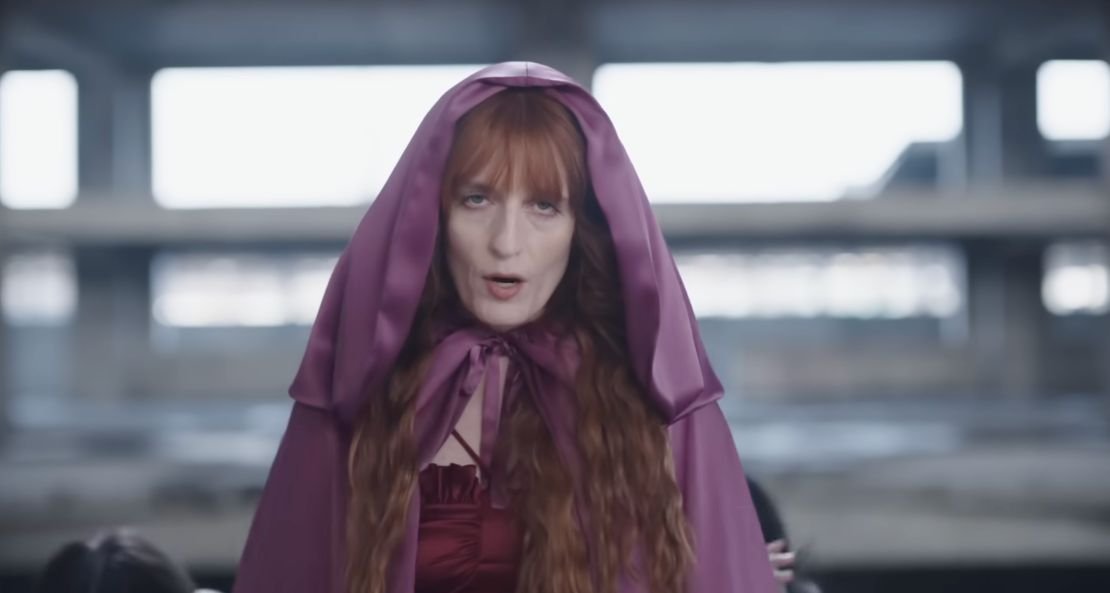
“King” by Florence + the Machine is about the conflict between artistic ambition and the desire for a family. Florence Welch does not treat it as a philosophical question. She treats it as a live argument, one that spills out of a kitchen and into a full orchestral announcement.
Released on 23 February 2022 as the lead single from the band’s fifth studio album Dance Fever, it marks the point where Welch stops treating her gender as irrelevant to her career and starts accounting for what it actually costs.
So what does “King” actually mean? At its most direct, it is a song about a woman choosing her work, but not pretending that choice is painless or uncomplicated.
Written and produced by Welch and Jack Antonoff, the track is classified as pop rock. It peaked at number 21 on the US Hot Rock & Alternative Songs chart, number 54 in the UK, and reached number 11 in New Zealand.
It received Gold certification in Brazil and was nominated for Best Alternative Music Performance at the 65th Annual Grammy Awards. In May 2023, it won the Ivor Novello Award for Best Song Musically and Lyrically, an honour that sits differently on a song this personal.
Welch has spoken directly about where the song came from. In a press statement at release, she said: “As an artist, I never actually thought about my gender that much, I just got on with it. I was as good as the men and I just went out there and matched them every time. But now, thinking about being a woman in my 30s and the future, I suddenly feel this tearing of my identity and my desires. That to be a performer, but also to want a family might not be as simple for me as it is for my male counterparts. I had modelled myself almost exclusively on male performers, and for the first time I felt a wall come down between me and my idols as I have to make decisions they did not.”
Later, in an April 2022 interview with Vogue, she described where the song sits for her: “The whole crux of the song is that you’re torn between the two. The thing I’ve always been sure of is my work, but I do start to feel this shifting of priorities, this sense of, like, maybe I want something different.”
That split is present from the opening line. “We argue in the kitchen about whether to have children / About the world ending and the scale of my ambition” does not soften the conflict in metaphor. It is a domestic scene. A real argument.
The world ending sits alongside whether to have children without irony. For Welch, both questions carry equivalent weight.
The verse continues into something harder to sit with: “The very thing you’re best at is the thing that hurts the most / But you need your rotten heart, your dazzling pain like diamond rings / You need to go to war to find material to sing.”
The language here is transactional. Pain is not incidental to the work. It is the material. Art feeds on the wound. The wound is the reason for the art.
“King” holds back longer than you expect. It opens with restrained vocals over a strong bassline and near-empty space. Welch’s delivery in the first verse is flat, measured, almost spoken.
The arrangement stays sparse past the point of comfort. At the three-minute mark, the song reaches an orchestral crescendo that critics described as a “monumental drum break followed by the thunderous impact of her band piling in.”
That build is not decorative. The length of the restraint makes the release hit harder.
The chorus, “I am no mother, I am no bride, I am king,” repeats without variation. There is no softened reprise, no key change, no bridge modulation that walks the statement back.
The refrain is the same each time. It is not emphasis. It is a door being shut. Each return shuts another door.
The second verse introduces the changeling image: “But a woman is a changeling, always shifting shape / Just when you think you have it figured out / Something new begins to take.”
In European folklore, changelings are fairy substitutes left in place of stolen human children, creatures that look human but are fundamentally other, wrong-footed in their own form.
Welch uses the word to describe the experience of discovering new desires that feel foreign, that arrive uninvited. The “strange claws scratching at my skin” is not external pressure. It is internal. “I never knew my killer would be coming from within.” The thing that could end the career she built is not the industry or the audience. It is her own body, her own shifting wants.
That line became harder to hear after 2025, when Welch disclosed she had suffered an ectopic pregnancy during the Dance Fever tour.
Her fallopian tube ruptured, causing internal haemorrhage that required emergency surgery.
She said: “The closest I came to making life was the closest I came to death.” The lyric was written before any of that. It held more than she knew when she put it there.
The outro does not conclude so much as it admits something. “And I was never as good as I always thought I was / But I knew how to dress it up / I was never satisfied, it never let me go / Just dragged me by my hair and back on with the show.”
The self-mythology of the chorus, the golden crown, the bloody sword, the king, has been quietly undermined.
The show continues not because she wins but because satisfaction never arrives. The goalpost moves. The stage pulls her back regardless.
Grazia called “King” the feminist anthem of 2022. That reading is not wrong, but it flattens what the song is doing. It is not triumphant in any clean sense. Welch claims the title and immediately shows you the empty rooms behind it.
For anyone trying to understand the Florence + the Machine “King” meaning beyond the hook, that is where it actually lives.
The track ends on a whisper after the orchestral peak. The band drops out, the voice stays, the argument continues at a lower volume.
She has been dragged back on with the show. She probably already knows it.
You might also like:
- Florence + the Machine Everybody Scream Lyrics & Meaning
- Mitski – “Dead Women” Meaning & Lyrics Explanation
- David Bowie – “Heroes” Song Story, Lyrics & Meaning
- Leonard Cohen – “Hallelujah” Deep Dive
- Sleep Token – “Gethsemane” Lyrics Meaning
- Florence + The Machine Sympathy Magic Lyrics Meaning: When Survival Becomes Ritual