
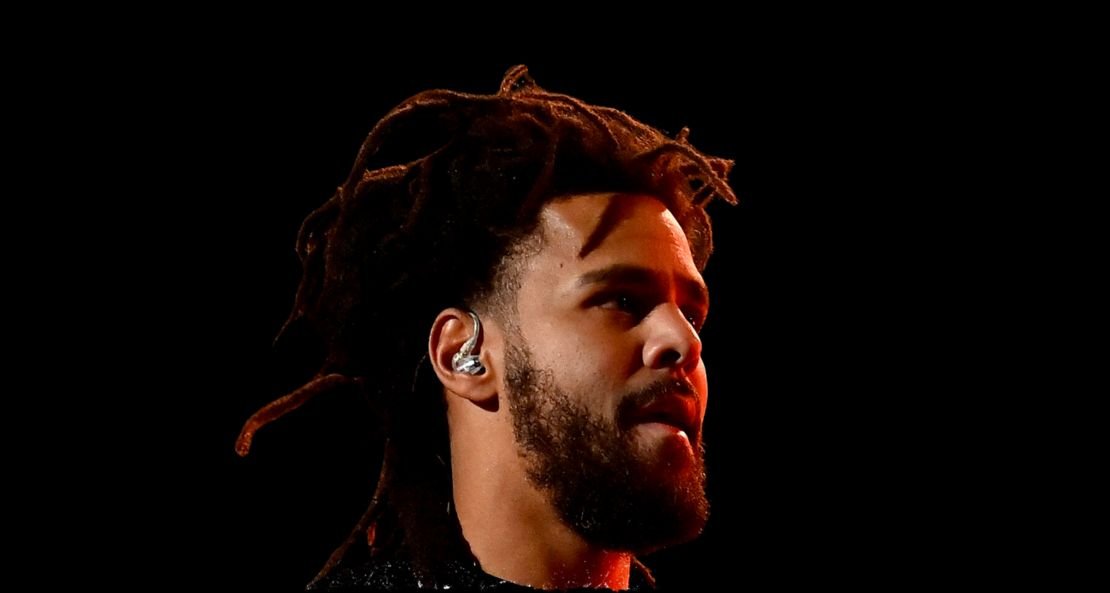
Cole is treating his apology to Kendrick Lamar like a negotiation he won on different terms.
Four freestyles, hosted by DJ Clue, released on his 41st birthday through his own website with a pay-what-you-want model starting at a dollar.
No DSPs, no rollout choreography, no permission. Birthday Blizzard ’26 positions exile as elevation, spinning the most humiliating moment of his career into proof of principle.
The conceit: if you knock someone out of the Big 3, they’ll come back swinging at something you can’t dodge. Technical skill.
The tension lives in the gap between what Cole claims and what he’s actually doing. He opens “Bronx Zoo Freestyle” by dissecting the engagement economy, podcasters turning gossip into revenue streams, rage-baiters mastering either “dick riding or hating” to survive algorithmically.
He distances himself from the spectacle: “Personally, I don’t write comments, I write commas.” But this entire mixtape is a comment.
A 20-minute essay on why he’s better than the noise suggested, delivered over classic Bad Boy and D-Block instrumentals that invoke a pre-platform era when skill supposedly mattered more than clicks.
Cole raps with the precision of someone who’s been studying film. The multi-syllable schemes on “99 Build Freestyle” carry for 16 bars without breaking sweat, locked into that ‘erse/irst/urt’ pattern whilst navigating alternate dimensions and portals.
He name-drops Marshall Faulk, Zeno from Dragon Ball Super, Jeffrey Dahmer, all within the same verse. The wordplay lands with surgical accuracy.
“So much ice you think I’m getting dudes deported to a border and turf” hits twice because it works as jewellery flex and ICE reference simultaneously. But the virtuosity feels like armour. The more technically flawless he becomes, the more trapped he sounds inside the proof.
The persona cracks on “Golden Goose Freestyle” when he addresses streaming fraud head-on: “If the streams say you’re winnin’, why your tours is losin’? / When the math ain’t mathin’, of course you’re juicin’ / That mean the bots is boostin’.”
He’s talking about someone specific but refuses to name them, turning accusation into riddle. The cowardice of the subtweet dressed up as principle.
Then he immediately pivots to ownership as masculine reclamation: “Universal distribution, but I own the music.” The flex isn’t about wealth accumulation. It’s about control. About refusing to be a product someone else can manipulate.
“Winter Storm Freestyle” over Biggie’s “Who Shot Ya?” carries the mixtape’s most revealing contradiction. Cole opens by admitting he scrapped his original plans when “the world decided to play,” a tacit acknowledgement that the Kendrick situation forced his hand.
But then he immediately reframes it as sexual conquest: “I feel like Lori Harvey how I ran through them niggas.”
The bravado collapses into wisdom literature by the second verse. “I used to get self-conscious around real gangsters and I still do,” he admits, then pivots to self-help: “Be yourself. Living your truth, niggas will feel you.” It’s the sound of someone talking himself into confidence he doesn’t quite possess.
The authenticity lecture would land better if it weren’t wrapped in manufactured mythology about climbing back from the bottom.
He’s not at the bottom. He’s a platinum-selling artist with full ownership of his masters using his own domain to distribute music. The martyr costume doesn’t fit. But the admission about gangsters does.
That’s the crack in the armour, the moment where Cole stops performing invincibility and reveals the self-consciousness that’s always animated his work. He’d rather be technically flawless than street-certified, and he’s still apologising for it.
The best wordplay on the tape arrives when he twists the biblical fish metaphor: “Teach a man to fish and the lesson is this: without a pole, you’re useless.” Pole as fishing rod, pole as gun.
He’s seen the violence, understands the necessity, but refuses participation. “No strap on my body, I’m an unarmed menace,” he declares, making the pen the weapon.
It’s Cole’s entire philosophy compressed into a couplet. The problem is that philosophy doesn’t generate heat in 2026. Being an unarmed menace in a culture that rewards armed rhetoric is just being unarmed.
That refusal to play the role extends to the apology itself. On “Bronx Zoo,” he reframes the Kendrick situation as deliberate strategy rather than retreat: “The top ain’t really what I thought it would be / And so I jumped off and landed back at the bottom / And restarted at a level where I wasn’t regarded as much / Just to climb past them again and tell ’em all to keep up.”
It’s an athlete’s logic. Jordan coming back from baseball. The narrative requires you to believe he chose to step down, that public humiliation was the plan all along.
Whether you buy it depends on how much you trust Cole’s capacity for long-term thinking versus his history of overestimating how much audiences care about intentions.
The most honest line arrives later: “N*ggas can never know the pain of Jermaine.” Not the pain of success, the pain of being Jermaine.
Of existing between technical excellence and cultural irrelevance, between respect from peers and indifference from the algorithm.
He sounds exhausted underneath the multi-syllable acrobatics, not from work but from maintenance. From proving the same point to diminishing returns.
DJ Clue’s ad-libs punctuate the tape like timestamps from a different era. “Desert Storm,” “Clueminati,” the kind of tags that made sense when mixtapes moved through car stereos and burned CDs rather than algorithmic playlists.
The nostalgia isn’t accidental. Cole is anchoring himself to a period when bars determined hierarchy, when freestyles over classic instrumentals signalled arrival rather than desperation.
But the infrastructure that validated that approach no longer exists. The culture moved. He’s rapping to ghosts.
The Chilli reference on “Golden Goose” betrays his age more than anything else. “Don’t be silly, want the chilly (Chilli), similar to Usher Raym’ / When he sang in the rain.” Rozonda Thomas from TLC, Usher’s ex-girlfriend, the “U Got It Bad” video.
It’s a flex that requires generational knowledge, the kind of bar that lands with 35-year-olds who remember when Usher was the blueprint for R&B heartthrob masculinity.
But it also dates him. Proves he’s speaking to a specific audience who remembers when cultural references didn’t need to be explained in Instagram captions.
The entire project functions as Cole’s version of peacocking. Look at how intricate these rhyme schemes are.
Notice how I’m addressing the discourse without participating in it. Appreciate the ownership structure whilst I critique yours.
But peacocking only works if someone’s watching. Dropping a mixtape on your own domain with no promotion beyond a Jadakiss podcast tease is the sonic equivalent of writing an angry letter and filing it away. Cathartic, maybe. Effective? Depends on whether you think hip-hop still rewards the thing he’s selling.
Cole sounds most vulnerable when he admits ambivalence about the fame he’s defending. “I despise my celebrity, I ain’t into fame” on “Golden Goose,” then later, “Niggas can never know the pain of Jermaine.”
The contradiction isn’t weakness, it’s the thesis. He wants respect without visibility, mastery without spectacle, to be acknowledged as the best whilst remaining invisible to the mechanisms that determine who gets called the best. That’s not a rap career, that’s a thought experiment.
Birthday Blizzard ’26 works as technical exhibition and fails as cultural intervention. Cole proves he can still rap circles around most of his peers whilst simultaneously demonstrating that rapping circles around people no longer moves the needle.
Skill isn’t obsolete, but skill alone doesn’t generate heat in an economy built on conflict and virality. He’s right about the bot farms and the engagement bait and the manufactured beef cycles.
He’s also standing outside the room complaining about the furniture arrangement whilst everyone else is inside deciding where to sit.
The mixtape ends with DJ Clue laughing, a sound that could represent anything. Triumph, absurdity, relief.
Cole positions The Fall-Off as his final album, the culmination of a career built on doing it his way. If this is the warning shot, the album better recontextualise the game. Because right now, it sounds like someone winning an argument nobody else is having.
You might also like:
- J. Cole “DISC 2 TRACK 2” Review: Life in Reverse | The Fall-Off
- J. Cole’s ‘Port Antonio’: More Than Just a Rap Feud
- J. Cole’s cLOUDs Lyrics Meaning and Review: A Reflection on AI, Greed, and the Future of Hip-Hop
- J. Cole’s She Knows Lyrics Meaning: A Sharp, Unflinching Confession Wrapped in Melody
- Drake ft. J. Cole’s First-Person Shooter: An In-Depth Analysis and Exploration
- The Meaning and Impact of All My Life Lyrics by Lil Durk and J. Cole: A Song of Triumph and Inspiration