
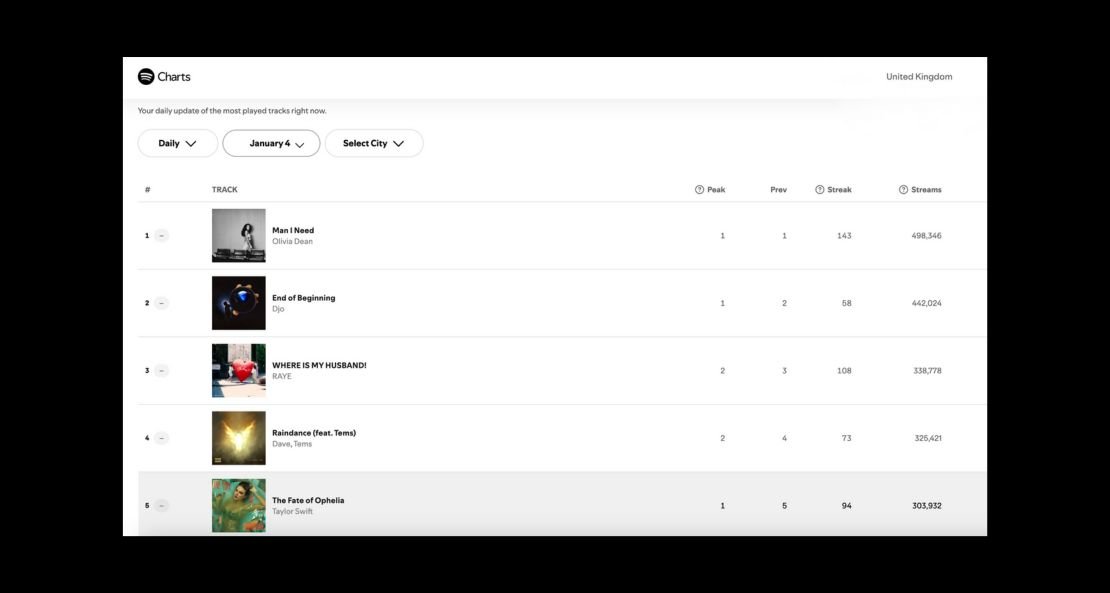
The UK Spotify chart for 4 January 2026 tells a story the industry stopped expecting: albums work again. Not as statements. Not as playlists with better artwork. As discovery units.
Olivia Dean occupies twelve positions across the top 100. Not through viral singles climbing upward. Through an album pulling listeners downward into its tracklist.

“The Art of Loving” returned to number one for a third non-consecutive week, and its chart presence reads like something from 2008 – multiple album tracks charting simultaneously because people streamed the whole project.
This pattern appears nowhere else in the top ten. Taylor Swift’s “The Fate of Ophelia” sits alone at number five. RAYE’s “WHERE IS MY HUSBAND!” holds number three without dragging up sister tracks.
Dean’s chart footprint looks architectural, built from sequential listening rather than algorithmic surfacing.
The shift runs counter to playlist culture’s primary mechanism: songs positioned as standalone objects, detached from context.
Dean’s chart presence suggests listeners treating albums as coherent environments again – not because artists demanded it, but because the music warranted prolonged attention.
This changes how attention converts to commercial success. Single-song virality produces spikes.
Album-depth streaming builds foundations. The former creates headlines. The latter creates careers.
The Fictional Groups Charting Like Real Acts

Seven positions in the top 100 belong to songs from “K-pop Demon Hunters,” Netflix’s animated film about fictional K-pop groups defending earth from supernatural threats.
HUNTR/X and Saja Boys chart alongside KATSEYE (an actual K-pop group) and both outperform established acts.
Position 7: “Golden” by HUNTR/X et al
Position 68: “Soda Pop” by Saja Boys et al
Position 99: “What It Sounds Like” by HUNTR/X et al
Position 121: “How It’s Done” by HUNTR/X et al
Position 122: “Your Idol” by Saja Boys et al
Position 178: “Takedown” by HUNTR/X et al
These aren’t novelty placements. “Golden” ruled UK charts for ten consecutive weeks in 2025, outperformed Psy’s “Gangnam Style” by duration, and earned Grammy nominations alongside Rosé and Bruno Mars’ “APT.”
The film passed 300 million Netflix views. Its soundtrack topped Billboard 200. Fictional groups now compete with real artists for commercial dominance, erasing boundaries between animated content and music industry economics.
Soundtrack success typically follows film success. But “K-pop Demon Hunters” reversed the equation – the music became the film’s primary marketing mechanism, driving viewership through chart presence rather than benefiting from it.
Visual storytelling now functions as a legitimate chart strategy, not a marketing supplement.
The medium through which audiences encounter music increasingly determines whether they return to it.
Catalogue Tracks That Never Left
Rihanna and Mikky Ekko’s “Stay” sits at position 132, up 67 spots. Released February 2013. Thirteen years old. Yet it re-entered UK charts in 2023, again in 2024, and now returns in 2026.
Fleetwood Mac occupies positions 22 (“Dreams”), 23 (“Landslide”), 43 (“Everywhere”), 44 (“The Chain”), and 70 (“Silver Springs”). Kate Bush’s “Running Up That Hill” holds position 20. Prince’s “Purple Rain” sits at 18.
These aren’t nostalgia plays. “Stay” gained traction through emotional vulnerability – stripped piano, bathroom acoustics, a single tear in the video’s final frame.
Its resurgences correlate with moments when listeners seek raw emotional honesty, not when they want to remember 2013.
Similarly, the Fleetwood Mac cluster doesn’t reflect Boomer listening habits. “Dreams” went viral through emotional recontextualisation on TikTok (Dogface208’s skateboarding video).
“Running Up That Hill” resurged via “Stranger Things” but sustained through TikTok’s 2.7 million video uses. Catalogue tracks return when they serve present emotional needs, not past memories.
The industry categorises pre-2020 music as “catalogue” and treats its performance as passive income from legacy fanbases.
But streaming data reveals catalogue tracks competing with new releases by solving current emotional problems. This revalues music catalogues entirely.
Songs don’t depreciate over time if they remain emotionally relevant. They appreciate as cultural context shifts and new audiences discover them through use cases the original creators never anticipated.
Artists creating work now should consider: what emotional function does this song serve? Not: what does it sound like? Function outlasts fashion.
The Pattern These Signals Form
Four separate behaviours converge in a single chart snapshot:
- Album-depth streaming replacing single-song discovery
- Visual media driving music consumption at commercial scale
- Emotional utility determining catalogue performance
- Fictional artists competing with real ones for chart space
Each represents music adapting to how people actually use it, not how the industry wishes they would. Albums return because listeners want coherent experiences.
Soundtracks dominate because people encounter music through stories. Catalogue resurges because emotional needs don’t follow release schedules.
Fictional groups chart because authenticity matters less than connection.
The UK chart for 4 January 2026 doesn’t predict the future. It documents the present that most analysis hasn’t caught up to yet. The forces shaping these 200 positions will shape the next 2,000.
What listeners do with music changes faster than what artists make. Pay attention to the former. It determines the value of the latter.
You might also like:
- Olivia Dean’s “Man I Need” Review: Lyrics, Meaning & Video
- Olivia Dean’s “So Easy (To Fall In Love)” Signals a Star Finding Her Voice
- Sam Fender Drops Deluxe “People Watching” Edition
- Album Formats And How They Have Changed Over The Years
- Taylor Swift Albums: A Complete Discography
- The Resurgence of Charli XCX: A Deep Dive into the Von Dutch Lyrics