
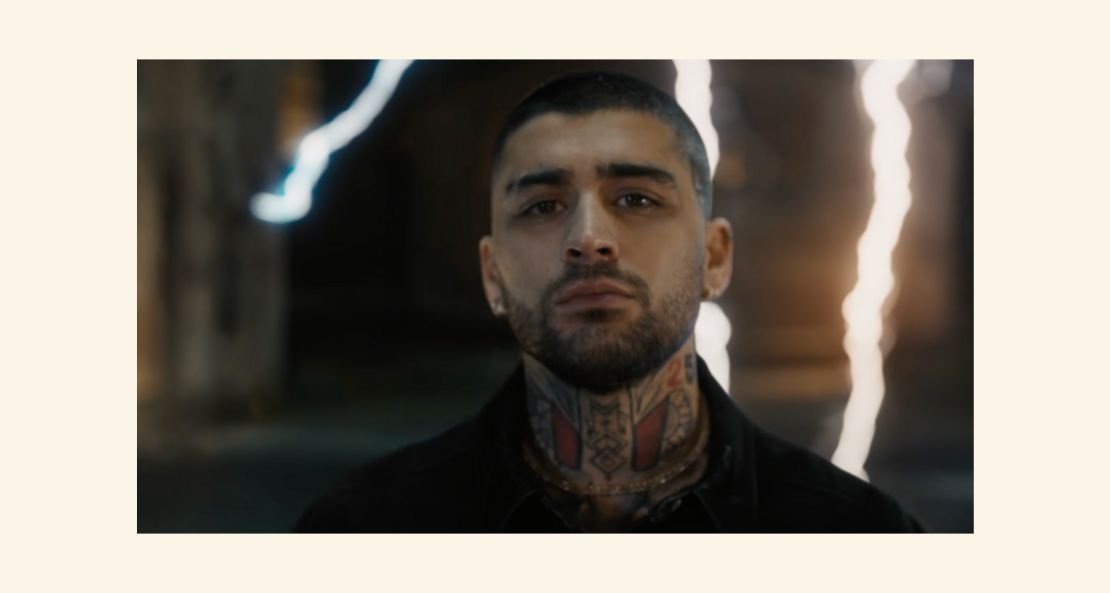
The promises ZAYN makes about KONNAKOL and the promises “Die for Me” actually keeps exist in two different worlds entirely.
Released February 6 as the lead single from his fifth album, the track arrives framed as a heritage-driven reset.
What actually lands is a perfectly calibrated mid-2010s dark R&B torch song that was written in 2022 by James Essien, NEA and Victor Thell for someone else entirely. Claudia Valentina recorded it first. ZAYN got it second-hand.
KONNAKOL, due April 17 via Mercury Records, is named after a South Indian vocal-percussion language that imitates drum rhythms through the voice.
ZAYN describes it as representing “the reverberation of a time before words existed,” positioning the album as a bridge between his British-Pakistani heritage and pop-forward territory.
He speaks of Carnatic percussion languages, of sounds that predate words, of threading cultural lineage through contemporary production.
The album cover shows his face merging with a leopard, suggesting primal fusion and ancestral connection.
There’s nothing ancient or wordless about “Die for Me.” It’s drowning in words, in cinematic strings, in the same sonorous drums and falsetto peaks that soundtracked every Fifty Shades trailer between 2015 and 2018.
The production from The Monsters & Strangerz and Isaiah Tejada knows exactly what it’s recreating: that chamber pop-meets-bedroom R&B intersection where The Weeknd’s “Earned It” lives permanently.
ZAYN’s voice does the work it was always capable of doing, flitting between smoky restraint and melismatic climax, making “you said you would die for me” sound both accusatory and resigned.
The song plays out romantic betrayal as high melodrama without apology or subtlety.
What matters here isn’t whether “Die for Me” works as dark pop—it does, efficiently and without innovation.
What matters is how little it resembles the album concept ZAYN described. KONNAKOL was supposed to mark a return to heritage, to percussive voice, to something elemental.
Instead, the lead single feels like premium pop real estate purchased from the same market that services every major-label R&B rollout. The gap between intention and execution isn’t bridged by strings or vocal acrobatics.
The single lands weeks after his Las Vegas residency announcement and ahead of a wider arena tour rollout, signalling a full-scale commercial return even as the album narrative leans into cultural depth.
That tension sits at the centre of the listening experience. The marketing language gestures toward lineage and identity; the music reaches for familiarity and streaming security. Nothing about the arrangement sounds confused. The messaging does.
This feels less like a return to self and more like a return to what worked commercially in 2016, repackaged under the language of cultural rediscovery.
The song shows an artist suspended between the narrative he wants to sell and a sound that already knows how to behave on playlists.
You might also like:
- Alienated Lyrics: Zayn Lays Bare His Soul on Raw, Introspective New Single
- The Weeknd’s Die For You Lyrics: A Deep Dive into the Meaning and Background
- Night Changes Meaning Explained: How One Direction’s Song Took On New Life After Liam Payne
- Is R&B Dying Or Evolving? Exploring the Evolution of the Genre from the 90s to Today
- Best R&B Songs 2025: 10 Tracks Reviving Real R&B
- Unravelling Steve Lacy’s Dark Red Lyrics: A Deep Dive