
“Wrecking Ball” is a song about the cost of loving someone who was never going to let you in — a power ballad about giving everything you have to a person who only takes, and coming out the other side not heartbroken so much as structurally collapsed.
Most people in 2013 spent their time arguing about something else.
When Miley Cyrus released it in August that year, she was twenty years old and in the middle of one of the most aggressively managed public image pivots the music industry had seen in a decade. The MTV VMAs performance with Robin Thicke had happened two weeks earlier. The cultural machinery was already running at full speed to process her as a symbol of something: former Disney kid gone wrong, pop star burning her credibility for attention, a cautionary tale about the industry eating its own. Into that noise came a song that had nothing to do with any of it. A song that was quietly devastating.
The track was written on September 24, 2012 in a single session by MoZella, the Detroit singer-songwriter Maureen Anne McDonald, alongside Sacha Skarbek and Canadian composer Stephan Moccio. MoZella had nearly not made the session at all. She had just broken off her own engagement that week. Moccio described her as barely holding herself together, too raw to have been there at all. The title came from him, shyly putting up his hand and suggesting “Wrecking Ball” while the three of them threw around metaphors. MoZella ran with it. The song, in every real sense, was hers: built out of her own wreckage, not anyone else’s story. It was written for Beyoncé. When it was finished, MoZella decided Cyrus was the better fit, and Cyrus, when she heard the demo, agreed immediately.
Produced by Dr. Luke and Cirkut, the track was built with OneRepublic in mind, specifically the kind of enormous, arena-filling ballad Timbaland used to anchor. The production is almost engineered to feel inevitable: a sparse piano intro, then the slow accumulation of drums and synths that doesn’t fully arrive until the chorus hits, and when it does, it hits with the mass of something being swung rather than played. Dr. Luke reportedly told Cyrus he didn’t think the song would go to number one. He was wrong enough that it cost him a $10,000 Numi toilet, a bet he lost when the song peaked at the top of the Billboard Hot 100 in September 2013, becoming Cyrus’s first ever chart-topper and the first number one in her family. Billy Ray had peaked at four with “Achy Breaky Heart.”
The lyrics take a demolition image and push it somewhere uncomfortable. Cyrus is describing herself as a force that came in hard, trying to break through somebody’s walls, and simultaneously as the thing that got wrecked in the process. Most breakup songs position the singer as the one who suffered cleanly, the innocent party. This one is honest about the aggression inside of wanting someone, the damage you can do to yourself when you love recklessly. The first verse, “We clawed, we chained our hearts in vain / We jumped never asking why,” isn’t romantic. The word choices are animal. The chorus doesn’t soften that: “All I wanted was to break your walls / All you ever did was wreck me.” She wanted to penetrate someone’s emotional defences and instead got destroyed trying. Most pop writing would round that corner off. This doesn’t.
The second verse lifts the stakes into something almost mythological. She put him “high up in the sky” and he “slowly turned” and let her burn. The ashes metaphor lands because it doesn’t feel like poetry. It feels like the vocabulary of someone who has sat with a particular kind of devastation long enough that it stops sounding dramatic and just sounds accurate. MoZella was barely keeping it together in a New York studio when she wrote those words. That’s where they came from.
The bridge gets overlooked. “I never meant to start a war / I just wanted you to let me in / And instead of using force / I guess I should’ve let you win.” It doesn’t apologise and it doesn’t accuse and it sits in the messy place between those two things where the end of a bad relationship actually tends to live. You can see your own role clearly enough that you can’t fully blame the other person, but not clearly enough to feel better.
Cyrus had no writing credit. The emotion she poured into the vocal performance was her own, though. She told Rolling Stone that the single tear she sheds in the video was real. Her dog had just died. That detail matters because it points at something the standard reading of the video keeps missing.
The video, directed by Terry Richardson, accumulated 19.3 million Vevo views in its first 24 hours, breaking the platform’s record at the time. It won Best Video at the 2013 MTV Europe Music Awards. At the 2014 MTV VMAs, where it won Video of the Year, the award was accepted by Jesse Helt, a formerly homeless Los Angeles teenager, while Cyrus directed attention to a fundraising appeal for homeless youth. None of that is how the video gets cited.
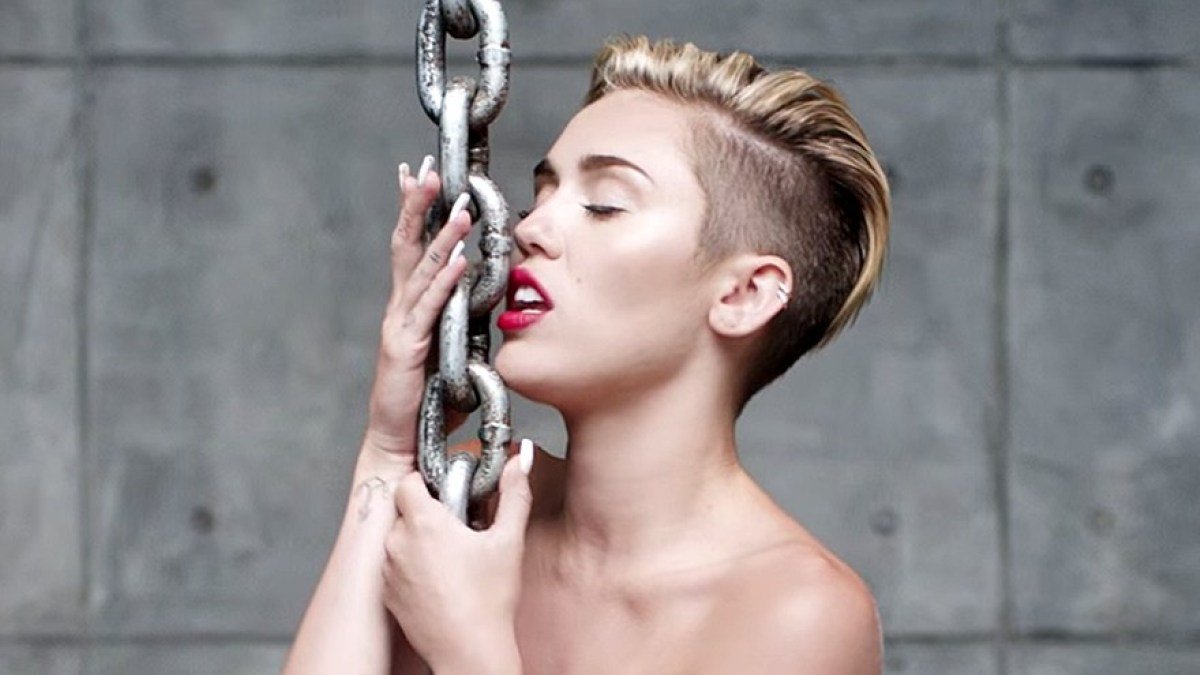
What the video gets cited for is the wrecking ball sequence and the sledgehammer. The backlash was enormous, and it attracted an open letter from Sinead O’Connor, who had been name-checked by Cyrus for the visual similarities between the close-up crying shot and O’Connor’s “Nothing Compares 2 U” video. O’Connor urged Cyrus not to let the music industry exploit her, arguing nudity and provocative imagery were obscuring her actual talent. Cyrus responded by posting old tweets from O’Connor about mental health struggles, which turned the whole exchange into tabloid territory and buried whatever the original point had been.
The song had enough power to cut through all of it anyway. Tom Breihan at Stereogum described being blindsided by it in the car, radio on, suddenly plunging into “this strange and vulnerable black hole.” That’s not a reaction to a music video. That’s a song doing something on its own.
Watch the video with the coverage stripped away and what you notice is not the wrecking ball. What you notice is the close-up singing sequence: Cyrus performing directly to camera, no cuts, the kind of shot that makes actors flinch because there’s nowhere to go. She doesn’t flinch. There’s an acting background there and it shows. She’s performing someone trying to hold it together and failing slowly, with enough precision that you can watch it multiple times and keep finding things in it. The reaction to the video in 2013 was shaped largely by the coverage that preceded it. The “loose cannon” framing, the “swing” headlines, the whole apparatus of the post-VMA news cycle meant people had already decided what they were going to find before they pressed play. What was actually in the video and what people said was in the video are not quite the same thing.
The song crossed a billion streams on Spotify in 2024. On an episode of Spotify’s Billions Club, Cyrus summed up the inspiration in four words: “My man wasn’t acting right.” The song is widely believed to concern Liam Hemsworth. They’d been dating since 2010, got engaged in 2012, and broke it off the same month the song charted at number one. They got back together, married in 2018, and divorced in 2020. “Flowers,” Cyrus’s 2023 record-breaker, is generally understood to close out the same story. The wrecking ball came through more than once.
Dolly Parton, Cyrus’s godmother, covered the song on her 2023 rock album Rockstar, pairing it in a medley with “I Will Always Love You.” Parton said the first time she heard the chorus it hit her in the car and she almost wept. That’s not a throwaway quote from someone being polite about a family member’s work. Parton has spent sixty years in the business knowing exactly what a chorus is supposed to do.
The song returned to number one in December 2013 after a nine-week gap, partly driven by a viral parody from YouTuber Stephen Kardynal. The nine-week wait for a second reign was the longest in Hot 100 history within a single chart run. That detail usually gets treated as a footnote. It sits more awkwardly than that: a song about being genuinely wrecked by someone you loved, sent back to the top of the charts by people laughing at it. Both things happened at once.
Cyrus has said since that she cringes at the video, specifically the image of herself on the wrecking ball, which she knows will follow her indefinitely. She’s probably right about that. The imagery that surfaces every time her name comes up is not the same thing as what the song was doing. One got fixed to her public image in a way she’ll never shake. The other kept accumulating listeners who had no particular opinion about Miley Cyrus at all, who just heard it on the radio or in a supermarket and felt something they hadn’t been expecting to feel.
The person the song was aimed at. Whether they ever actually heard it is a different question entirely.
If you enjoyed this article, you may also like to read our other articles on music analysis: