
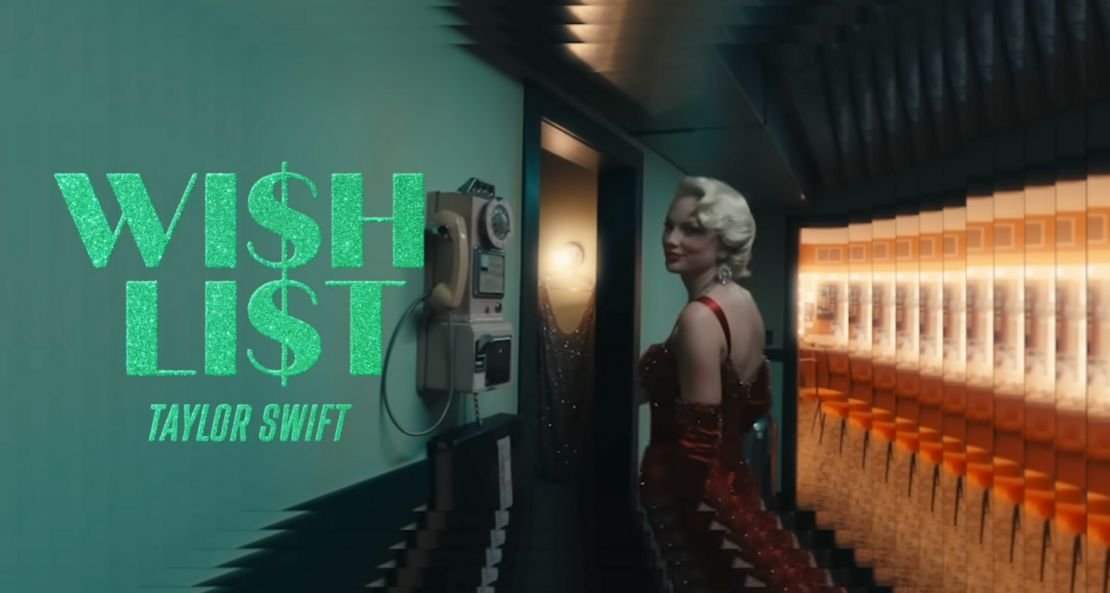
“Wi$h Li$t,” track eight from Taylor Swift’s The Life of a Showgirl, opens with Swift’s falsetto floating over electropop production from Max Martin and Shellback.
It’s Swift co-writing with her most reliable hitmakers, crafting what she’s described as a meditation on competing dreams and priorities in an age of curated online personas.
The song positions itself as a contrast study: everyone else wants yachts and Oscars and Real Madrid contracts, but Swift just wants a driveway with a basketball hoop and some kids who look like Travis Kelce.
It’s a hard sell, but not impossible.
“Wi$h Li$t” splits down the middle. The verses catalog ambitions Swift sees online: yacht life under helicopter blades, Balenciaga shades, critical acclaim at Cannes, Oscars on bathroom floors. Real Madrid contracts. Off-grid freedom with three dogs instead of kids.
Then the chorus: “I just want you.” Kids who look like Travis Kelce. A driveway with a basketball hoop. Privacy from everyone else. That line encapsulates Taylor Swift “Wi$h Li$t” lyrics meaning in its most direct form.
The dollar signs in the title announce the comparison. Material opulence versus domestic simplicity. Except Swift already has the material opulence, which changes how the message lands.
Swift explained the song explores “all the different dreams people have” in online spaces where priorities are on display.
She wants listeners to know they have their own wishes, and she hopes everybody gets theirs, but the wishes in the song are hers. She compared the chorus to her “happy place” or utopia—wanting a life with her partner that feels like home.
The bridge adds history. Swift sings about making wishes “once, twice, but I did not,” presumably referencing past relationships, before someone “caught me off my guard.” It’s the most revealing moments on the track.
After you’ve hit every industry benchmark, maybe building a family does feel like uncharted territory. Creating a home culture, raising children, choosing partnership over perpetual hustle. That’s a different kind of project.
The question is whether it translates when you’re already living a life most people can’t access. Your “simple life” still involves wealth and security that nullifies the comparison to actual simplicity.
“We tell the world to leave us the fuck alone, and they do, wow.”
That sarcastic “wow” acknowledges the impossibility. Swift knows the privacy she wants doesn’t exist at her level.
But she also built the machine that makes privacy impossible. Her entire success runs on fan intimacy, curated access, and parasocial connection.
This isn’t unique to Swift. Most massive celebrities navigate this situation. The difference is that most don’t write songs positioning themselves as longing for normalcy while continuing to operate at maximum visibility.
You can’t maintain the apparatus and complain about its effects at the same time. Or you can, but don’t expect sympathy, which is not necessarily what she’s asking for.
The line “got the whole block looking like you” generated online debate. Some critics read it as expressing desire for genetic uniformity or even racial homogeneity, though the straightforward interpretation (wanting multiple kids who resemble your partner) is almost certainly what Swift meant.
When you operate this far from ordinary circumstances, even casual family planning statements get scrutinised differently.
Online conversations also latched onto “boss up, settle down” as potentially reinforcing what’s been labeled “trad wife” ideology.
The lyric frames domesticity as a reward you earn after professional conquest, rather than something people pursue on their own terms.
Swift isn’t arguing women should skip careers for marriage. She’s saying she did the career part first, so now she gets to want the other thing.
That sequencing implies hierarchy. And the hierarchy maps onto broader cultural tensions about women’s choices and timelines, which again Swift did not intend.
An area the track exceedingly succeeds is during the “contract with Real Madrid” line, it modulates unexpectedly through a bVImajor7 chord that briefly shifts to minor.
It sounds bright externally but contains shadows underneath. That’s the song’s most honest moment—a musical choice that acknowledges complexity.
Swift drops profanity twice: the privacy plea and describing “spring break that was fuckin’ lit.” Neither adds anything noteworthy to the song. After seventeen albums, Swift knows how to write a sharp line.
The swearing reads like signaling rather than authentic expression. It’s more like someone trying to sound casual instead of actually being casual. It’s a shortcut where specificity would land harder.
What actually works is the basketball hoop detail concrete enough to register. The bridge about past relationships carries genuine weight. When Swift says she wanted “a best friend who I think is hot,” the plainness cuts through and lands.
The core idea holds merit: achievement doesn’t automatically equal fulfillment. Building a life with someone represents legitimate ambition regardless of other accomplishments.
“Wi$h Li$t” acknowledges the weirdness with dollar signs and sarcastic “wows” but doesn’t work through it.
She positions herself as both observer and participant, both critic and beneficiary, both vulnerable and protected.
She wants incompatible things: total privacy and total visibility, simplicity and luxury, the benefits of fame without its costs.
Maybe that’s the most honest thing about “Wi$h Li$t.” It doesn’t resolve its contradictions because Swift hasn’t resolved them either.
The song is a snapshot of someone trying to articulate an impossible position without admitting it’s impossible.
The basketball hoop is still a nice image. Whether it means anything beyond the image depends on how much you’re willing to extend her the benefit of the doubt.